As the latest plan to privatize Pinnacol Assurance again is engendering skepticism, it also is producing suggestions by legislators that could ground negotiations to halt — that state officials essentially raffle off the workers’ compensation company to the highest bidder.
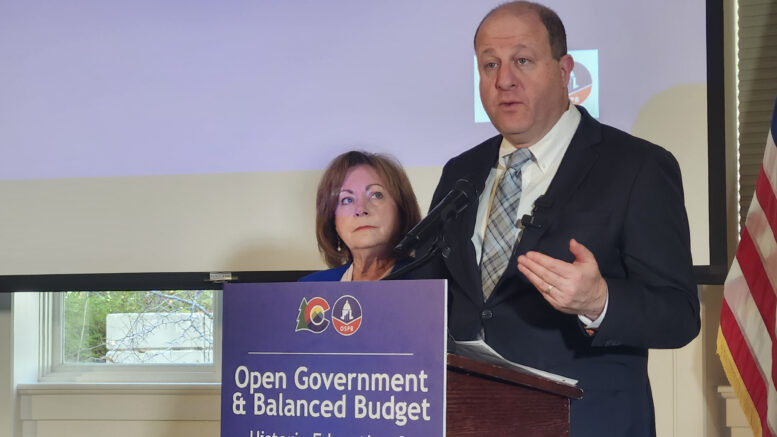
For the second legislative session in a row, Gov. Jared Polis has pinned his budget-balancing proposal partially on the idea of disaffiliating the state-chartered mutual insurance company and allowing it to operate without government controls. The deal, Polis says, could generate $400 million for a Legislature looking to try to close an $800 million budget gap next year, and it would free Pinnacol to sell policies in other states, which is viewed as key to the company recovering its lost market share.
While state and Pinnacol leaders still would have to agree on the final details of any transaction — assuming legislators approve a change in law allowing the privatization — a seemingly acceptable price appears to have emerged. A Joint Budget Committee memo from earlier this year noted that Pinnacol officials said they are willing to consider any price that did not cost them more than $600 million, including costs beyond the disaffiliation fee that are needed to repay the state’s pension system.
Should state demand more than “halfsies”?
But on Wednesday, as the Joint Budget Committee discussed the potential for such a move, several legislators asked whether the state, rather than letting Pinnacol purchase its freedom, could sell the company and bring in more money instead. Sen. Jeff Bridges, D-Greenwood Village, particularly pushed that line of questioning, saying he has heard from “folks in the market” that some are willing to pay more than the $400 million price that the Democratic governor has floated for the company to pay the state.
“Why are we going halfsies when we could get a lot more money by just selling that outright?” Bridges asked during a hearing on the Pinnacol proposal.
Mark Ferrandino, director of the governor’s Office of State Budgeting and Planning, replied that while Polis is not opposed to such a plan, Pinnacol does not support that idea, so the administration is focusing on a simple financial transaction for disaffiliation. He added that allowing Pinnacol to continue operating as it is but without state oversight also would create more consistency in the market, which the businesses that make up Pinnacol’s customer base would prefer.
But when asked by The Sum & Substance about the possibility of being sold by the state, Pinnacol responded in no uncertain terms that the idea is not only unacceptable but is flat-out illegal, in the company’s view.
“The state does not own Pinnacol. The state cannot accept bids or sell Pinnacol outright because Pinnacol’s assets belong to employers,” said Wes Parham, vice president of public affairs for the insurer.
Pinnacol history
Legislators created a workers’ compensation division to sell insurance in 1915 but gave it autonomy in the 1980s to act like a private firm, even as the governor appointed its board and oversaw the charter determining what policies it could sell and how it could sell them. Wanting to eliminate the state’s financial risk and liability in the company, legislators agreed to transfer $80.8 million to Pinnacol in 2002 and allowed it to operate as an independent mutual company under the ownership of its members, as it does today.
Still, the state continues to hold power over its board appointments and its operating rules, including provisions that Pinnacol cannot sell policies to workers in other states and that it can’t sell other lines of insurance. And those restrictions, combined with the state’s budget crunch, have married Pinnacol’s long-standing interest in privatization with the state’s newfound interest and have brought discussions to the point where they are today.
Both Polis and Pinnacol officials believe the company’s future is a lot murkier if it can’t start selling policies outside of Colorado. Once the holder of a 60% market share, Pinnacol has fallen under 50% — including a drop last year from 52% to 49% — in part because it can’t serve companies with workers beyond Centennial State borders unless it contracts with other insurers to handle those out-of-state policies, typically at much higher prices. As a result, it now serves only 5% of Colorado companies with multistate workforces at a time when roughly half of all companies have workers in other states.
Pushback against idea of privatizing Pinnacol
While 49% share isn’t chump change — Pinnacol still serves some 50,000 companies, and the next closest competitor has a 3% share, Colorado Insurance Commissioner Michael Conway said — the more business Pinnacol loses, the more its finances are imperiled. That’s because it serves as the insurer of last resort, meaning it writes policies for the highest-risk companies that private insurers won’t take. And the higher percentage of its business that those companies make up, the lower its operating margins will get, forcing it to cut service or raise premiums, Ferrandino said.
While Polis and Pinnacol officials support disaffiliation at the right price, JBC members, who have the responsibility for writing the state’s annual budgets, are more skeptical.
Several of them, along with unions like the Colorado AFL-CIO, have expressed concern that privatizing Pinnacol would shift its focus away from customer service and toward expansion insted. They also worry such a move would send construction-firm or outdoor-recreation-company premiums soaring without there being a state-chartered insurer of last resort, though Ferrandino detailed several ways the state could handle last-resort policies.
Rep. Kyle Brown, D-Louisville, and Sen. Judy Amabile, D-Boulder, suggested that Pinnacol could be permitted to sell policies out of state or to sell other lines of insurance without the state having to go so far as to privatize the company. But Ferrandino responded that Pinnacol doesn’t want to have to sell other lines of insurance, and he noted that 25 states, ban workers’ compensation insurers who are part of another state’s government because they have unfair tax advantages. (Pinnacol, for example, pays no premium tax in Colorado.)
Required PERA payment another potential sticking point
Pinnacol officials reiterated Wednesday in a statement, as Ferrandino did in his conversation with the JBC, that they would prefer to reach a deal in which they paid the state to disaffiliate.
“Pinnacol agrees that a full separation from the state is the most seamless way to modernize its structure and meet the needs of its members,” Parham said. “Pinnacol would remain a mutual company, owned by its members with no outside shareholders. Pinnacol is not seeking private equity, outside investment or to be sold outright to another company in its conversion.”
Yet, there is another snag that threatens the deal — the amount of money that the Public Employees’ Retirement Association is seeking to cover the unfunded liability created by Pinnacol withdrawing its roughly 500 workers form the public pension plan.
Using a discount rate of 5.25% to factor in the revenue it will lose over time from the loss of those workers in its plan, PERA has suggested it would require payment of $320 million from Pinnacol. Pinnacol officials suggested that PERA use the same 7.25% discount rate that it uses to estimate long-term earnings on its investments, which would bring the cost down to about $180 million. Ferrandino told the JBC he prefers something in between.
Is there enough time to get deal done?
The money owed to PERA will be in addition to whatever disaffiliation fee that Pinnacol pays the state, which currently has suggested the aforementioned $400 million figure. But the March 17 JBC memo makes it clear that Pinnacol believes the costs should not exceed $600 million combined, which they would by roughly $120 million under PERA’s $320 million ask.
Ferrandino also told the JBC that if the discount rate ends up close to the 5.25% that PERA is seeking, that could mean that the state gets a lower payment in the deal — something around $300 to $350 million. And that would mean that legislators would have to find other ways to plug a portion of the current budget hole.
Rep. Rick Taggart, a Grand Junction Republican and retired businessman, said he agrees with the privatization strategy, rather through disaffiliation or sale. But with the JBC needing to have a budget draft by mid-March and so many questions hanging over this proposal, he questioned whether such a deal can happen this session.
“To me, the elephant in the room is the 400 million dollars as it relates to the budget,” Taggart said during the JBC hearing. “And it seems to me the reaction to this could make it hard to get this done in time.”