Colorado House members approved a sprawling four-bill tax package Monday that will reduce business tax breaks by more than $550 million annually to fund a new tax credit for families making less than $100,000 a year.
During debates in committees and on the House floor over the past two months, it became increasingly obvious that supporters and opponents of the measures are debating about entirely separate points. Backers say they must find new revenue for child tax credits after federal tax cuts that shrunk state revenue turned those credits off, while bill critics say sponsors’ tunnel-visioned pursuit of money for children clouded the fact that the changes could cost Colorado jobs — the very positions needed to provide money for families.
After a full day of debate Friday and some brief final arguments Monday, each of the four bills passed by a vote of 42-23, with every Republican in the chamber voting against them along with Democratic Rep. Bob Marshall of Highlands Ranch. They head to the Senate now with just nine days left to go in the session but with nearly unanimous support from the majority party, leaving them with a better-than-average chance of crossing the finish line before the May 13 adjournment of the General Assembly.
Three of the bills will generate a combine $544 million in their first full year of enactment for the new Family Affordability Credit, which is fashioned after the currently inactive Family Affordability Tax Credit for families making under $96,000 annually. That credit, which benefitted about 330,000 families in 2025 and provided as much as $3,273 per child, is given only when state tax revenues exceed the Taxpayer’s Bill of Rights cap, and that excess is not projected in the coming years.
Discussions stem from 2025 federal tax breaks
One significant reason for the shortfall in excess revenues is President Donald Trump’s July signing of federal House Resolution 1, also known as the One Big Beautiful Bill, which offered new and extended corporate tax breaks that were mirrored in state statute. While legislative Republicans said that chronic overspending on the part of majority Democrats went hand-in-hand with that budget impact, Democrats vowed to find a way — in the form of these bills — to redirect tax savings from big businesses to needy families.
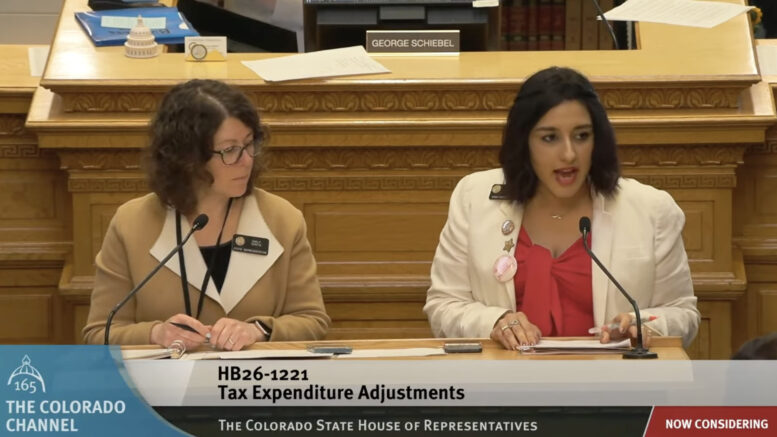
“In my work as a tax attorney, I know that our tax code is rigged. It is rigged to favor the ultra-wealthy and giant corporations,” Rep. Yara Zokaie, the Fort Collins Democrat cosponsoring House Bill 1221, said on the House floor on Friday. “This is a matter of priorities. Ours are clear: Children matter more than corporate profit.”
Republicans and business leaders lamented, however, that these tax-break rollbacks, will sound a loud message that Colorado is not interested in supporting job creators and will cost it the tax revenue — and jobs — that come with corporate expansion or relocation. Recent reports from the Colorado Chamber of Commerce have found this state is the sixth-most-regulated in America and that it’s lost 13,000 jobs since 2019 via relocation or via companies choosing to expand elsewhere, often as they cite regulatory concerns.
“It means less cash for jobs, less cash for equipment, less cash for follow-up expenses and ultimately less cash for investment for businesses in Colorado,” said Rep. Max Brooks, R-Castle Rock, said of the package while discussing HB 1222 on Friday. “Folks, we are going to continue to lose businesses through this death by a thousand tax-break cuts … When the businesses go, so do the jobs.”
What each bill does
HB 1221 would reduce the net-operating-loss deduction allowable to companies from a maximum of 80% of a newly profitable company’s income over as much as 20 years to a cap of 70% of a company’s income over a period of 10 years. It also would reduce the maximum deduction that a company could take for executive salaries from $1 million per position to $250,000.
HB 1222 decouples state tax policy from four tax breaks that expanded in HR 1, generating $329.2 million in revenues for the new tax credit. Those include sped-up depreciation schedules for manufacturing equipment, new buildings and research-and-development investments and expanded deductions for loan and mortgage interest.
HB 1223 eliminates a $90.7 million annual sales-tax exemption for downloadable software that is not available for packaged software purchased at stores. Sponsors say the bill is a matter of equitable treatment of similar products that only are packaged differently, while opponents argue the bill is an unconstitutional new tax, as it pulls in products like software as a service that have not been subject to tax before.
HB 1289 makes a number of changes to tax incentives ranging from enterprise-zone breaks to tax breaks on electric bikes. And for Colorado companies that are part of international conglomorates, it defaults to worldwide reporting with a needed election to remain at water’s edge reporting — a move that could pull in more of a company’s international revenue when calculating income for Colorado taxation and, thus, raise tax bills.
Debate over cumulative impacts of bills
Colorado Fiscal Institute Policy Manager Caroline Nutter, who helped to craft the tax package, reiterated that one of the primary reasons for the bills was to find a way to turn back on a family tax credit that benefitted 48% of the kids in the state last year. The changes bring Colorado tax law more in line with that in many other states and also bring many of the tax policies back to where they were in 2025 before passage of HR 1, she said.
For example, the change to the net-operating-loss deduction, which is viewed as vital to startups that go years without profit and hope to recover losses in the future, is a “good middle ground” when many other states allow firms to take the deduction for eight to 15 years, Nutter said. And the elimination of the downloadable-software exemption would bring state policy in that area in line with existing policies that allow taxation of streaming services or audiobooks, she said in an interview.
However, Phil Horowitz, state and local tax director for Baker Tilly and chairman of the Colorado Chamber of Commerce Tax Council, said the debate is centered wrongly because it’s not focused on creating good tax policy as much it is on increasing revenues. While Horwitz acknowledged that a tax break for families is appealing, it should be considered on its own rather than linked directly to the rollbacks of specific tax breaks that legislators are considering, he said.
Should tax breaks be considered separately from expenditures?
The decoupling from the federal tax breaks will complicate state tax policy and conflicts with the reasoning behind coupling state and federal policy in 1987 — to make it simpler for employers and to help the state attract jobs for that reason. Similarly, defaulting to worldwide combined reporting for international companies brings about a “huge increase in complexity” that could cost companies significantly in accounting bills to figure out the proper share of their worldwide profits that are owed to one state, he argued.
“Tax policy should be evaluated not exactly in a vacuum but with respect to the entirety of tax policy of your revenue-raising structure in a way that is not tied together with your expenditure side of things,” Horwitz told the “Colorado Chamber Office Hours” podcast. “There was nothing you could say to derail these bills because the expenditure side (the family affordability credit) is so important.”
Business groups did get some concessions. HB 1289, for example, had planned to repeal a sales-and-use-tax exemption for property used in space flight, but it paused it for three years instead to see if there is future interest in the break. And though HB 1221 authors had wanted to eliminate any executive compensation tax break, they ended up settling on a reduction to $250,000 instead.
It remains to be seen how the proposals fare in the Senate, though Democrats have a near-veto-proof majority in that chamber as well. It also remains to be seen how they sit with Gov. Jared Polis, who typically has asked legislators when repealing significant tax breaks to offset new tax revenues with a reduction in the state income tax — a reduction that is not present in any of these bills.
Different goals, different votes
Rep. Emily Sirota, the Denver Democrat who is cosponsoring HB 1221, emphasized, as Horwitz noted, that the talking points around these bills should be the children they are helping, first and foremost.
“We are protecting families, strengthening our economy and ensuring that Colorado remains a leader in child well-being,” Sirota said on Friday.
But Rep. Rick Taggart, a Grand Junction Republican who was CEO for several outdoor companies, said that these bills unfairly try to juxtapose company profits against the greater needs of society when the truth is that those profits help to meet those needs.
“You’ll have to excuse me when I am accused that … my corporation was greedy because we made money but at the same time employed 1,400 people,” Taggart said. “We put a lot into society. If nothing else, stop the ‘us against them.’”