
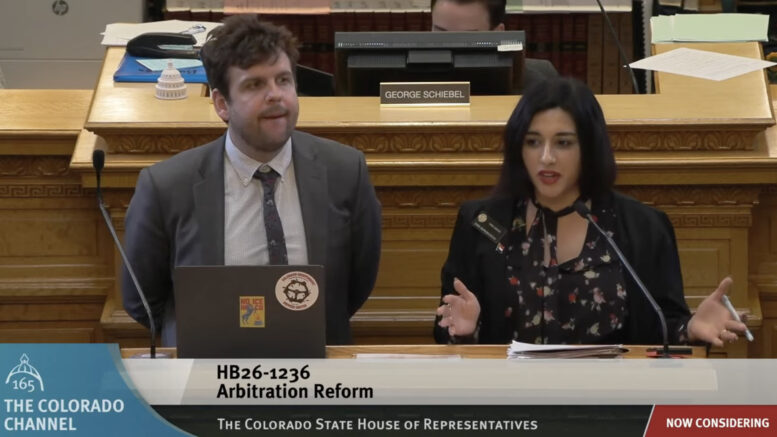
As Gov. Jared Polis considers which bills to veto or to sign over the next four weeks, some legal organizations, particularly those in the defense bar, are hoping he considers nixing an arbitration-reform proposal that squeaked through the Legislature in its final days.
House Bill 1236 is narrower than it was upon introduction, when it sought to prohibit provisions in arbitration agreements that waive a party’s ability to take the case to court unless preempted by federal law. That was meant to let the state limit the use of arbitration clauses if the federal government ever rolls back its oversight of the practice, but sponsors removed the provision after opponents argued it sowed great confusion about what might fall under federal or state law.
What’s left in the bill are three provisions that supporters say will make the alternative judicial-resolution process, required in most employer-employee and merchant-customer contracts, more balanced for everyone involved. Those are:
- A ban on mandatory arbitration if the cost of the process substantially exceeds the cost of filing the case through in state or federal court, whichever is more appropriate;
- An ability for parties to block arbitrators or arbitration organizations from hearing cases if they have a demonstrated pattern of conduct that violates neutrality; and,
- A mandate that parties that are required to pay a judgment via an arbitration decision do so within 120 days or face a doubling of damages.
Why supporters believe arbitration reform is needed
While arbitration was less common several decades ago, more than 60 million American workers now are subject to the dispute-resolution practice if they have problems with their employers, cosponsoring Rep. Javier Mabrey, D-Denver, said. A 2019 University of California-Davis study found that 826.5 million contracts, including most that govern consumer disputes with products they purchase, are subject to arbitration — a number twice the size of the American population, Colorado State University graduate student Michael May noted.
“What this bill is really about is ensuring the system is fair whether you go to arbitration or you go to court,” cosponsoring Sen. Matt Ball, D-Denver, told the Senate Judiciary Committee during a hearing on May 6. “This is about ending cases where unconscionable fees are charged as the price to get into arbitration.”

Colorado state Sens. Nick Hinrichsen and Matt Ball discuss their arbitration-reform bill in the Senate earlier this month.
But while sponsors say they are seeking fairness, leaders of groups ranging from the Colorado Civil Justice League to the Colorado Chamber of Commerce said that the bill adds confusion and incredibly vague terms that now can muddy the process. And they questioned why sponsors would want to change a process that is more advantageous for consumers than going through the judicial system — in terms of time, costs and results.
Does arbitration benefit employees and consumers?
Both House and Senate Republicans cited a Consumer Financial Protection Bureau report that found consumers and employees won 42% of the time in arbitration versus 29% of the time in court. Average awards were higher ($79,000 versus $71,000) in those cases, and the average time of resolution dipped from 429 days in court to 321 days in arbitration.
“I think there’s a recognition that arbitration is fairer, faster and better for consumers and for employees — but, of course, it’s not as profitable for plaintiff’s attorneys,” Sen. John Carson, R-Highlands Ranch, said during Senate debate on May 11.
There also is significant dispute about whether the provisions meaning to bring clarity to the process will do that.
Senate sponsors — Ball and Sen. Nick Hinrichsen, D-Pueblo — sought to align the maximum-costs provision to current legal doctrine by adding the term “substantially exceeds” to describe what costs are unacceptable. However, Sean Gallagher, a labor and employment attorney at Polsinelli, said the provision raises questions about whether some current requirements, such as those in merchant-consumer contracts that require 50/50 split of costs, would be considered excessive.
Colorado state Sen. John Carson speaks against an arbitration-reform bill in the Senate earlier this month.
When should an arbitrator be disqualified?
Similarly, Jeffrey Ruebel, an official with CCJL and the Colorado Defense Attorneys Association, warned that the arbitrator-disqualification allowance, which was changed as the bill advanced, remains “dangerously vague.”
Mabrey and cosponsoring Rep. Yara Zokaie, D-Fort Collins, sought to clarify that an arbitrator could not be disqualified just because they have a demonstrated history of ruling for one side over another. Instead, supporters like David Seligman, executive director of Towards Justice law firm, said they want to prevent instances where a product developer may have created their own arbitration firm that makes it harder to do discovery or other judicial proceedings in cases.
But Gallagher said that by including language that “an individual or arbitrator associated with an arbitration organization” can be deemed as biased based on decision patterns in the number of cases they hear from the same attorney or based on prevention of a party from asserting their rights in arbitration could open a pandora’s box. Plaintiff’s attorneys could search out rulings against national arbitration associations and, finding certain rulings, could seek to disqualify an arbitrator based on something that happened to their firm in another state, he argued.
Should arbitration awards be limited?
Meanwhile, several defense attorneys criticized a provision of the bill that allows arbitrators to award exemplary damages, which are meant not to satisfy economic claims but to punish parties for certain actions. Arbitrators are not judges and should not have the authority to do this, they said.
However, Ball pointed to U.S. Supreme Court rulings that have said that state laws cannot disadvantage arbitration versus the legal system. And he argued that if attorneys were prevented from getting punitive awards in arbitration but not in the court system, that would be violating that directive because it would make arbitration an unequal option.
Polis, whose background is in business rather than in law, will have to determine if the bill is a consumer and employer aid, as its backers argue, or a hindrance to doing business in Colorado versus other states. HB 1236 passed the Senate by a 19-16 vote and eked out of the House on a margin of one vote, 33-32, when 10 Democrats joined with all the chamber’s Republicans in opposing it.
Bell Policy Center Director of Government Relations Joshua Mantell noted that the portion of workers required to settle employment disputes via arbitration has skyrocketed from 2% in 2002 to 55% in 2018. Jason Wesoky, president of the Colorado Trial Lawyers Association, warned that the standards for disqualifying an arbitrator now are so high “that it is a veritable impossibility to overturn or question an arbitrator’s ruling.”
“I don’t know that you can prepare for this”
“It is one of the most effective tools that employers have to insulate themselves from true responsibility,” Mabrey told the House Judiciary Committee on April 7, arguing that too many arbitration cases lack transparency and require nondisclosure. “This bill aims to make a system that is financially and structurally unfair a little more fair.”
But Gallagher said that at a time when federal rules govern arbitration and identify it rightly as a preferable forum to the backlogged court system for disputes involving specific issues with products, HB 1236 seeks to undermine this means of dispute resolution. And given the commonality of arbitration clauses in contracts today, the bill would generate wide-ranging uncertainty and changes — something that should cause the Democratic governor to pause.
“I think this is coming in under the radar of a lot of people who are going to be hit by it. I don’t know that you can prepare for this,” Gallagher said. “In practical terms, I think it’s going to be very difficult for anybody to enforce an arbitration agreement going forward.”
Polis has until June 12 to sign or veto bills coming from this legislative session.