Colorado legislators sought this session to boost regulations on transportation-network companies like Uber and Lyft regarding passenger safety, treatment of disabled passengers and the portion of drivers’ fares that they keep. They succeed on two of the three counts.
One year after Gov. Jared Polis vetoed a bill that sought to require TNCs to deactivate drivers who were the subjects of complaints and allow for the recording of full rides for safety purposes, backers returned with a toned-down bill that they say Polis will sign. But they won’t seek his approval for a measure that would have required the companies to ensure that drivers keep at least 80% of the fares paid for each ride, after a committee killed the bill on Tuesday, claiming it wouldn’t do what sponsors wanted.
Those actions — plus the passage of a less-controversial bill to require TNCs train drivers about their legal requirement to transport disabled passengers with their service animals — made 2026 the fourth straight year in which regulation of the sector was a major issue. Meanwhile, the death of the TNC fares bill seems to ensure that debate will return on the growing sector and the rules the state puts around it in 2027.
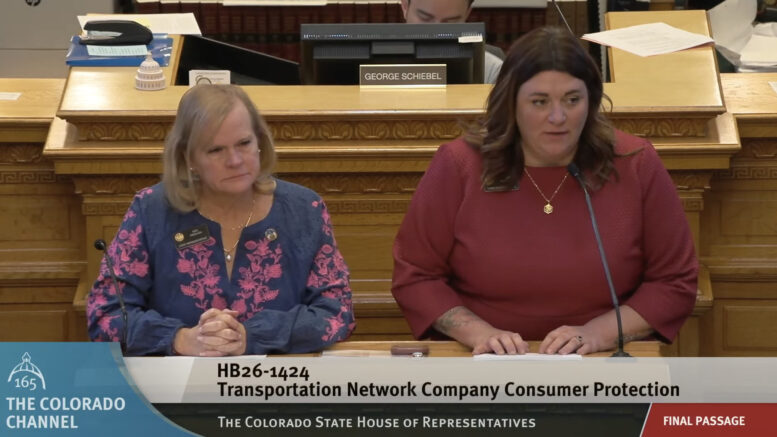
But the two bills going to Polis this year seem to represent areas of agreement between legislators, TNC companies and a governor averse to overregulating the sector, as Uber and Lyft sought amendments but did not oppose either. Rep. Jenny Willford, author of both the vetoed 2025 bill and House Bill 1424, the new rider-safety proposal, said on the final day of the legislative session Wednesday, as the House concurred with Senate changes to HB 1424, that she expects Polis will sign it.
A continuation of years-long debates
“We regulate taxis, we regulate buses, we regulate airlines — not to punish them, but because when a person steps into a vehicle, they deserve to know that someone other than a corporation decided a minimum standard for their safety,” Willford said earlier when the bill passed the House on a largely partisan vote. “Uber and Lyft have had the time to do the right thing.”
While legislators have expressed concerns on the companies for several years, particularly around their relationships with their drivers, those concerns escalated significantly after Willford reported in 2024 that she was sexually assaulted during a Lyft ride. The Northglenn Democrat tried in a bill last year to crack down on impostor drivers, as she dealt with during her incident, and to require more frequent background checks and audio/video recording of trips to protect passengers.
Polis, however, said some of the provisions in that bill were so onerous that the companies could leave Colorado — including liability increases, recording requirements violating the Colorado Privacy Act and immediate disqualification of drivers that violated a 2024 law. After his veto, he ordered the Colorado Public Utilities Commission to put in place new policies address less-controversial provisions, and Willford, along with fellow Democratic Rep. Meg Froelich of Greenwood Village, returned with a focus on negotiable provisions.
What the TNC safety bill does
HB 1424 requires TNCs to develop policies against impostor drivers and account sharing, run background checks on drivers every six months and ban drivers who have been caught account sharing or have been convicted of assault, harassment, kidnapping, menacing, stalking or domestic violence. And if a driver is barred by one rideshare company that employs at least 1,500 drivers, they would be barred from driving for all TNCs in Colorado.
Also, the bill would allow both riders and drivers to opt in to a video or audio recording of the ride from pickup to drop-off, and it would bar transportation of most unaccompanied minors and require any food or water offered by drivers to be factory-sealed. TNCs must investigate complaints about drivers and respond to subpoenas or search warrants within 72 hours and provide annual reports to the PUC and Legislature about criminal incidents in their vehicles.
Sponsors made several amendments to ensure the bill conforms to state law, adding provisions on issues like audio/video recording storage until the PUC finishes a rulemaking on the matter by 2028, but said they believe they have met all of Polis’ requests.
HB 1043, meanwhile, got some bipartisan support and appears to be in line to be signed. In addition to making TNCs provide more education to drivers on Americans with Disabilities Act requirements like accepting service animals, it requires monthly reports from TNCs on service denials and raises the maximum fine for denials that violate the law, to $1,300.
Addressing drivers’ take of fares
But as much as legislators were willing to add rules to protect riders and to protect blind people, they drew the line this year at requiring TNCs to give a four-fifths percentage of each fare to drivers, as HB 1273 sought to do.
While drivers used to keep as much as 90% of fares, that changed in 2022, when both of the sector leaders introduced upfront pricing and employed algorithms to determine what riders would pay and what drivers would take, said Willford, also a cosponsor of this bill. Since then, studies have shown drivers keep an average of 40% of fares, and drivers packed committee hearings to call this “modern slavery” and a practice that is “reprehensible.”
HB 1273, also cosponsored by Froelich, would have mandated that drivers get at least 80% of fares after taxes, tips, airport fees and other fees were excluded from the total. Ken O’Donnell, board treasurer for the Drivers Cooperative of Colorado, estimated this would put $22 million annually more into the pockets of Colorado TNC drivers.
But representatives from Lyft and Uber called the calculations unworkable, noting they already pay more than 20% of each ride for state mandates, including higher-cost insurance coverage that went into effect several years ago.
TNCs: Policy would lead to fewer earning opportunities for drivers
About 25% of Uber’s Colorado rides currently are money losers, meaning that they are lower-fare transports of limited amounts of time for which the company allows drivers to make more money only by having the company take a hit, company executive Harry Hartfield told the House Business Affairs and Labor Committee on March 11. Were the company to have to pay drivers 80% for each ride, it would have to double its prices in the state, which in turn would leave it inaccessible to a number of riders and reduce demand and earnings potential for drivers, he said.
Opponents of the bill pointed frequently to a National Bureau of Economic Research study that showed that after Seattle required higher pay rates for TNC drivers, drivers actually earned less because demand fell and the number of rides they got decreased as more drivers flooded the market. That seemed to sit powerfully with some legislators, such as Sen. Matt Ball, D-Denver, who told sponsors that he doubted that their bill would have the impact they expected before he joined three Republicans and two other Democrats in killing it in the May 12 Senate Transportation & Energy Committee by a 6-3 vote.
“The take rate works on a trip-by-trip basis,” Hartfield said of the bill, which would have made Colorado the first state to attempt a mandate like what was proposed. “This idea as a whole is probably not viable for us as a business.”
Polis has until June 12 to sign or veto bills passed during the 2026 legislative session.