
This legislative session was supposed to be a defining one for the utility and energy sectors — one in which legislators would debate and pass a long-discussed plan to move up the net-zero emissions deadline by 10 years and also remake the Public Utilities Commission.
But the story of the 2026 session for energy advocates instead turned out to be all about what didn’t happen. No 2040 net-zero plan got introduced. No radical changes came through the extension of the PUC. And for the first time in over a decade, no existential threats to the oil and gas sector received debate in the 75th General Assembly.
The topics that took center stage instead were reliability and affordability of energy sources. Legislators held a hearing on power shutoffs implemented by Xcel Energy on dangerously windy days, and they opted against introducing a last-minute measure that could boost the cost of natural gas. Environmental goals took a back seat to legislators’ desire to protect working-class families from further spikes in energy costs caused in part by regulations.
Carly West, executive director of the American Petroleum Institute Colorado, admitted after the May 13 adjournment of the session that she’s not sure whether this is a blip or a permanent redirection of a conversation that’s focused solely on emissions for many years. But she said she was “encouraged” by the willingness of majority Democrats this year to pause efforts that have led to 50 new rulemakings on the sector since 2021 and discuss the bigger picture of how people can afford to keep the lights on in their homes.
Colorado Energy Crossroads’ major influence

Carly West is executive director of the American Petroleum Institute Colorado.
“There did seem to be a much broader conversation about reliability, affordability, feasibility and the jobs related to the energy sector,” West said in an interview. “I would love for the answer (to the question of why) to be that there is recognition of all the work that has been done and continues to be done to lower emissions. I don’t know that I’m enough of an optimist to believe that.”
In retrospect, the tone for energy discussions this session may have been set on Dec. 12, when energy, utility, business and labor-union interests came together to form a coalition at the Colorado Energy Crossroads summit. It was there that the groups with frequently diverging viewpoints declared that an unbridled rush to net-zero energy by utilities would result in lost trades jobs, skyrocketing utility bills and a grid that couldn’t handle a massive increase in electric devices and heat pumps.
Over the next few months, members of Gov. Jared Polis’ administration engaged in frequent talks with the coalition and evolved their plans. First, they jettisoned the idea of mandating net-zero by 2040 and replaced it with a broader but still emissions-reducing focus on continuing improvements after the 2030 deadline. Then they replaced a proposed 40-page bill with a compact five-page proposal that left much of the specific rulemaking in the hands of the PUC. Then they realized that no bill would pass this year.
Worries about energy costs on par with emissions concerns
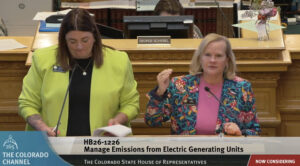
Colorado state Reps. Jenny Willford and Meg Froelich explain House Bill 1226 on the chamber floor.
What came from these talks, said Colorado Oil & Gas Association President/CEO Lynn Granger, was the idea that many groups felt it was time to stop having “unrealistic discussions” focused on emissions reductions at the expense of all other considerations. She sensed growing pragmatism in some Democrats who, while seeking cleaner air — as energy groups too want, she emphasized — aren’t willing to imperil a $32 billion economic engine or force residents to choose between buying groceries or paying rising energy bills.
It’s noteworthy that only one bill passed this session that’s likely to lead to new rulemaking before the Colorado Air Quality Control Commission — House Bill 1226, which Polis signed Thursday and which requires the AQCC by 2029 to adopt regulations for coal plants that the federal government forces to stay open past 2034 under emergency rules. And in their messaging on the bill, sponsors criticized the federal government not just for blocking the state’s emissions-cutting plan by requiring at least one coal plant set for closure to stay active but for jacking utility costs for customers powered by the plant.
“There is consensus among the Colorado Attorney General, environmental organizations and the operators of the Craig Unit 1 power plant that forcing coal plants to stay online will increase utility costs for Coloradans,” cosponsoring Rep. Jenny Willford, D-Northglenn, said in a news release when HB 1226 passed the House. “Colorado needs authority to plan for our own energy future, and this bill helps protect ratepayers and bring us closer to our climate goals.”
A look at energy bills that passed and failed
Along those lines, legislators approved Senate Bill 182, which would allow municipal utilities that are unable to meet 80% emissions-reduction goals by 2030 to have an extra three years if they file plans and cut emissions more in the future. The proposal was moderated from an original plan to delay compliance until 2040, but its bipartisan sponsors emphasized that some delay is needed to avoid electricity bills spiking due to utilities having to buy expensive renewable power in the short term.
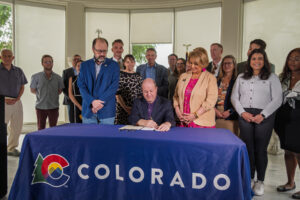
Gov. Jared Polis signs the PUC sunset bill, House Bill 1326, into law on June 1.
Legislators also took a decidedly moderate approach to the PUC sunset bill, amending out a provision in HB 1326 that would have allowed the commission to mandate that utilities use profit-lowering securitization on projects with high price tags. While utilities and business groups unsuccessfully asked legislators to expand the three-member PUC to five people in hopes of getting greater ideological diversity on the panel, sponsors at least agreed to a provision to study that idea.
A House committee quickly rejected an effort, HB 1121, to require companies with emissions permits to list their emissions on their corporate websites. Bipartisan opponents argued that such a requirement was unnecessary with those same emissions records publicly available through the Colorado Department of Public Health and Environment.
And energy-industry leaders avoided getting drawn into a last-minute, contentious debate over potential fees on natural-gas sales when House Democrats pulled a proposed bill on the subject three days before the end of the session. The bill was positioned as a countermeasure to an outside group’s ballot initiative seeking to give Colorado residents the permanent right to heat their homes with natural gas as a buffer against increasing talk of banning that energy source in favor of electrification.
Will existential debates restart in 2027?
Beyond those measures, most energy bills that passed this session were relatively noncontroversial and were focused on consumers’ financial needs. SB 2 requires all investor-owned utilities to have standardized frameworks for energy-assistance programs based on percentage-of-income payment plans. HB 1007, which was negotiated heavily with utilities, makes it easier for Coloradans to install meter collar adapters to connect small electricity panels to their electric-vehicle chargers or other power sources.
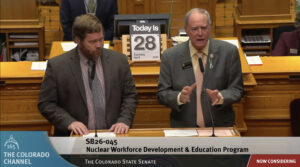
Colorado state Sens. Kyle Mullica and Larry Liston discuss their bill to boost the nuclear-energy workforce with the Senate.
Maybe the only other big loss for all-of-the-above energy proponents was the late-session deaths of two bills aimed at boosting the Legislature’s 2025 declaration that nuclear energy is clean energy by launching a nuclear-energy-workforce development program and setting the stage for regulation of small nuclear reactors in Colorado. In both cases, proponents faced pushback about whether the state, while now accepting nuclear energy as a policy, is ready to push for development of nuclear plants — a conversation likely to return in 2027.
But after the passage of 73 bills since 2021 impacting the energy sector — and an average increase in energy bills of 38% over that time, Republican Sen. Barbara Kirkmeyer of Brighton noted — the 2026 session was a quieter one in this policy area. It remains to be seen, however, if a deal between environmental groups and major oil/gas firms struck in 2024 to delay major policy proposals affecting their industry through the end of 2027 holds after a new governor replaces the term-limited Polis in January.