
Hoping to ween commercial landscapers off emissions-producing gas-powered equipment, Colorado regulators will consider rules later this year to limit the percentage of companies’ mowers and blowers that are revved by fossil fuels.
The Colorado Air Quality Control Commission on Thursday voted to schedule a November rulemaking that is a successor of sorts to a 2023 rule that banned the summertime use of the same equipment by the state and local governments over the past two years. AQCC members declined to impose the same regulations on commercial operators back in 2023, saying at the time that they worried a quick shift away from traditional equipment would cost too much for companies and lead to job losses.
Three years later, however, Colorado Air Pollution Control Division staffers said that the cost of such equipment is coming down and that more companies have begun to migrate their inventory of equipment toward electric options. The proposed new regulations would not ban use of gas-powered equipment so much as they would decrease the percentage of gas-powered equipment that firms could use annually over the next six years.
APCD officials are going after gas-powered hand-pushed mowers — as well as hedge trimmers, hand-held string trimmers, blowers, edgers and pruners — because they contribute in no small measure to state ozone problems. Colorado is in severe nonattainment of U.S. Environmental Protection Agency ozone limits, and the AQCC has passed rules to limit emissions by industries including oil and gas, manufacturing and commercial buildings to try to get back into compliance.
A gradual decline in the limits for gas-powered equipment
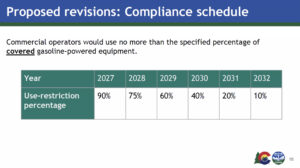
This is the proposed schedule for reducing the amount of gas-powered lawn and garden equipment used by commercial operators.
Gas-powered lawn and garden equipment is the largest producer of volatile organic compounds — the gases that react with nitrous oxide to create ground-level ozone — outside the oil and gas sector, APCD regulatory development specialist Ashley Brubaker told the AQCC during a meeting Thursday. They account for 14% of all VOCs and 5% of all NOx in Colorado’s inventory, and commercial equipment accounts for 66% of all VOCs and 18% of all NOx produced by this sector.
Because ozone causes breathing difficulties and respiratory infections and exacerbates conditions like asthma and chronic obstructive pulmonary disease (COPD), reducing the amount produced by lawn and garden equipment could have big upsides, Brubaker said.
“Not only will it have air-quality benefits, but it will have benefits for workers,” she added, noting that electric equipment produces less noise, fumes and vibrations.
Under the proposal going before the AQCC, the maximum portion of lawn-and-garden equipment that is gas-powered and can be used by for-profit operators would be capped at 90% in 2027 and would decline annually by 15% to 20% a year until reaching 10% in 2032. The rule would affect all equipment that is 10 horsepower or less — a designation that captures pretty much all push or walk-behind mowers but not riding mowers that have fewer electric replacement options.
Use of gas-powered equipment already decreasing
No commercial operators appeared at the public-comment portion of this week’s AQCC meeting — a gathering largely focused on credit-trading rules for large manufacturing facilities — to offer their thoughts on the proposal. However, Brubaker said that in stakeholder meetings over the past year, companies have been “generally supportive” of the plan because electric lawn-and-garden equipment is more affordable and accessible than it was even three years ago.
That doesn’t mean that even those companies that have begun using electric equipment haven’t expressed some concerns, though, she said. The need to swap batteries during the day means it takes longer to complete work, there is concern with fire safety around batteries and the use of outlets for recharging can be timely or costly, she acknowledged.
But the use of gas-powered equipment already is on the decline, particularly as the state offers tax credits worth 33% of the sales price to approved retailers selling electric equipment. And officials believe the time is right for more extensive limitations.
In-house groundskeepers would be exempted from rule

Colorado Air Quality Control Commission member Jana Milford speaks during a hybrid commission meeting in July.
The rule would impact only independent landscaping and lawn-care companies, not private entities like golf clubs or apartment complexes that employ in-house staff for groundskeeping. It’s more difficult to reach those companies and determine what kind of equipment they use, though any that contract out such services to commercial operators would be affected, said Leah Martland, a supervisor in APCD’s regulatory development and engagement unit.
Several AQCC members advocated for expanding the rule to include in-house groundskeeping staff, with commissioner Jon Slutsky saying that a lot of businesses would be exempted and that the state should reduce emissions from the sector even further. However, an effort to expand the scope of the hearing to include those operators failed on a 4-3 vote Thursday.
The limitations on usage of gas-powered equipment would apply between June 1 and August 31 of each year — the same peak ozone season in which governments are banned from using gas-powered mowers and blowers. AQCC member Jana Milford said she is interested in expanding that time frame to more months — a request that can be debated during the November hearing.
The hearing is scheduled for Nov. 18-20 and will be offered as a hybrid meeting that members of the public can attend online or in person.