
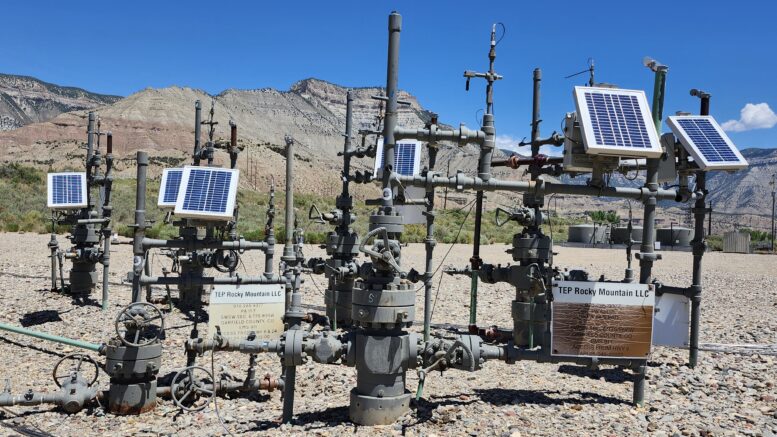
Colorado air-quality regulators approved a third and final set of rules Friday to reduce methane emissions released in oil and gas production, becoming the first state to draw up regulations based on two-year-old U.S. Environmental Protection Agency guidelines.
State leaders considered and passed the rules in three phases over the past 19 months. In February 2025, the Colorado Air Quality Control Commission established a timeline to phase out natural-gas-driven compressors and pumps by 2029. Then, earlier this year, commissioners created a crosswalk between federal requirements and Colorado’s decade-old methane regulations that helped to inform producers on how to meet the federal standard.
Finally, during a three-day hearing this week, the AQCC firmed up rules around the monitoring and reporting on pieces of equipment at existing oil-and-gas facilities that are meant to control emissions. These including things such as closed venting systems, covers and enclosed combustion devices at locations such as well sites, storage-vessel facilities and natural-gas-processing facilities.
An economic impact analysis indicated that state leaders don’t expect emissions reductions directly from what are known as the “Quad OC” rules — referring to the subpart of federal law to which they conform — but that is misleading in some sense. While the new regulations aren’t expected to lower methane emissions on their own, they will go a long way toward preventing fugitive emissions escaping from processing equipment, which several supporters said can be a significant source of air pollution.
How the rules will limit methane emissions
“What we’re doing here is really protecting public health and the environment,” AQCC member Martha Rudolph said near the end of the rulemaking hearing. “We hear that (as a request) from community members frequently, and we acknowledge that. But I really want to acknowledge that today.”
Part of Colorado’s eight-year push to cut emissions from industries ranging from oil and gas to commercial buildings to manufacturing, the Quad OC rules did not generate the same industry pushback and warnings of economic infeasibility as some other regulations have. However, leaders of the oil-and-gas industry warned that they will not come without costs to companies already dealing with a significant uptick in regulatory overhead that has contributed to a significant decrease in the number of oil and gas rigs operating in the state.
Companies operating the regulated equipment will, for example, have to inspect the equipment more frequently for leaks and repair malfunctions more quickly when they discover them. Oil companies extracting natural gas with a high amount of methane from oil wells will have to capture that gas rather than burning it off.
The heaviest debate during the hearing centered on a Colorado Air Pollution Control Division proposal that operators of enclosed combustion devices designed to burn up at least 95% of potentially harmful emissions that enter them must monitor these devices more frequently. Rather than record the minimum and maximum flow through the devices and report that on an annual basis, operators must continuously monitor the flow of gases through the machinery and ensure they are moving at a proper speed to maximize destruction of volatile organic compounds and hazardous air pollutants.
Costs to smaller oil-and-gas producers
Such a requirement will not be cheap, industry leaders said. Just five years after new regulations required ECD operators to procure flow meters for more frequent monitoring, this provision likely will cause the same companies to have to upgrade them or to buy actuators to ensure a more consistent flow for maximum pollutant destruction. And the new rules will require this not just for equipment falling under EPA’s Quad OC guidelines but for a wider range of equipment under the state’s Regulation 7 guidelines pertaining to lower-emitting and smaller-scale activities.
Clay Taylor — an attorney for Williams Weese Pepple & Ferguson representing petroleum-industry groups — estimated this expansion of the regulations will pull in thousands of other ECDs, as every controlled storage tank in Colorado has at least one. Not only will such retrofits be pricey, but the originally proposed compliance deadline of April 1 would have meant that tanks in remote locations on the Western Slope and elsewhere would have required the work in the dead of winter, likely slowing installations.
Colorado Oil & Gas Association Vice President of Regulatory Affairs Ryan Steadley noted that the economic impact analysis that APCD performed on the rules did not signal a cost estimate to operators for this work that most definitely will consume resources, which he said could create “significant legal vulnerability for the rule.” And both he and Taylor questioned the efficacy of the requirement when the same EIA estimated no reduction in emissions from the rule — an opinion shared by several members of the AQCC.
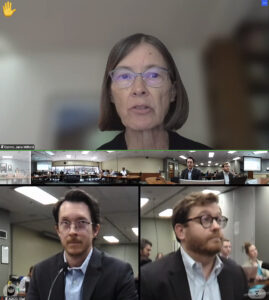
Colorado Air Quality Control Commission member Jana Milford asks petroleum-industry representatives Ryan Steadily (left) and Clay Taylor a question during this week’s hearing to establish new rules on methane emissions.
A “common-sense” practice?
Yet environmental groups from GreenLatinos to Environmental Defense Fund to Physicians for Social Responsibility specifically asked commissioners to expand the rule beyond just Quad OC-covered equipment, calling it key to preventing fugitive emissions. And staffers like Jeremy Schuster of APCD’s planning and policy program said that he asked industry leaders repeatedly how much such retrofitting would cost but could not get an answer.
AQCC member Curtis Reuter proposed a delay in the start of the new regulations for non-Quad OC facilities until the start of 2030, saying that would give time to save up and plan for upgrades and would allow APCD staff more than just eight months to consider requests for alternative monitoring arrangements, which are allowed under the rules. But fellow commissioner Jana Milford countered with a proposal to extend the deadlines for non-Quad-OC equipment operators only by one year, until April 2028, and her suggestion won out in a 5-4 vote of commissioners.
“I think it’s just common-sense, good engineering practice that you’re going to operate and maintain control over devices like these,” Milford explained.
Reduction in methane emissions expected
Many of Colorado’s larger oil and gas producers, which are all subject to Quad OC regulations, offered little pushback to the rules other than clarifying several of the provisions. Reuter applauded industry and environmental groups and APCD officials for reaching “a remarkable consensus through this process.”
Environmental groups lauded the final vote, saying that such steps to capture and reduce emissions are desperately needed as Colorado remains in severe nonattainment of EPA ozone standards, leading to many days this summer that triggered struggles for asthmatics and other northern Front Range residents with cardiovascular conditions.
“Thankfully, solutions are available, and with today’s vote our state leaders have taken another step toward making our air safe to breathe,” said Kirsten Schatz, clean air advocate for the CoPIRG Foundation, in a news release after the final vote. “Especially when better, cleaner technology is available, we should no longer tolerate preventable releases of harmful pollution into our air.”