
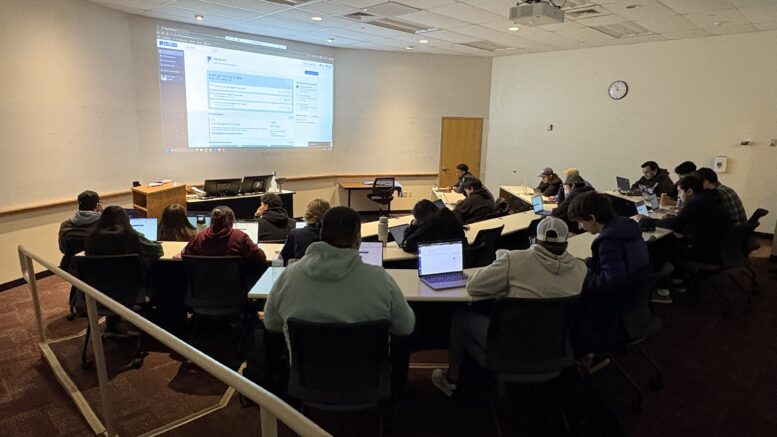
Though most employers want to be able to offer internships and apprenticeships, smaller companies often lack resources to oversee such programs. Similarly, students who work full-time to put themselves through school can’t avail themselves of those opportunities.
One alternative for both learners and businesses is work-integrated learning, a growing field in which employers partner with professors to offer students real-world research or testing projects in class, giving those students experience while benefitting the companies. In fact, the Colorado Department of Higher Education this semester launched a pilot program in which it’s serving as the intermediary between employers and educators to establish such partnerships for five classes a semester at each of five colleges.
The classes range from integrated media to food-service management to broader, introductory-level courses like Chemistry 101. And the participating employers are companies as small as a food-truck purveyor looking to understand how he can grow and as large as a multi-state employer seeking help in understanding various data sets.
“This isn’t just busy work”
McKenzie Fair, manager of CDHE’s work-integrated learning program, believes these opportunities are equally beneficial for the participating students and for the employers. Students can learn how the skills they are acquiring can translate into potential careers and employers both can benefit from the extra help on needed projects and can begin to cultivate future workers, often from schools in their own backyards.
“It’s about ‘What is the business challenge? What is the business’ need? This isn’t just busy work,” said Beverly Jones, CDHE’s director of social mobility and strategic sustainability. “And are we removing the barriers for students who are geographically isolated or working fulltime while they go to school, which reduces their work-based learning opportunities?”
As such, the five schools in the three-year pilot program — Adams State University, Colorado Mountain College, Colorado Northwest Community College, Fort Lewis College and Lamar Community College — are rural in nature. And as CDHE officials have gone into the surrounding communities seeking business participants, they’ve attracted companies that don’t typically step up to offer the internships and apprenticeships that have become a a favorite push of workforce-development advocates.

The Student Life Center at Fort Lewis College in Durango
Chef Safari, an African fusion food truck in Durango, is working with a food-service-management class at Fort Lewis to understand food trends and marketing opportunities, noted Janae Hunderman, director of career strategy at that college. In Lamar, a local food company looking to bolster their nutritional labeling is working with a chemistry class to analyze its foods, Fair said.
How employers get involved
Nunn Construction, a 200-employee general contractor with workers in Durango and two other Colorado locations, is overseeing three different WIL groups in a 300-level project-management class at Fort Lewis. One of them is investigating the company’s use of labor resources across its three offices and trying to determine if there are better ways it can employ its workers that will benefit both the company and staffers.
Chris Schnurr, Nunn senior project manager, acknowledged the program is taking more time than he originally estimated, but that’s because company leaders decided to dedicate more time to getting to know the students and ensuring they get something out of this. The payoff is not just the knowledge students gain from their efforts but the ability for Nunn to get to know attendees of a college without a specific construction-management track and find those who may be interested in joining the industry upon graduation.
“That is absolutely a benefit of doing this — especially our office here. We really like bringing in young talent and developing it,” Schnurr said, noting his WIL co-collaborator Trent Del Grippo, a Nunn assistant project manager, was found through a different partnership at the school. “Bringing in a group of college students gives you a fresh perspective.”
For the CO-WIL pilot program, employers are asked to commit about an hour a week to check in with students and see how their research is coming. Employers can create profiles of the work they want done on Riipen, a platform that connects educators to real-world projects, and CDHE can be the go-between matching them with school leaders.
How employers can benefit
CDHE estimates that with 10-15 students participating in each selected WIL course and with each of the colleges offering five courses per semester for the next five semesters, between 1,250 and 1,875 students will gain valuable experience through the program. The research organization RAND will evaluate the results of the program, for which participating students will receive a stipend through CDHE funded by philanthropic partners, and then state leaders hope to be able to spread it to more schools and classes.
Some of the pilot-program participants already are breaking ground in this area. Mark Millhone, director of the integrated media program at CMC, created a student-run, faculty-mentored creative agency that links students with local businesses and nonprofits to work on marketing and story-telling strategies.
The Colorado Mountain College campus in Edwards
The businesses that Millhone now partners with — and will do so even more through the pilot program — typically don’t have the capacity to supervise a college student. But by allowing the learning and research to take place in the classroom, those businesses can benefit and the students can get the opportunity to show how their skills translate to jobs.
“The primary obstacle for companies to grow is that they don’t have skilled labor,” Millhone said. “So, I think that integrating workforce with education and expectations, that becomes a huge win for employers.”
Precedent set at other state colleges
While the program will focus on just the five chosen colleges, Fair said she hopes other schools may learn of it and try to integrate the WIL philosophy into their existing classes, particularly as all have access to the Riipen platform.
And at least a few other schools already are doing so.
Jim DeLung, associate vice president of workforce and Commerce City for the Community College of Aurora, has used work-integrated learning in both the direct-skill classes he teaches in the diesel power mechanics’ training program and in the durable-skills classes students must take as well to earn their associate’s degree. He worked with a fintech company to have students analyze its investing platform in a career math class that included personal-finance components, and this fall he has a public-speaking class working in groups to introduce Riipen to nonprofits and small businesses to describe why they may want to use it.
Jesse McKay, who went through DeLung’s program as an entry-level worker for Wagner Equipment and now works as the company’s pathways coordinator, said that the way CCA teaches the durable skills classes is invaluable to producing more well-rounded graduates. The extra layer of responsibility they learn prepares them to move up in his company, which both has sponsored students going through the diesel program and has hired students who put themselves through without a corporate sponsor.
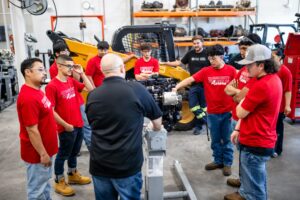
Students learn skills in the diesel power mechanics’ training program at Community College of Aurora. They also must complete life-skills courses that sometimes include work-integrated learning opportunities.
How employers can learn more
Similarly, Allana Farley, the career-connected-learning director for the Center of Workforce Initiatives at the Community College of Denver, has used work-integrated learning across multiple courses at her institution. Students in a cybersecurity course did vulnerability assessments on company websites, and students in a construction class examined building codes for an architectural firm.
While these and the pilot schools offer examples that can inspire more colleges to participate, Fair said that if the project goes as she hopes, other schools will see even more evidence to pick up the same program in three years.
And folks like Farley agree that this new way of bringing work opportunities to students who may not be able to seek them out on their own is a key to imbuing graduates with the work-ready schools that employers say they desperately want them to have.
“Employers get to see the talent early on. They can shape that talent. It can inform what kind of skills we are teaching,” Farley said. “These types of projects allow you to support small businesses too. I feel like, ideally, they’re now going to see these entry-level students that they can help to grow and support on their way to a job with them.”
For more information on participating in the CO-WIL pilot project, employers can go to CDHE’s explainer site on the Colorado Work-Integrated Learning program.