
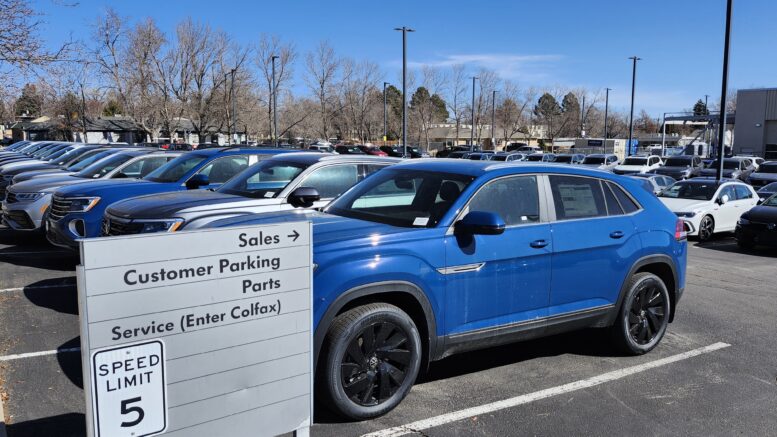
Colorado regulators are revving up what could be a highly contentious legislative debate, as the annual sunset-review process has recommended the state end its blue laws that have banned automobile sales on Sundays for the past 80 years.
That suggestion came as part of the Colorado Department of Regulatory Agencies’ yearly process in which it re-examines laws and commissions that are set to expire and offers analysis on why they should be maintained, changed or just let go. This year’s sunset review, released on Friday, also calls for ending some other regulations and continuing some prominent commissions, but nothing else in the report is likely to generate reactions similar to the proposed change to the blue laws.
The Centennial State is one of about a dozen states that still bars licensed dealerships from operating on the first day of each week. Enacted in the 1940s, the restriction was meant to ensure employees have at least one day a week in which they could spend time with their families, engage in religious observances or both, according to the sunset report.
But while this reasoning resonated with the auto-industry regulatory advisory board that was created in 1945, it does not stand up as well in a changing marketplace and should be removed because it is overly restrictive, the sunset report concluded. The team that authored the wide-ranging sunset report covering 14 programs and boards acknowledged that “no subject garnered more heated discussion” than the Sunday auto-sales ban but said it’s time for the state to pull back the law.
Automobile dealers lead pushback
“Though emotions run high in discussions surrounding the prohibition on Sunday sales, in the end there is no valid public-policy reason for the state to prohibit the sale of motor vehicles on Sundays,” the report concluded. “Many of the arguments put forward in opposition to this recommendation may have merit, but at the end of the day there is no valid reason for the state to dictate what should be a business decision.”
However, the biggest opponent to this change is going to be the state’s several hundred auto dealers themselves, who have fought vigorously to defend a rule that regulators now see as an anachronism. Matthew Groves, president/CEO of the Colorado Auto Dealers Association, said he worries that permitting Sunday sales — an allowance that will quickly evolve into every auto dealer feeling the need to operate that day — will lead to an exodus of workers and a decrease in Colorado sales.
“I don’t know what ultimately the Legislature will seek to do with this,” Groves said in an interview Friday, noting that he hasn’t been approached by any legislators who have expressed interest in pushing the concept as a standalone bill. “We are certainly not eager or wishing to talk risks versus rewards with legislators on this.”
Groves cited three main reasons — each of which were cited and then pushed back on in the sunset report — for wanting the keep the roughly 80-year-old law in place.
Auto-sales workers could lose major perk
First, the auto-sales industry holds the Sunday sales prohibition up to staffers and potential workers as a major benefit that attracts labor. Even with that the sector faces a shortage of 8,000 to 10,000 auto technicians, and Groves said he fears that could get much worse — and imperil some dealers’ operations — if a designated day off evaporates.
“It would be easy for our talented technicians to say, ‘Why don’t I just go work in aerospace? They don’t work on Sundays,’” Groves said in an allusion to current efforts by that industry to attract more technicians in Colorado and other states. “At a time when the state is trying to compel us to add benefits, this is a benefit it could take away.”
The sunset report acknowledged that significantly more dealerships are owned today than in the 1940s by multi-state corporations that may value employee well-being less than smaller, local operators. But the argument that the state should require dealerships to remain closed on Sundays to protect workers overlooks other changes that have occurred in the motor-vehicle-buying process, including the move of many sales to online sites, making this restriction overly prohibitive to companies looking to stay competitive, it said.
Groves noted secondly that customers like Sunday sales bans because they offer them one day when they can roam a lot to look at vehicles without being pressured by salespeople.
More costs without more automobile sales?
But, the sunset report retorted, this is more of a criticism of a culture than a statement of a public benefit — and a culture that may not be shared by all of Colorado’s new- and used-car dealerships. It also overlooks the fact that the blue law limits consumers’ choice and access to products on a day when they may be freer than others to do this purchasing.
Finally, Groves argued the requirement for dealerships to staff up and keep the lights and power on for an extra day a week would make the already costly process of investing in a motor vehicle even more expensive at a time when Colorado is struggling with affordability. Car sales aren’t likely to rise, but the cost of dealership operations is likely to jump 17% by adding a seventh day of operations — at a time when 18% of all Colorado car buyers already are paying more than $1,000 a month in vehicle payments, he said.
Authors of the sunset report acknowledged this is one consumer-protection argument that holds water in their minds, and they agreed the added operational costs could, in turn, lead businesses to raise prices of their products to the detriment of consumers.
However, repealing a prohibition on Sunday sales does not force dealerships to open that day, the report stated — just as the most recent blue-law change that ended the ban on Sunday liquor-store sales in 2008 did not force the hands of those purveyors. And, the report noted, the Sunday-sales prohibition already doesn’t apply to powersports vehicles, nor does it apply to sales of auto accessories or even to dealers’ service centers, which can operate seven days a week.
Regulators say many conditions have changed
“Thus, it is reasonable to question whether the prohibition on Sunday sales serves to protect the public,” the report reads, noting that the first criterion on which sunset reviews are conducted is a question of whether the regulation is necessary to protect the health, safety and welfare of the public.
Groves called the option of remaining closed a false one.
Auto manufacturers like Rivian and Tesla that are allowed to bypass dealerships and sell directly to customers already have an advantage on Sundays, albeit a small one since their sales are minimal compared to most dealers, he said. If large corporate-owned dealerships see an opportunity to close that disadvantage, they will take it in a heartbeat. And then smaller dealerships will have to follow suit or face a potential significant loss of sales.
“It’s also a reality to say that I don’t have to pay my medical bills. But then someone will send me to collections,” Groves said in comparing the argument about not having to open.
No legislator has said they’ll sponsor bill yet
If a legislator were to introduce a bill next year to end the ban on Sunday car sales as DORA recommended, it would continue a run of debates about car sales that have enlivened the Capitol in recent years.
Legislators in 2020 expanded the number of electric-vehicle makers that could avoid dealers and sell directly to the public, over initial industry opposition. And in 2025, lawmakers debated but ultimately set aside a CADA-backed proposal that was aimed at requiring electric trucks and SUVs from Scout Motors, which receives a heavy investment from Volkswagen, to be sold through Volkswagen dealers.
The auto-sales industry is an important one to Colorado, employing some 40,000 workers and generating about $886 million a year in sales and use tax, Groves noted.
But it also is an industry facing declines in sales, as new light-vehicle registrations for the first half of 2026 dropped 15.4% from the same period in 2025, according to CADA statistics. That falloff was impacted by a 55% year-over-year decline in battery-electric vehicles after federal tax credits for that subset of cars expired last fall.