

Colorado’s statewide recycling program is beginning to seed free collection programs in several cities. But it’s also dealing with lawsuits and with an emerging debate over what kinds of recycling should actually be considered recycling.
While the legal actions against the program are new — two have been filed in the past seven months — the debate over what is known as advanced recycling is not. An advisory board to the Colorado Department of Public Health and Environment, which oversees compliance for the program, debated the issue last year but did not take any action previously to limit the use of chemical recycling of harder-to-recycle items.
The issue of chemical recycling is important because, much like the state’s efforts to reduce emissions from hard-to-decarbonize industries, advocates for chemical recycling say it’s the only way to divert tens of millions of pounds of materials that otherwise would end up in landfills. Opponents, however, say that processing materials this way generates significant amounts of volatile organic chemicals and hazardous waste and that companies should not get credit for the recyclability of their materials when that happens.
And this debate goes directly to the bottom line of any company that produces packaging that is used in Colorado — paper, glass, plastic, metal or any other material. These packaging producers fund the newly launched recycling program by paying “dues” to the private organization that the state contracts to operate it — fees based upon the tonnage of materials in circulation and the recyclability of each material.
So, as Colorado’s recycling program begins to really take shape four years after legislators passed the law to set it up, the exact shape that it will take — and the impact it will have on businesses — remains up in the air.
History of the recycling program
Legislators in 2022 approved what’s known as an extended producer responsibility (EPR) program — a model that levies the costs for recycling not on homes and businesses that recycle but on producers of the goods being recycled. In doing this, the state determined it would hand operation of the program to a chosen producer responsibility organization (PRO) — a private group led by officials from the industry paying the fees, which determines the structure and amount of those fees.
Late last year, CDPHE approved the fee schedule, which ranges from 4 cents per pound for producers of the most recyclable forms of glass packaging to $1.72 per pound for makers of the hardest-to-recycle types of rigid plastic. The first bills went out to producers in January. The PRO, Circular Action Alliance, which will use revenues to pay haulers and material recovery facilities and to educate the public about how the program works, among other things.
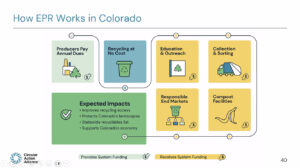
A graphic from Circular Action Alliance explains how the funding for Colorado’s statewide recycling program works.
Local governments that now charge homes and businesses for recycling services became eligible in June to participate by being reimbursed for the full cost to run their efforts, and Circular Action Alliance began the process of signing agreements and contracts. Residents of cities like Cortez, Grand Junction and Thornton now have access to this industry-funded curbside recycling, and refuse collectors and drop-off recycling centers in more rural areas also are being paid under the program, with more coming on each month.
“Colorado’s EPR program is moving from plans and agreements to real services and infrastructure for communities across the state,” Juri Freeman, Colorado executive director for CAA, said in a news release last week. “Every new agreement brings us closer to a more convenient and consistent recycling system for Coloradans, supported by the producers of packaging and paper products.”
Legal actions
But it’s also brought controversy.
First, there are questions about the implementation and constitutionality of the program, as evidenced by two lawsuits filed against CDPHE since March.
One came from the Independent Lubricant Manufacturers Association, which argued that the law forces its members — companies in the lubricant and metalworking fluids industry — to pay fees to private organizations that accountable neither to governments nor to the companies that are required to participate. This is particularly injurious because members are paying fees of 56 cents per gallon of packaged lubricants sold in the state, which is disproportionately burdensome to smaller companies that struggle to stay competitive while adding that cost to their products, CEO Holly Alfano said in an interview.
The other came from the New Civil Liberties Alliance and the National Association of Wholesaler-Distributors, which argued the law violates the 14th Amendment by delegating legislative power to a private party and forcing distributors who must join these PROs to give up their right to sue in order to do so. Particularly as other states like Oregon and California are implementing similar EPRs, packaging makers need to step in and stop this activity before a large number of states begin to require it, NCLA Senior Litigation Counsel Andrew Morris said in an interview.
“Members of our client are not fighting recycling. All of these companies have green programs, and they are attuned to packaging,” Morris said. “What they’re opposing is this brand new system being handed over to a private entity where members can’t challenge fees … There’s not a precedent for doing this in the recycling world.”

Andrew Morris is a senior litigation counsel for the New Civil Liberties Alliance.
Industry groups defend recycling program
While the cases are beginning their legal journeys in Colorado, a U.S. District Court judge in Oregon rejected similar claims from NAW in that state, ruling that the program does not deprive businesses of due process, according to an article last month in Plastics News. In that story, CDPHE officials said that decision should pave the way for the program to continue unabated here.
Meanwhile, at least one industry group — Interchange 360, which represents the larger automotive and petroleum companies that are part of the Lubricants Packaging Management Association — is very pleased with the way that the program is going so far. Shelly Fuller, director of operations, said her organization assembled a network of return-collection facilities, transportation partners and specialized processors that collected 778 pounds of used motor-oil containers and other lubricant packages this summer. Those are cleaned and turned into pellets that are made into five-gallon buckets for auto-body shops.
“People in general are not used to change. Our work has been more trying to bring awareness to them,” said Fuller, whose group operates the only individual program plan approved by Colorado for a specific industry — the plan that ILMA specifically opposes. “But people want to do the right thing … Now the goal is: Well, let’s get more and more sites so we can collect all of this.”
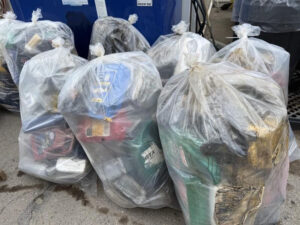
Bags of oil and gas lubricants are prepared for recycling as part of the individual program plan granted to Interchange 360.
But while some sectors are looking at how to expand their efforts, those sectors that practice advanced recycling or chemical recycling are just trying to get their work to count toward the recycling goals, which in turn affects the pricing of their packaging. And the debate over that issue has heated up in recent months, particularly at the Aug. 12 CDPHE Producer Responsibility Advisory Board Meeting.
What is chemical recycling?
Unlike the process of mechanical recycling — in which machines clean, break down and reshape materials from glass to cardboard — chemical recycling involves reducing plastic polymers to their chemical building blocks, often through extreme heat and pressure. A common method for this is pyrolysis, in which the broken-down goods are heated to very high temperatures in an oxygen-free reactor, producing an oil that can be used to make plastics again but also producing solid and hazardous waste.
At the August meeting, Eloissa Wells, ExxonMobil global director for energy products and circular solutions, noted this is the only way to recycle products such as certain plastic films, food packaging, artificial turf, ecommerce packaging and dry cleaner bags. A plant the company operates in Baytown, Texas had recycled more than 150 million pounds of plastic feedstock this way by mid-2026 — goods that otherwise would be buried in the ground with breaking down.
“One of the biggest advantages that advanced manufacturing has is the ability to process hard-to-recycle materials and broader ranges of materials,” Wells said. “Advanced recycling is part of the solution set. It complements mechanical recycling.”
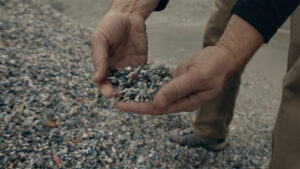
Plastics are prepared for recycling at an advanced recycling facility.
As of now, both chemical and mechanical recycling count toward the recyclability of products when determining fees under the state program, unless the recyclable materials are converted to fuel. But several members of the advisory board have suggested that policy should be reconsidered, and the board could recommend to CDPHE that chemical recycling not count toward those goals in the future.
“Lack of transparency”
Several environmental groups are backing this push.
Plastic-waste processing creates volatile organic chemicals, particulate matter and fire risks, and it generates on average 28 times the amount of hazardous waste as mechanical recycling facilities, said Veena Singla, a public-health scientist and researcher at the University of California-San Francisco. And because chemical recyclers create both new plastics and fuels in the process, it is impossible to tell what materials become reusable and which become liquids that are then burned and give off even more emissions, said Jessica Roff of the Global Alliance for Incinerator Alternatives.
“This is literally a system of not tracking or not knowing what is being allocated,” Roff told the advisory board in August. “This is one of those situations where the lack of transparency is a huge problem.”
In addition to the possibility that the advisory board could recommend removing chemical recycling from the determinations of packaging producers’ recyclability, the issue also could be settled legislatively. Several people watching the debate have hinted that a bill could be coming to Colorado in 2027 seeking to ban pyrolysis.
Debate could affect packaging costs, availability
Officials from the Consumer Brands Association told The Sum & Substance last year that if chemical recycling is essentially declared to not be recycling, that could jack the cost of the goods sold in plastic containers or could end the use of such containers, which could cost manufacturing jobs. Such a move would come at a time when the cost of living is paramount in national debates.
But opponents of the practice said that the accounting system of “mass balance with free allocation” employed by chemical recyclers leaves them unable to determine the exact inputs or outputs of the process and whether the outputs truly create recycled goods. As the statewide recycling system spreads to more areas, such policies must be nailed down, they say.
In the meantime, Colorado’s nascent curbside recycling system is growing — but not without a lot of questions.