
The statistics on Colorado crime can be unnerving. U.S. News & World Report ranked the state 49th for public safety, noting it had the seventh-highest violent-crime rate per capita and the second-highest property crime rate.
But for business owners, the topic has begun to take on economic importance. Retail theft cost the state $1.4 billion in 2025, according to an analysis by the Common Sense Institute. Some Denver retail business owners cite crime as an inhibiting factor to their operations.
That may explain why, in some legislative races, candidates are making public safety an issue — but giving it the unusual spin that it has become a business issue. Some criminal-justice-reform advocates also are turning the issue around and arguing that the more the state can do to give prisoners sustainable career pathways, the more they will contribute economically and become less likely to re-offend at a cost to businesses.
“Public safety has always been a business issue”
There are few empirical ways to determine whether the strategy is a taking hold with a voting populace that wants to take about Colorado’s affordability crisis but may not be connecting crime to an impact on their wallets. But with crime becoming a central talking point of at least one candidate in three separate competitive races, it’s a subject that may be spurring more interest, both among business leaders and general voters.

Nate Marsh is running to represent House District 43 in the Highlands Ranch area.
“I would say public safety has always been a business issue,” said Nate Marsh, a deputy district attorney seeking to oust a Democrat in a Highlands Ranch-area state House seat that is one of just two where Republicans are playing significant offense. “These costs of crime are going to crush innovation. They are going to crush efficiency.”
The logic, according to Marsh, who is running against Democratic Rep. Bob Marshall, goes like this: It costs even more for businesses to operate when they are suffering shoplifting, dealing with property vandalism or addressing other direct costs of malfeasance. In a normal atmosphere, that is bothersome to employers. But with Colorado having become one of the most expensive states in the country to live and do business, these extra financial burdens can mean the difference between staying in business and closing.
Shoplifting and auto theft
Marsh said he’s seen it in his area, even though Highlands Ranch has a significantly lower crime rate than the rest of Colorado. Businesses must eat their losses from theft or invest in security guards to prevent them. Potential entrepreneurs see this and decide either that they won’t open a business at all, lowering potential employment, or that they will open it at a higher cost, which likely gets passed along to customers and exacerbates the affordability crisis, he said.
One of the bills Marsh speaks frequently about running if he were to win is a proposal to repeal a law that gives judges the discretion to ticket and release people who are accused of stealing less than $50 worth of goods rather than holding them in jail. Those folks too often turn around and steal further, knowing their punishment will be slight, and it is businesses who end up suffering the most from it, Marsh said.
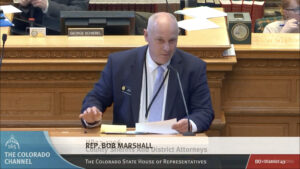
Colorado state Rep. Colorado state Rep. Bob Marshall speaks on the House floor in 2023.
Interestingly, Marshall, the incumbent, lists public safety just behind good governance as an issue on his campaign website, noting that he supports funding law enforcement and revoking recognizance bonds for auto-theft suspects. While Marshall doesn’t link crime directly to rising costs of doing business, it’s clear that both candidates are hitting on an issue that seems to be of major concern in the south suburban district.
Public safety an issue in higher-crime communities too
Another candidate who is making public safety a top issue is Jonathan Post, a retired police officer who is seeking a Democrat-held swing seat in the Pueblo area — a community with one of the highest per-capita crime rates in Colorado.
House Minority Leader Jarvis Caldwell, R-Monument, cited Post and Marsh as the best pickup hopes for Republicans in a year when they are facing significant headwinds, and he mentioned the public-safety issue as a big reason why, agreeing it has business impacts. (And unlike in the Marshall-Marsh race, Post’s opponent, Democratic Rep. Tisha Mauro, does not mention public safety on her campaign website.)

House candidate Jonathan Post speaks at a Colorado Chamber of Commerce gathering in July.
But for all the Republican talk that getting tougher on crime will help businesses — Post, for instance, wants to repeal a 2020 law that removed qualified immunity from local police officers — Democratic Rep. Jamie Jackson is arguing her criminal-justice-reform efforts are just as much of a pro-business stance.
Criminal justice reform as a business issue?
At an Aug. 18 candidate forum hosted by the Aurora Chamber of Commerce, Jackson introduced herself to the crowd by touting her efforts to prevent people from being or staying incarcerated rather than saying that criminal penalties must increase. Her reasoning: Even if the state can’t stop people from committing crimes and going to jail, it can use their time behind bars to get them into a career pathway and to have them ready to re-enter society as individuals ready to join the workforce and contribute economically.
After the comment period, Jackson expounded in an interview that this career-focused education must go hand-in-hand with rehabilitation services like behavioral healthcare and drug- and alcohol-addiction treatment to give individuals wrap-around care. She acknowledged that elements of crime such as retail theft are destructive to businesses, but by focusing on how to prevent people from entering a life of crime and giving them work skills, that can contribute to a stronger business atmosphere, she said.

Colorado state Rep. Jamie Jackson speaks at an Aurora Chamber of Commerce candidate forum in August. Behind her stands Aurora Chamber President/CEO Naomi Colwell
“It’s not just giving people a job. It also needs to be partnered with more health services and substance-abuse services,” said Jackson, who fended off a more moderate primary challenger in her Democrat-leaning district. “It’s really starting the process long before the person is released.”
Will voters see public safety as more of an economic issue this year and consider it when they are thinking about how to address affordability and job creation? It remains to be seen, but several legislative candidates clearly are pushing for that kind of change of mindset.