

The “S” word — supermajority — is omnipresent in insiders’ discussions of legislative elections this year. If Democrats pick up one more seat in both the House and the Senate, they can use their two-thirds majority in each chamber to override vetoes or send constitutional amendments to voters without a single Republican vote.
What this would mean isn’t fully clear. Most of the bills vetoed by term-limited Gov. Jared Polis over the past two years came after the session had finished already, offering no opportunity for majority Democrats to override him. And while supermajority status can create a pathway to the ballot for controversial initiatives, Rep. Andy Boesenecker, a leading candidate to be the next House speaker, said that legislating from the ballot is not a great idea.
So, when Democratic leaders talk about why they want a supermajority — and Republican officials speak of the importance of avoiding it — what most often comes up is the idea of what could happen if majority Democrats just have another vote or two in each chamber.
To wit, a bill that would have allowed state officials to regulate workplace safety for the first time, taking over what’s been the exclusive role of the federal Occupational Safety and Health Administration in Colorado, died in May by one vote in the Senate. One month earlier, an agricultural-business-backed bill to raise the threshold for overtime pay for farm workers passed the House by a single vote on its way to becoming law.
Would more legislative balance boost the business environment?
So, even if supermajority status doesn’t open the floodgates to a slew of veto overrides and amendments-to-be, it could tip the balance on bills that business leaders have fought for or fought against. And even as Democratic leaders say they will continue to use bills like this year’s regulatory-review law to establish a framework of how they address business concerns during a time of economic uncertainty, many observers worry that by handing either party a more dominant majority, they could be reducing their voice in negotiations.
“We need to restore balance in Colorado because we are out of balance and have been for the past couple of years,” Colorado House Minority Leader Jarvis Caldwell, R-Monument, said in an interview. “I say to voters, ‘Look, if you think the Legislature has been bad recently, just wait until they have a supermajority.”
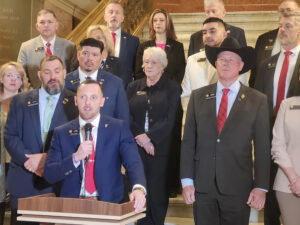
Colorado House Minority Leader Jarvis Caldwell offers remarks at a House Republicans’ news conference in January.
Democratic leaders, of course, dispute the characterization that the Legislature has been bad. Boesenecker, the Fort Collins Democrat who has served as speaker pro tempore of the House, said the party has a true north of trying to reduce the cost of living for Coloradans, even if the ways it wants to get to that goal are different from Republicans’ preferred pathways.
But what can’t be disputed is a national discourse that Colorado is slipping in its business-friendliness. CNBC dropped it from No. 11 to No. 25 in its Top States for Business rankings this year, citing costs and regulations as major factors. A Colorado Chamber of Commerce report noted 98 businesses relocated or expanded out of state between 2019 and 2025, costing the state 13,607 jobs.
And the legislative elections will determine which pathway the General Assembly, in conjunction with a newly elected governor, will take to try to fix that.
Key legislative races
Democrats hold a 43-22 advantage in the House and a 23-12 edge in the Senate. And leaders of both parties have identified a handful of races that will determine whether those margins shrink or grow wider in a year in which polling shows significant national headwinds for Republicans.
In the House, Democrats are looking to win back the three seats they lost in 2024 — the Greeley-area seat belonging to Rep. Ryan Gonzalez, the Erie-area seat held by Rep. Dan Woog and an open central Colorado Springs seat occupied by retiring Rep. Rebecca Keltie. They also believe they can win an open Loveland-area seat held by Rep. Ron Weinberg, who is stepping down, as that seat has been trending bluer in recent elections.
Republicans, in addition to defending those districts, are pushing to win two Democratic-held seats. One is the seat in the formerly rosy red Highlands Ranch area that’s been held for the past four years by Rep. Bob Marshall. The other is a Pueblo-area seat held by Rep. Tisha Mauro — a seat that Republicans have not won anytime in recent memory but that is trending toward them in national elections.

Lobbyists, including many that represent business organizations, gather outside the Colorado Senate chamber during the 2023 legislative session.
In the Senate, most observers acknowledge the makeup of the chamber will come down to the “Big Three” seats — two currently held by a Democrat and one held by a Republican. Democrats will have a supermajority if they can sweep:
- Senate District 3 in the Pueblo area, an open seat now held by retiring Democratic Sen. Nick Hinrichsen in a traditionally pro-union Democratic area that has pushed back against the party’s environmental-regulation stances and efforts to move to renewable energy;
- Senate District 15 in the Loveland area, where Democratic Sen. Janice Marchman upset GOP Sen. Rob Woodward four years ago and now faces him in a rematch that will pit their voting histories against each other; and,
- Senate District 30 in the Highlands Ranch area, where appointed Sen. John Carson attempts to hold a longtime Republican seat against Democratic challenger Kevin Leung in an area that is seeing the party preferences of its voters change.
How Dems, Republicans are speaking to voters
Senate President James Coleman, D-Denver, said voters in those three districts are talking about affordability and asking office-seekers what the Legislature can do about it. Democrats in return are explaining that the state needs to boost funding for education, healthcare and affordable housing — issues that are key also to several ballot measures on income-tax rates and on school funding.
“The biggest thing is that we have to have jobs that pay a livable wage,” said Coleman, the sponsor of a 2026 regulatory-review law, explaining the balance he seeks to strike between business concerns and the concerns of traditional Democrat supporters like unions. “How do we make sure that businesses run more efficiently … and also that labor flourishes?”

Colorado Senate President James Coleman offers opening-day remarks at the start of the 2026 legislative session.
Assistant Senate Minority Leader Lisa Frizell, R-Castle Rock, said the outcome of the three tightest Senate races could determine how far Senate Democrats will go in tilting that attempted balance toward labor or business.
A bill to upend the Labor Peace Act by eliminating the second election needed to allow unions to take negotiating fees out of all workers’ paychecks at a unionized company most certainly will return this year after two vetoes by Polis. But, she predicted, so will the bill that would allow the state to pass and enforce workplace-safety laws if such laws are rolled by back by OSHA, and even one more Democratic senator could tilt the vote and get that bill passed.
Legislative committee makeups also at issue
“That’s why keeping out of the superminority is so important for Republicans in the Senate: We need to be the adults in the room,” Frizell said in discussing how Democrats have run the House, Senate and governor’s mansion since the 2018 election. “It is about balance, but it is also about cost of living for all of us. And that is a message that all of our candidates are really concentrated on, whether it is in the House or the Senate: Are you better off than you were eight years ago?”
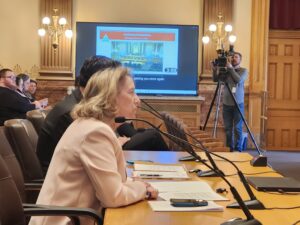
Colorado state Sen. Lisa Frizell fields questions about Senate Bill 11 from the Senate Judiciary Committee on Feb. 11.
Looking beyond specific legislation that could return, Caldwell noted that a supermajority could widen the margins on legislative committees, which reflect the overall makeup of their chambers. For example, House committees that now favor Democrats by a margin of 7-4 or 9-4 could become 8-3 or 10-3 — requiring Republicans hoping to stop legislation to flip one more Democrat, which is not an easy task.
And as much as Democrats aren’t campaigning on the idea of pushing constitutional amendments onto the ballot without GOP help, Caldwell envisions a very prominent issue on which that could be done. Were Amendment 87, which seeks to replace Colorado’s universal 4.4% income-tax rate with a graduated system where higher-earning businesses and individuals pay higher rates, to fail in November, Democrats could tweak the proposal and send it back to the ballot without having to collect statewide signatures, he said.
Boesenecker said that while Democrats will continue to seek regulations in areas where they perceive the public health or safety to be at risk, he doesn’t see ascension to a supermajority leading to any radical bills passing. Democrats are looking to do what they hear voters asking for — boost affordable housing, stabilize Medicaid and put guardrails on data-center development, for example — but expect to continue the open dialogue that he and other leaders have sought to create with businesses about concerns, he said.
Speaker candidate says worries are overblown
“If you look back at Senate Bill 137, it is a great example of ways we can work together … and we will continue to make that commitment,” he said of the regulatory-review law that Coleman teamed with Senate Minority Leader Cleave Simpson, R-Alamosa, to pass. “It is always going to be a balance that we will appropriately regulate the state but not be an undue burden on business.”
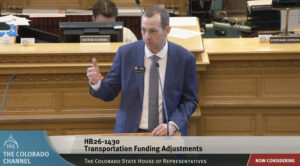
Colorado state Rep. Andy Boesenecker discusses HB 1430, his bill pertaining to transportation funding, on the House floor in May.
While candidates running for key legislative seats may be talking about kitchen-table issues with potential constituents, it’s clear that the issues of supermajorities and the type of legislation that may come from them are permeating their thinking as well.
Nate Marsh, a prosecutor and first-time candidate running against Marshall for the toss-up House seat in Highlands Ranch, said he fears ideas like tax-break rollbacks — including several that Polis killed by threatening a veto earlier year — could rise again with wider margins and with a new governor like Democratic nominee Phil Weiser. And he is talking about that to voters as an example of why they need to even out the numbers in the House — even though Marshall was the only House Democrat who voted against those rollbacks.
New candidates discuss issue of legislative makeup
“We’ve seen a big, huge leftward swing not only in the Legislature but in primary results,” Marsh said, noting that progressive challengers ousted two moderate House Democrats in June and won matchups with more moderate party members for nominations in several open seats. “This big leftward swing is not going to be good for business.”
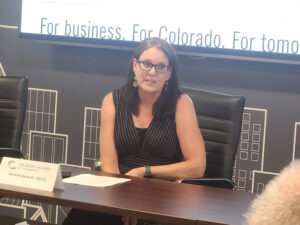
Colorado House candidate Danielle Varda speaks to a Colorado Chamber of Commerce gathering in July.
Danielle Varda, a Democratic business owner who is seeking an open, Democrat-held seat in the Arvada area, acknowledged that she wants her party to think more about the impacts on small business when they consider regulations. And she is working on strategies for how she plans to make that happen, she said.
But she also rejects the conclusion that the House and Senate will be significantly more progressive or anti-business after the Nov. 3 election, saying that the likely new members whom she’s spoken to are eschewing labels and wanting instead to find solutions. And with many voters telling her and other candidates how much harder it seems to be to find a job right now, she believes that the impact of regulation on job creation will be a bigger topic than it’s been in the past.
“Systemic change takes time. But I think people are willing to reconsider how we are regulated in Colorado,” Varda said. “I do think there’s a conversation right now about what this means for us as an economy. And people are worried about losing a job.”