
When the Colorado Public Utilities Commission passed its Clean Heat Plan last year, critics called it a de facto future ban on gas-line hookups for new homes. Supporters pushed back, saying that it required only emissions reductions for utilities around residential and commercial heating without mandating how that is to be done.
Those initial debates on the plan’s impact led directly to Amendment 82, which will go before voters on the November ballot. The initiative, written by the conservative Advance Colorado Institute, would give consumers a constitutional right to buy natural gas for cooking and heating in homes and businesses and give distributors and utilities a right to sell natural gas to customers.
Kristi Burton Brown, executive vice president for Advance Colorado, said her organization felt such a step is necessary because natural gas, long viewed as a cleaner but still inexpensive alternative to coal, is under attack by state policy makers. And with 75% of Colorado residents living in homes heated by natural gas and 65% of them cooking with it, something needs to be done to protect that practical source of heat, she said.
“The state shouldn’t be able to come in and take control of your ability to have a reliable source of energy,” Burton Brown said in an interview. “Natural gas has moved us away from coal.”
How far-reaching would the amendment’s impacts be?
But while the amendment may be worded simply, critics — particularly the coalition of conservation organizations, civic groups and health officials that make up No Pollution in the Constitution — say its vague language will open the state to all kinds of legal fights. This new right could block environmental regulations meant to reduce emissions, and it could force utility ratepayers to foot the bill for new housing or office developments to which customers say they want natural-gas line to run, opponents say.
“Amendment 82 would be the first measure of its kind in the nation; no other state constitution grants a right to buy and sell a specific fossil-fuel product,” a group of 52 Democratic legislators and 17 candidates wrote last month in an open letter to Coloradans. “Because it is a constitutional amendment rather than a statute, this could create tremendous legislative and legal chaos as legislators and stakeholders are left to reckon with the outcomes.”
While focused on natural gas, this proposal is not being run by the industry; in fact, Colorado’s oil and gas organizations and major companies have declined to weigh in on it. Two years ago, many agreed to a deal with Gov. Jared Polis and environmental groups to drop competing ballot issues and put a three-year pause on what had been an annual back-and-forth over proposed new rules seeking major changes to industry regulations.

Kristi Burton Brown discusses the income-tax ballot measures on the “Colorado Chamber Office Hours” podcast.
Burton Brown wears it a point of pride that Amendment 82 instead is an effort for businesses and homeowners who want their choice of heating fuel rather than a measure for industry.
“We think sometimes big interests should get out of the way on both sides,” she said.
What natural-gas initiative will and could do
From a business perspective, Amendment 82 will ensure that homebuilders or commercial-building owners have a choice in whether they want to use electricity or heat pumps for their property or whether they want reliable natural gas, she said. While the initiative doesn’t allow the state or local governments to ban natural gas as a heating option, it also does not force anyone to use it, she said.
But what it could do, critics warn, is force utility and policy choices out of fear that they could be violating a constitutional right if they don’t take certain steps.
For example, business and homeowners who get no benefit from extended natural-gas lines may still have to help pay for them if other property owners call upon utilities to fulfill their right to run such lines to their buildings, the legislators’ letter warns. The cost of extending such lines is factored into bottom-line rates — a concern that was aired three years ago when legislators held special hearings on utility pricing.
Environmental advocates push back
Beyond that, cementing a right to an energy source that is pollution-emitting into the constitution means that regulators and state officials will have to take new steps in crafting environmental regulations that don’t encroach on it, opponents have said. That also gives an unfair advantage to producers of natural gas over other energy sources and discourages cleaner alternatives, legislators wrote.
That could open the door to lawsuits challenging setback requirements between natural-gas wells and homes and schools, and it could threaten plans that seek a reduction of emissions from buildings, which often are achieved by limiting natural gas. It even could imperil natural-gas pipeline safety and inspection rules if they are viewed as encroaching on this right, critics have said.
“The Colorado Constitution is eight times longer than the U.S. Constitution, and we don’t need to clutter it up more with a constitutional amendment that permanently protects a single industry at the expense of the average citizen of Colorado, said K.K. DuVivier, a professor of natural resources law at the University of Denver, at a recent rally against Amendment 82.
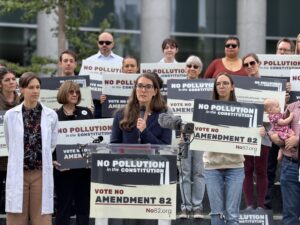
Kasey Butcher Santana of Arvada speaks at a Sept. 23 news conference outside the Colorado Supreme Court held by opponents of Amendment 82.
Regulation of natural gas a local issue too
Burton Brown decries such arguments that the amendment would halt wide-ranging regulatory efforts, saying there is clear precedence that governments can regulate protected rights as long as they don’t take away those rights. So, bans on using natural-gas or de-facto bans that force elimination of the energy source to meet certain emissions goals would be banned if Amendment 82 passes, but big-picture pollution-reduction imperatives certainly would not, she said.
In recent weeks, local-government organizations, including the Colorado Municipal League and the group Counties & Commissioners Acting Together, also have come out against Amendment 82, calling it a usurpation of local control. Local governments can enforce energy-efficient building codes, for example, and putting limits onto how they regulate natural gas in those instances expands the constitution beyond its proper scope, they wrote in an Oct. 1 news release.
Amendment 82 is one of a record 14 ballot initiatives that Colorado voters will consider this fall, including efforts to lock the state’s 4.4% income-tax rate into place, to scrap that single rate for a graduated income-tax system and to exempt K-12 funding from the state’s Taxpayer’s Bill of Rights revenue cap. Residents also will choose new office-holders to fill all four of the state’s constitutional offices, including governor, and will determine whether Democrats can win a supermajority of seats in the state House and Senate.