
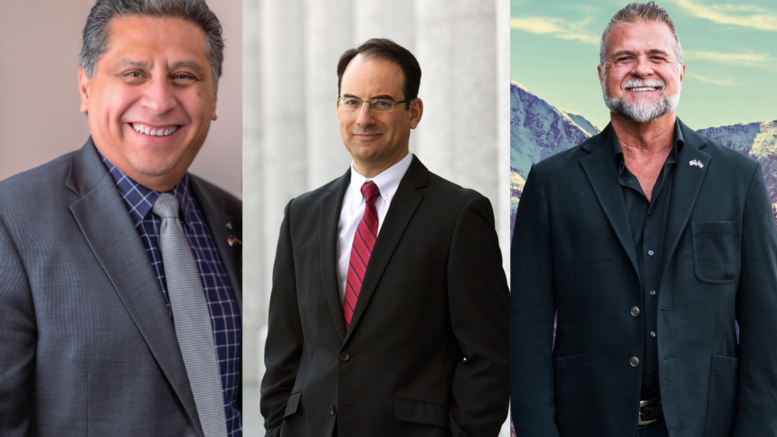
Colorado has become too expensive to live in, too costly to do business in and is overregulated, according to multiple surveys of both businesses and residents. And yes, the state’s three main gubernatorial candidates, say, they hear those messages and agree.
But how exactly Democrat Phil Weiser, Republican Victor Marx and independent candidate Greg Lopez plan to tackle those issues — as well as healthcare affordability, an eroding roadway system and the existential questions around technology regulation — differs. And whether Colorado can make substantial progress toward recovering its once nation-leading reputation for business-friendliness depends on whether their ideas are the right ones.
The Sum & Substance interviewed each of the candidates on one or multiple occasions to try to discern their specific plans in each of these key areas and to contrast them where they differ. What follows is a list of primary concerns from the Colorado business community and how the three men seeking to be governor seek to address them.
Regulations and economic competitiveness
Once ranked in the top three in CNBC’s Top States for Business, Colorado fell to No. 25 this year. U.S. News & World Report dropped it to No. 17. A Colorado Chamber of Commerce report identified 98 businesses that chose to relocate or expand elsewhere between 2019 and 2025, costing the state 13,607 jobs.
The three candidates all agree that the primary culprits are regulations and costs — each acknowledged Colorado being the sixth-most-regulated state in the country — and say they are willing to re-examine state policies in order to make them less burdensome to business and allow jobs to grow more. The differences between them lie in which questions they say they plan to ask to examine which rules need to be rolled back.
Marx, a ministry organization leader and first-time candidate, said his questions all revolve around the impact of regulations on cost — the cost to small business, to housing, to energy, to jobs and to consumers in general. Though he didn’t identify specific regulations he wants to change during Thursday’s Colorado Chamber gubernatorial forum, he promised to “make every major regulation get a trial” and to stop increasing regulations of frequently on businesses.
Weiser, who has served as Colorado’s attorney general since 2019, said his big-picture goals including speeding up permitting across sectors and avoiding or ending unnecessary, overly prescriptive rules. He plans to perform cost-benefit analyses on both existing and proposed rules and to ask whether affected parties have all weighed in on regulations, how other states regulate such areas effectively and how rules can be targeted just to solve existing problems.
Lopez, a former Republican U.S. representative from the 4th Congressional District and one-time state director for the U.S. Small Business Administration, said more broadly on the “Colorado Chamber Office Hours” podcast that he would target overregulation. Improving the business atmosphere, however, is not just about writing rules well but about bringing in good corporate partners to help grow the small business community, he said.
Economic development incentives
Colorado currently relies heavily on the Job Growth Incentive Tax Credit, which provides a 50% reduction of chosen employers’ FICA tax payments on each worker that they hire and keep for at least a year, provided they create at least 20 new jobs.
All three candidates suggested in interviews for the podcast that they would keep that incentive in place. Marx added that he would ensure that incentives are not just going to companies that are politically favored.
Lopez also said he would interview companies that have left the state recently and try to discern which state policies pushed them the most to do this. He added that he would not seek to recruit just large companies, which he believes oftentimes are shopping for tax deals, but would interview companies to ensure they want to help Colorado grow.
“We need to make sure that when we’re talking with them, they truly care about the state of Colorado and they truly care about the people who are working for them and living here, because that’s what Colorado is all about,” he said.
Weiser, founder of the Blackstone Entrepreneurs Network in Colorado, said he also would build a business navigator tool to convey easily to startups and small companies all the assets that the state can offer in helping them to grow. The state needs to lean into helping those firms more, he added.
Cost of living
Each of the candidates has plans to get new, more affordable housing built, and each of them offers that they will work in partnership with local governments to do so, as local governments hold most of the power over permitting speed and costs. Term-limited Gov. Jared Polis has tried to push for more requirements from local governments — including denser zoning near mass-transit lines and allowance for accessible dwelling units to be built in urban areas — but has run into pushback from some local governments.
Marx said he will offer infrastructure money to local governments that speed up permitting, though he didn’t say where the money would come from at a time when the state faces another billion-dollar shortfall. He also said he would look to cut regulations that have made residential construction more expensive, which seems a reference to green-building standards the state instituted last year.
Weiser said he would use the bully pulpit of the governor’s office to both encourage and nudge local governments to speed up permitting and to reduce the cost of residential permitting. He also will look to boost modular housing, which can be built 20% more cheaply and 30% more quickly without sacrificing aesthetic or safety appeal, by making it more acceptable in codes.
Lopez pointed to a term he served as mayor of Parker and said he will be able to build better relationships with local governments to allow construction of the 1,100-square-foot starter homes that are becoming rarer in Colorado.
Healthcare Affordability
When asked about how to make healthcare more affordable in a state that routinely ranks in the lowest quartile for that statistic, the men offered broader and differing suggestions.
Marx said he will do more audits of Medicaid and other state-funded programs and move money away from administration and to providers, which he believes will bring down costs. He also said he would seek to boost price transparency further — an area that Polis also has sought to attack.
Weiser said his top concern will keeping rural hospitals open even as federal Medicaid payments are reduced and that he will focus on increasing access to primary care, so people can treat conditions before they become too acute and expensive. He also said more regulation is needed for pharmacy benefit managers that work with drug manufacturers and pharmacies to impact pricing of drugs, as he believes there are “shenanigans” that the next governor can stop.
Lopez said he would like to study why costs continue to go up and then determine where the state can step in to lower prices.
Energy regulations and affordability
The three candidates all vowed to balance energy affordability with the state’s ambitious emissions-reduction regulations, but their answers showed different levels of prioritization when it comes to the environment and to electricity bills.
Marx said during the Chamber forum that he will ask first about whether environmental regulations make energy more reliable, then about whether they make it more affordable, then about whether they have environmental benefits. He wants to promote more of an all-of-the-above portfolio that includes natural gas and oil, as well as nuclear energy and renewables, and he will stop shutting down coal plants and other energy facilities before their replacements are fully online.
“I believe that clean, reliable and affordable energy, they’re not enemies,” he said. “But for years the state has treated reliable and affordable as kind of an afterthought.”
Weiser said that Colorado needs to continue to protect its clean air, water and public lands and emphasized that there must be oversight and enforcement of environmental rules in order to ensure those protections. But he also said he would like energy and environmental interests to sit down more often together to craft rules in ways that will clean the state while also offering affordability, and he will push for rules that allow more locally generated solar power and local power storage to reduce reliance on utilities, he said.
Lopez said he will work with legislators and local communities if he sees bills that are introduced that could be harmful to residents’ affordability.
Data centers
The use of natural resources in the building of data centers — which largely have been smaller facilities going up so far in Colorado, as the state doesn’t offer the tax incentives for construction that other states do — is a significant part of the discussion of that topic. And while Weiser and Marx both said they will considerations of environmental impact, economics and electricity costs in considering the issue, they proposed different tacts to it.
Weiser said any bill regulating data centers should mandate that they protect energy reliability and should ensure that local residents do not have to bear the burden of infrastructure-upgrade costs for the local grid. But he said he’d like to push for the construction of data centers in areas like northwest Colorado where coal plants are closing and taking jobs with them, believing they can provide employment and can use alternative sources like geothermal energy for some of their power.
“We need to make sure communities aren’t having data centers shoved down their throats,” Weiser said at the Colorado Chamber gubernatorial forum. “We need to protect all of us from our electricity rates going up to pay for data centers.”
Marx also said he would expect big energy users to fund the infrastructure upgrades needed to support data centers, and he acknowledged that the cities and counties passing their own policies on the facilities should continue to have local control. But he also said he also said he doesn’t want Colorado to fall behind on the advancement of technology and added that the centers must be seen as an economic boost as well when they are being considered.
Technology regulations
Similarly, while Marx and Weiser both expressed more interest in regulating disruptive technology — such as social media and pricing based on surveillance data — than Polis has, they offered different levels of enthusiasm for doing so.
Marx said he will look for bills aimed at protecting children and stopping fraud but also said the state cannot overregulate the sector as it attempted to do in a landmark 2024 artificial-intelligence rules bill that was replaced in 2026 by a measure with fewer requirements. He would ask whether a technology has demonstrated harm that needs to be reined in, whether the government can effectively fix it and whether it can fix it without crushing innovation, he said.
“My philosophy is innovation with guardrails,” he said at the Colorado Chamber gubernatorial forum. “Regulate a harmful product, but not an entire technology.”
Weiser said he believes more regulation is needed in several areas where Polis pushed back on proposals. He’s like to bring back a vetoed 2025 bill that would require social-media platforms to take down content promoting illegal activity like drug sales and human trafficking, and he also would like to toughen a law that passed this year that limits how chatbots can interact with children.
“We have a youth mental health crisis,” Weiser said. “It’s been driven by social media.”
Transportation funding
One area on which all three of the candidates agreed was the need to refocus state resources on roadway expansion and maintenance, which many critics felt took a backburner under Polis to transit solutions and vehicle electrification. Once again, though, the way in which they would do that differs.
Weiser, who helped to negotiate a deal in which backers of a constitutional amendment pulled an initiative from this year’s ballot that would have redirected about $700 million in existing tax revenues to highways annually, said he will first work as governor to find extra money in the budget to put to pavement improvement and expansion. Then he’d work with advocates to put a measure onto the 2027 seeking a new source of funding for roads that can provide a dedicated stream of revenue, he said.
Marx told the podcast that he’d like to focus on getting more money to roads as well, though he said he believes he can find that money within the existing state budget. He hopes to do thorough audits of the budget if elected to discover areas of overspending and corruption, he said.
Lopez said he would like for the state to acquire the E-470 toll road running around the eastern Denver area, remove its tolls and ensure that it can serve as an alternate travel path to get cars off of over-congested Interstate 25. He formerly sat on the board that oversees that public highway.