
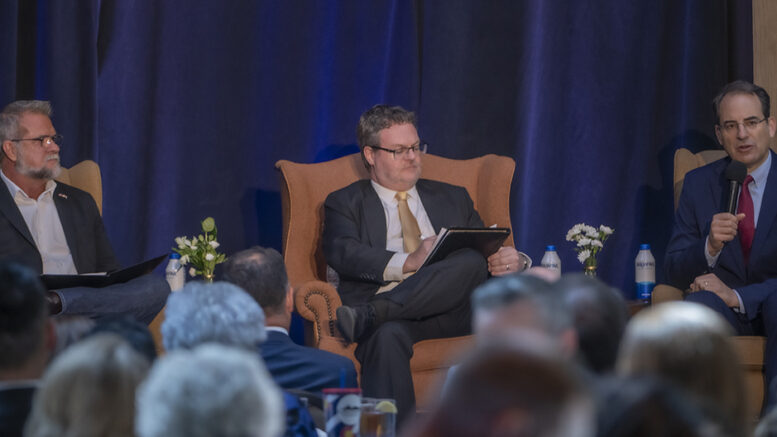
Colorado gubernatorial candidates Victor Marx and Phil Weiser staked out very different positions at a forum Thursday on environmental regulations, the future of the Colorado Labor Peace Act and the need to increase revenues for state services.
The two men spoke at the Colorado Chamber of Commerce’s annual meeting, detailing policy proposals on critical issues that so far largely have taken a back seat to other topics in the race to succeed term-limited Gov. Jared Polis. (Full disclosure for readers: I moderated the forum, which you can watch in full in this video, and wrote many of the questions.)
The Republican Marx, a ministry leader, and the Democratic Weiser, who is Colorado’s attorney general, agreed on some things. Both vowed, for example, to work with local governments to speed up permitting to boost the stock of affordable housing, and both expressed more willingness than Polis to regulate emerging technologies and social media to protect state residents.
However, they also diverged on numerous issues that are likely to be flashpoints in the upcoming legislative session. And in answers that often featured both reciting lists of questions they will ask in order to arrive at exact policies regarding areas like regulatory reform or data centers, they also demonstrated divergent ways that they will think about the issues.
Disagreement on the Colorado Labor Peace Act
Maybe no subject brought such different answers as the expected return of a bill that would eliminate the required second vote for union security under the Colorado Labor Peace Act — an effort Polis vetoed twice because business and labor could not find consensus. The effort passed two straight years on partisan votes and helped to lead to a rift between Polis and his own party.
Marx stated he would veto any effort to make it easier for unions for take negotiating dues directly from workers’ paychecks as opposed to the current requirement of a second vote that must receive 75% approval in order to enact what is known as union security. He equated the effort to rewrite Colorado’s unique organizing to the rising support of socialism, and he said there are other ways to help workers.
Weiser, meanwhile, said that he will sign such a bill, though he didn’t specify exactly what he wants to see in the bill. He broadly promised to work with both employers and unions to try to achieve some sort of consensus, despite that goal having eluded Polis.
“The Labor Peace Act is antiquated, and we can do better,” the attorney general said.

Democratic gubernatorial nominee Phil Weiser answers a question at Thursday’s Colorado Chamber of Commerce forum.
Protections versus affordability in gubernatorial candidates’ energy policy
On the broader question of how to balance environmental protections with energy affordability and reliability, the two men diverged on which side of that debate they thought should take priority in determining regulations.
Weiser said that the state must lead the way in protecting its natural resources, and it could do that and ensure affordability simultaneously with targeted regulations that seek to reduce the most damaging sources of emissions. It is key, though, that such regulations have oversight, and he will seek to enforce laws, despite concerns from some business leaders that such enforcement can be burdensome, he said.
Marx said the way to ensure energy affordability at a time when the cost of living is becoming harder for many people is to allow and encourage uses of more types of energy sources, including continued use of natural gas and exploration of small nuclear reactors. In considering what regulations to enforce and which to roll back, affordability will be a top consideration, he added.
“For years, the state has treated affordability and reliability as some kind of afterthought,” Marx said.
A revenue problem or a spending problem?
Similarly, Weiser and Marx offered different views on the now commonly asked question of whether Colorado’s consecutive years of billion-dollar budget shortfalls are the result of overspending or a lack of revenues due to Taxpayer’s Bill of Rights constraints. That same debate is central to the discussion around a pair of income-tax initiatives on the November ballot — one of which would cap state income-tax rates at their current 4.4% level and the other of which would create a graduated income-tax system in which businesses and residents that earn more money pay higher rates, up to 8.4%.
Marx doubled down on his contention that the state government is littered with overspending and corruption, pointing to reports of significant overspending by several Medicaid programs, and he said he would audit much of state government if elected. He said he would target administrative growth, duplicative technology systems and out-of-state consultants for cuts — without estimating how much money that would save — while trying to preserve at-risk funding like reimbursements for providers of special-needs Medicaid services.
Republican gubernatorial nominee Victor Marx speaks at Thursday’s Colorado Chamber of Commerce forum.
Weiser said he too would cut overspending in areas that audits have shown questionable spending, but he said the state’s problem is that it doesn’t have enough resources to provide for major services, particularly in K-12 education. In that way, he said, he would continue to look for ways to bring in revenue until safety-net and essential services are funded at appropriate levels.
Affordable housing discussed at gubernatorial forum
The two men also laid out unique approaches to a shared goal — trying to boost the amount of affordable housing in a state that is ranked in the five most expensive places to live in America.
Weiser said he will use the bully pulpit of the governorship to build partnerships with local governments to speed permitting and lower permitting fees, and he also will push for broader statewide adoption of modular housing that can be built more quickly and cheaply without being aesthetically or operationally problematic. He, like Marx, also said he’d look to offer more career-and-technical-education opportunities to get students and job-switching adults into construction, which now faces a 30,000-worker shortfall in Colorado.
Marx said he would look to speed permitting by putting a deadline on state permitting reviews, though the state oversees little residential-construction permitting. However, he said that he would try to speed reviews on the local level by rewarding cities and counties meeting review timelines with infrastructure money, and he added that he would look for ways to reduce state environmental and other regulations that drive up the cost of residential construction.
Both candidates were provided the questions before the forum so that they could offer concise responses — requested at two minutes oir less — for the 10 different topics that were addressed during the conversation. Check back to The Sum & Substance in the coming days for stories that include more business issues in the governor’s race.