
For most of this year, business leaders expected an election debate over whether the state should put more money to highway expansion. Instead, the only transportation question they’ll consider is whether to fund inner-city passenger rail as one solution to congestion.
Ballot Issue 7A, which will be decided by voters in 31 Front Range cities and one special district, seeks to levy a 0.33-cent sales tax increase in those areas to fund the full buildout of the Front Range Passenger Rail and let the district take on as much as $580 million in bonded debt. If approved by voters, the train will make 10 trips per day by 2032 to 15 newly constructed stations between Fort Collins and Pueblo.
The idea, a longtime vision of Gov. Jared Polis’, is that the train could pull people off overcrowded Interstate 25 and allow individuals who may live in Colorado Springs, Boulder or Fort Collins to travel to Denver for work and play — or vice versa. District leaders expect the train to carry roughly 3,500 one-way trips each day at full service and to generate new economic activity.
But critics question whether the price for the new passenger-rail system — the tax is expected to raise $295 million annually to help fund what’s estimated as a $4.7 billion buildout cost — can be justified given what they call its minimal transportation impacts. Even if ridership reaches hoped-for levels and every rider represents someone now piloting a single-occupancy vehicle, the 3,500 trips is a small fraction of the 200,000 cars per day now on I-25, which will do nothing to alleviate congestion, said Randal O’Toole, director of the Independence Institute’s transportation center.
“It’s up to voters at this point as to whether it’s a good investment of tax dollars to move forward,” said John Putnam, chairman of the Front Range Passenger Rail District board, when announcing the plan to seek a tax increase for funding on Aug. 28.
Debate shifts from highways to rail
Business leaders, many of whom have expressed concerns about how Colorado’s congested and potholed highways slow worker commutes and speed of product delivery, had expected to be voting on a different question in the Nov. 3 election. Initiative 175, sponsored by a Colorado Contractors Association-led coalition, sought to require all sales-tax revenues from vehicle sales and two-thirds of such revenue from auto-parts sales be dedicated to roadway maintenance and construction, moving $700 million annually from other uses for that purpose.
But legislative leaders pushed back that such transfers would cut funding now available for healthcare and other priority programs and passed a bill late in the 2026 session that would have cut current transportation funding by $700 million annually to offset the new money had Initiative 175 passed. And after monthslong negotiations, Initiative 175 proponents cut a deal with those same legislative leaders and Attorney General Phil Weiser to pull the ballot measure in exchange for a combination of legislative and ballot action next year.
So, with the Front Range Passenger Rail question being the last remaining transportation issue on the ballot, business leaders are left asking two primary questions about it. Will this new offering do anything to improve the flow of traffic along Colorado’s primary north-south roadway corridor? And will the increase in sales tax that will be borne by Colorado businesses have commensurate benefits for them?
Regardless of the outcome of the vote, the train is slated to begin running in 2029, though on a more limited 69-mile basis between Denver and Fort Collins at three trips per day. Startup funding comes from the Regional Transportation District that has never gotten around to building commuter rail to Boulder and Longmont that was promised, from two state transportation enterprises and from revenues from a new fee on oil and gas production levied as part of the 2024 “grand deal.”
How the new rail system would operate
The additional funding, if approved, would extend the new system to 190 miles in length, running south through Littleton and Sterling Ranch to Colorado Springs and Pueblo. District leaders estimate that 85% of the passengers will use it for discretionary travel like trips to concerts, sporting events and day visits, with the other 15% of passengers relying on the train to get to work or school.
Former House Minority Leader Mark Waller listens as Front Range Passenger Rail District General Manager Sal Pace speaks to the Colorado Chamber of Commerce board of directors on Sept. 3.
The trains should make the trip between Colorado Springs and Denver in 79 minutes, with the district agreeing to not exceed 108 minutes in advertised time, district general manager Sal Pace told the Colorado Chamber of Commerce board of directors. Though fare is yet to be set to ride in the transportation with WiFi, reclining chairs and beverage carts, leaders are modeling rider costs of about 19 cents per mile, similar to the Colorado Department of Transportation’s Bustang service, he said.
One-sixth of the initial funding will build out stations and add last-mile connections from the surrounding neighborhoods to those stations, Pace said. Many of those will be located near high-traffic areas like the new Denver Summit soccer club stadium that will feature a pedestrian bridge and the U.S. Olympic & Paralympic Museum in Colorado Springs.
With studies showing that the average Denver-area commuter loses 76 hours per year in congestion, Pace said he believes passenger rail will appeal to people who prefer to read or relax in peace on long trips rather than pump their brakes in snarled traffic. And it’s not just traditional supporters of multimodal options backing the effort; former Republican House Minority Leader Mark Waller of El Paso County told the Chamber board that he came to endorse the effort after completion of the widening of I-25 in his area.
“We have to have alternative transportation solutions, because you’ll never build yourself out of congestion with highways,” Waller said.
Will passengers actually ride the rail?
But you’ll also never cut into congestion with an alternative that appeals to so few people, O’Toole countered. The inner-city travel represented by the Front Range Passenger Rail is slow and runs for a limited number of times per day, plus it goes to a small number of places, limiting its utility for workers outside of downtown areas who don’t go where the train stops.
Pace pointed to the expectation-exceeding success of similar inner-city trains in other states, including along the Gulf Coast in the Washington/Oregon region, and noted that inner-city rail ridership is up 29% nationally. But O’Toole pointed to struggles to attract passengers on more regional trains, noting ridership of the Rio Metro trains in New Mexico is at about 19% capacity, while ridership of Utah’s FrontRunner train is at about 31%.
Trains seem to carry a magical property as a fun form of transportation in the minds of many people, but if they are not running frequently to places where many people want to go, they are often more than half empty despite high operational costs, O’Toole said. He referenced an article in the satirical publication The Onion entitled “Report: 98 Percent of U.S. Commuters Favor Public Transportation for Others.”
“I think what happens is somebody’s stuck in traffic and they look around them and say, ‘Oh, look, there’s a rail line over there. If we only had a train, I would have an uncongested road because everybody else would be riding the train,’” O’Toole said.

Randal O’Toole is director of the Independence Institute’s transportation center.
A “very tangible” plan
The voters who will determine if Front Range Passenger Rail gets the money to expand from its original operations are those in cities where at least 20% of the population lives within five miles of a planned station — big cities like Denver and Colorado Springs as well as smaller municipalities like Bow Mar and Glendale. Residents of the Sterling Ranch Metropolitan District also are impacted.
Polis said on the Crux Politica podcast on Sept. 16 that the proposed funding system is very fair, offering people who live nearest the stations and are most likely to take advantage of the train the opportunity to decide whether to pay for it. He said he preferred an idea like this as opposed to Amendment 87, an initiative to institute a graduated income-tax system that he opposes.
“Yeah, you’ll be paying … a few cents more. And what you’ll get out of it is very tangible,” the Democratic governor said. “You say, ‘This is what you’re going to pay, this is what you’re going to get.”
Where rail stations will be
O’Toole said his bigger issue is with the idea of the train itself as a congestion fix than with the funding mechanism. RTD’s FasTracks project took 8,000 cars a day off Denver-area roads between 2008 and 2019, when ridership was at its highest, but there remain 12 million vehicle trips a day in the region, he said.
“When you’re talking about spending $4.7 billion on one train, somebody’s going to be making a lot of money,” he said, pointing to companies that manufacture and service rail equipment. “Everybody else is going to get screwed.”
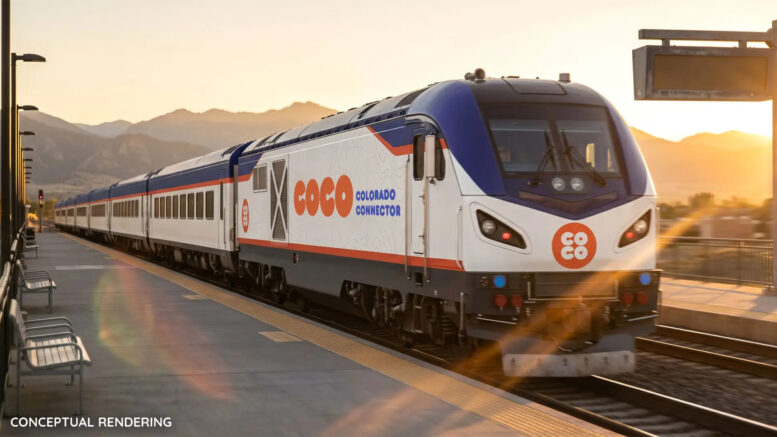
The train will be called the Colorado Connector, or “CoCo” for short.
The 12 stations planned for daily service are in Fort Collins, Loveland, Longmont, Boulder, Louisville, Broomfield, Westminster, Denver, Littleton, Sterling Ranch, Colorado Springs and Pueblo. Another station is in development in northern. Colorado Springs, while special-event service is planned for Summit and Denver Broncos games. Meanwhile, Trinidad is schedule to get new station infrastructure on the Amtrak Southwest Chief, with a direct connection to CoCo beyond 2045.