
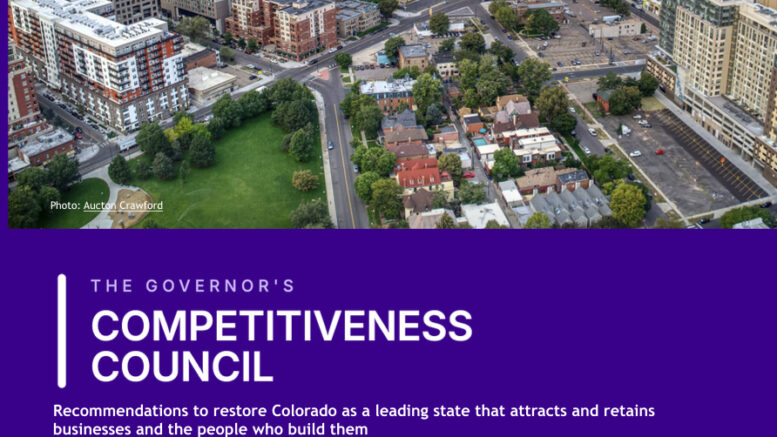
A public-private partnership created by Gov. Jared Polis recommended a six-point plan to boost the state’s lagging economic competitiveness Wednesday, calling for more predictable rules, faster permitting and investments in workforce and housing.
The Democratic governor called together the Competitiveness Council — 27 hand-picked business and public-sector leaders — in July as the state was reeling under criticism of its business atmosphere having dropped from nation-leading to middling status. Over the past three months, the group held public meetings across the state and studied an economic analysis done by the University of Colorado Boulder to identify both strengths and the biggest obstacles that have emerged to continued growth.
The policies it recommended reflect a smattering of new ideas and an urgent plea to continue or expand certain programs launched by Polis, who is term-limited and will give way to a new governor in early January. And it builds on recommendations that are being developed and recommended concurrently by groups such as the Transition Advisory Commission on workforce issues and an Environmental & Sustainability Working Group led by state-agency heads and Colorado Chamber of Commerce appointees.
Polis said in a statement that he will study the recommendations and see how the state can use the proposed roadmap “to support homegrown businesses, attract new companies to Colorado and make our economy stronger.”
“We can win it back”
Council members, meanwhile, said they tried to lay out ways in which businesses and economic-development groups can work in partnership with the state to ensure that it regains its attractiveness to employers and produces workers who can thrive in this economy.
“Colorado has lost momentum as a hub for innovation and opportunity,” said Dan Caruso, managing director of tech-investment firm Caruso Ventures, in a news release. “Working together, we can win it back and make Colorado the place where the next generation chooses to chase their dreams and build their lives.”
The first set of recommendations from the council made it clear that Colorado must start its efforts through regulatory reform, and it acknowledged the law passed this year requiring state agencies to do more comprehensive and frequent reviews of rules. But the group urged further action including establishment of a concierge system to coordinate the most complex permitting needs and adoption by state agencies of timely permitting reviews and clear requirements as to what constitutes a completed application.
In the area of tax and fiscal policy, it proposed some broad short-term goals, including a recommendation to “pursue tax policy that supports competitiveness with other states” and to continue simplifying the state’s sales- and use-tax system. But it also suggested implementation of a cumulative-effect system by which state officials would examine not just the individual impacts of newly proposed fiscal policies but the layered effect these policies would have on existing laws — much like regulators now must consider the cumulative effects of multiple pollutants on communities.
Housing, infrastructure key to economic competitiveness
The committee emphasized the importance of increasing construction of affordable housing, saying that could be done by establishing an incentive-laden local housing-permitting framework built around established review timelines. It also suggested that the Legislature must strengthen Colorado’s existing laws meant to limit construction-defects lawsuits, and it said state officials should review the slew of tenant protections signed by Polis in recent years to determine whether they are producing the intended effects or making housing significantly more expensive.
Recommendations on boosting workforce talent drew heavily on ongoing efforts. They included implementation of the work of the TAC, which is tasked with combining state higher-education and workforce-development programs in one department. They also included implementation of ideas suggested in last year’s business-led Opportunity Now Regional Talent Summits, including expansion of a pilot program to get more technology and cybersecurity students to begin the process of getting security clearance.
Some of the boldest suggestions for new ideas, meanwhile, surrounded the idea that the state should do more for workplace-site readiness by acting more proactively to develop transmission lines, substations and large-load grid capacity. Such capacity is often associated with data centers — facilities so controversial that many communities have taken to putting moratoria on them — but also is necessary as more homes and vehicles electrify and the state seeks to onshore advanced-manufacturing plants.
What happens next with competitiveness report
Council members said the state needs to create a single coordinated review pathway for these major investments, offer incentives for them and require that they prove a demonstrated statewide benefit. Establishment of a “Statewide-Importance Zone” designation could prioritize the infrastructure investments that many larger employers seek when deciding whether they will expand or relocate to an area.
Polis, of course, won’t have time to implement or even begin the recommendations, making the 44-page report largely a letter to his successor, expected to be either Democratic Attorney General Phil Weiser or Republican ministry leader Victor Marx.
But with leaders of organizations ranging from The Colorado Chamber to Office of Economic Development and International Trade and from the University of Colorado to companies like CoorsTek serving on the council, it offers a thoroughly researched effort by a wide-ranging group. And participants said they hope that state government leaders can move forward quickly with some of the suggestions before Colorado dips even more in the competition to attract and retain good-paying jobs.
“The report gives Colorado a practical path to strengthen business competitiveness through more predictable rules, faster permitting and investments in workforce and housing,” said Chris Romer, president/CEO of the Vail Valley Partnership. “Business competitiveness matters because successful businesses support good jobs, essential public services, and community vitality.”