
An Amendment 87 opponent sued Thursday to stop the initiative’s new income-tax brackets from taking effect, arguing that authors violated the Taxpayer’s Bill of Rights by bundling a constitutional amendment and statutory changes in the same ballot question.
Advance Colorado, which authored the unsuccessful Proposition 136 countermeasure, also claimed in a lawsuit filed in Denver County District Court that Amendment 87 backers included false information about what the measure would cost voters. Specifically, via a methodological error, it underestimated what voters would owe — a miscalculation that meant some businesses and individuals making more than $500,000 who were told they’d see tax cuts from the measure instead will face average $2,651 tax-bill increases.
The lawsuit comes as more national analysts are weighing in on the impact of Amendment 87’s graduated income-tax system on Colorado’s economic competitiveness. The Tax Foundation, for example, dropped Colorado’s tax competitiveness ranking from 33rd to 44th after a reassessment that followed the passage of Amendment 87.
“Colorado employers are already struggling with rising costs, and these tax increases will make it even harder for businesses to grow, hire and invest in our state,” said Loren Furman, president/CEO of the Colorado Chamber of Commerce. “We cannot afford to give employers more reasons to move jobs elsewhere or choose another state for their next expansion.”
What Amendment 87 will do
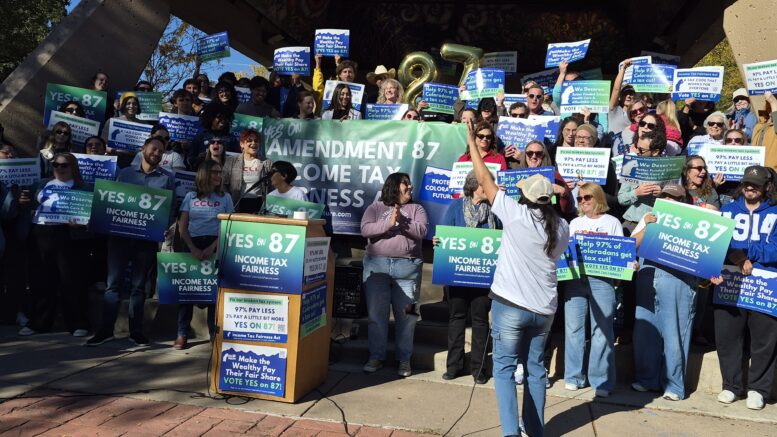
A spokesperson for Protect Colorado’s Future, the coalition of education and progressive fiscal groups that powered Amendment 87 to passage with 51.7% of the vote in this month’s election, did not respond immediately to questions about the new lawsuit. But the group successfully fought a lawsuit that tried to get the initiative tossed from the ballot because some signature gatherers were not registered with the Colorado Secretary of State, saying moneyed interests were desperate to block the impacts of the proposal.
Amendment 87 would, if implemented, repeal the flat 4.4% income-tax rate that all businesses and residents pay and replace it with a system under which those that generate more revenue pay those taxes at higher rates. While rates would drop to 3.7% for earnings under $25,000 and 4.2% for earnings between $25,000 and $100,000, they would rise to 7.4% for earnings over $500,000, 7.9% for earnings over $750,000 and 8.4% for earnings over $1 million. Earnings between $100,000 and $500,000 still would be taxed at 4.4%.
Proponents touted that 97% of Colorado residents and 95% of state businesses would get tax breaks from the measure, leaving only high earners to pay the estimated $2 billion more in income-tax revenues that the state expects to collect annually from it. That money is required to go to health care, K-12 education and childcare, though Gov. Jared Polis warned last week that mushrooming Medicaid expenses could force all the new revenues to fund that program unless legislators slow its rising costs.
Why opponents claim Amendment 87 is unconstitutional
However, the lawsuit, filed by attorney Suzanne Taheri of West Group Law, argued that proponents, in estimating costs and benefits of the new tax rates, applied the graduated rates to income that already had been apportioned to Colorado, reversing the order of operations that Colorado law requires. That error distorted nine of the 12 income-tax brackets that laid out financial impacts of Amendment 87 in the Blue Book, misstating the fiscal impact of the measure by as much as $1.2 billion, the lawsuit alleges.
Plus, by asking in one question for voters to OK a constitutional change (striking multiple requirements in TABOR, including a mandate for a flat tax rate) and statutory changes (increases to individual and corporate income tax rates), the question is unconstitutional. The lawsuit thus asks the court to declare that Amendment 87 violates TABOR and enjoin the Colorado Department of Revenue from collecting increased taxes, which were supposed to take effect on Jan. 1, under the measure.

Sen. Barbara Kirkmeyer explains her property-tax-break bill to the Senate during the 2024 special legislative session.
“It’s clear that Amendment 87 should have been filed as two measures, not a single one,” Kirkmeyer said in a news release announcing the lawsuit. “The constitution wasn’t followed, and voters will pay the price if this measure isn’t overturned.”
Advance Colorado President Michael Fields also announced in the news release that the campaign filed several measures for the 2028 statewide ballot Thursday intended to counteract Amendment 87. Among them is a proposal to reduce the income-tax rate for any earnings of $100,000 or less to 0% — a change he said would pave the way for “more success for struggling and family-owned businesses.”
Another drop in business rankings for Colorado
Backers of Amendment 87 said it’s needed to make wealthier businesses and individuals pay a “fair share” for public services and to boost underfunded schools, cost-limited public-health benefits and a childcare system that is both expensive and hard to access. Colorado Polling Institute data showed its passage was driven by voters under the age of 45 who are struggling to afford daily life in Colorado and who have a growing skepticism of capitalism in general.
Business leaders warned that raising income-tax rates on employers in a state that’s already one of the most expensive to live in and one of the most regulated would remove one of the few competitive advantages Colorado has left in battles for job expansions. And the new, seventh-worst-in-America ranking it received for its tax competitiveness Thursday from the Washington D.C.-based Tax Foundation seemed to confirm that thinking.
The tax-policy research think tank had issued a new ranking just before the election placing Colorado in a more middling 33rd place, though even that designation represented a drop from the No. 21 spot in 2022. The new ranking, produced after national media organization Axios asked the organization to reassess the states in light of results in the Nov. 3 election, considers that Colorado already ranks in the top third of states for its high property, sales and unemployment-insurance tax rates, which include local-government rates.
Amendment 87 could impact state budget
Business and state-government leaders offered very different reactions to the passage of the measure over the past week.
Democrats on the Joint Budget Committee, which began convening on Nov. 12 to put together the state’s financial plan for the fiscal year that begins on July 1, expressed relief that the new revenues wiped out an expected $1.6 billion budget shortfall for next year. The new money could ease up on the $660 million in Medicaid spending rollbacks suggested by Polis, and it could aid revenue-short enterprises like the Health Insurance Affordability Enterprise that subsidizes private health-insurance costs, members suggested.
Business groups, however, warned that they are already hearing of plans by member companies to pause growth and even consider relocating expansions or entire workforces to other states. Michael Smith, Colorado director for the National Federation of Independent Business, said that members are facing options such as raising prices of goods, stopping hiring or cutting jobs.