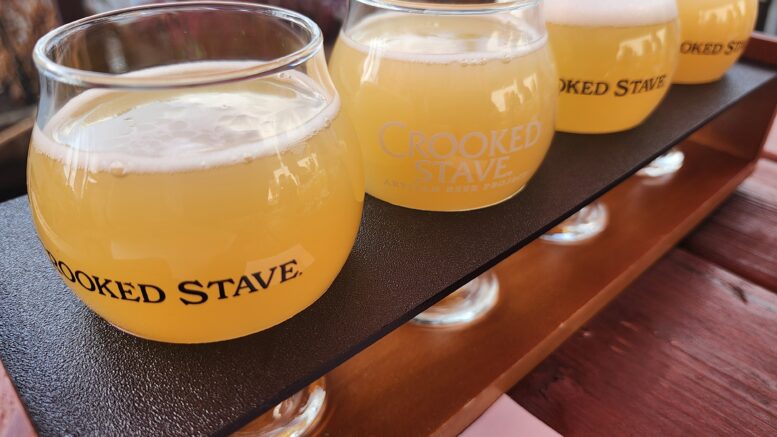
Alcohol is big business in Colorado. Centennial State breweries are responsible for more than 61,000 jobs. Western Slope wineries help to drive tourism to the region. The beer, wine and spirits industries generate $23.9 billion annually in economic activity.
But while these sectors provide a definable boost to the economy, health professionals say they have a less quantifiable but equally important impact on public health — namely, that they foster alcohol disorders that wrack individuals and require medical intervention. And two bills that are set to get their first hearings in the Colorado Legislature this week seek to raise fees or taxes on alcohol sales to help fund the treatment whose cost burden sponsors believe this industry should help to shoulder.
The bills come at a pivotal time for both the industry and the state. Reduced rates of alcohol consumption are reducing revenues and jobs in the sector; 102 breweries have closed just within the past two years in Colorado. But the state faces an $850 million budget shortfall that is causing it to pull back funding from healthcare services, leading advocates to look for new funding streams to stabilize or grow existing programs.
House Bill 1271, set to get its first hearing in the House Health and Human Services Committee on Tuesday, would create new fees on beer, wine and spirits sales that would fund three new enterprises to mitigate alcohol-related harms via prevention and treatment. HB 1301, which goes before the same committee one day later, would ask statewide voters in November to approve new taxes on the same sectors — and on retail marijuana — to fund a new mental-health hospital in Aurora.
A combined $79M in annual revenue
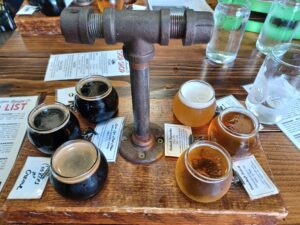
A sampler tray at Parts and Labor Brewing in Sterling.
Sponsors of both bills say the impact on prevention and treatment would be significant. HB 1271 would raise $35.5 million in its first full year, according to a fiscal note from the nonpartisan Legislative Council. Though HB 1301 doesn’t have a fiscal note yet, sponsoring Rep. Bob Marshall, D-Highlands Ranch, told the Capital Development Committee on Thursday that he expects it could raise $44 million a year.
But that impact would be equally significant on alcohol makers of all sizes, as neither bill features an exemption for smaller producers, as some past efforts have. The fees required by HB 1271 represent an average 60% boost over what brewers, vintners and distillers now pay in state excise taxes, according to the Colorado Beverage Coalition. If you add in the additional taxes that HB 1301 would require, the combined bill would be a 154% increase just for breweries.
While the two bills are separate efforts — HB 1271 cosponsoring Rep. Jamie Jackson, D-Aurora, said she hopes each will be considered on its own merits — they each bring up two questions that legislators must consider. How much should legal and already regulated industries that are linked to specific medical conditions be required to contribute to the funding of treatment for those conditions? And how must legislators attempt to balance any financial responsibility they assign to those industries with the tax revenue that such sectors already bring in to fund everything from public health services to public safety?
Dispute over whether alcohol makers now pay enough

Colorado state Rep. Jamie Jackson, D-Aurora
“Taxpayers right now are literally paying the cost for alcohol disorders,” Jackson said in an interview, pointing to not just the state’s bills for treating individuals but to greater societal costs from crime to broken families requiring safety-net services. “I really believe that this can help shoulder the costs and also help people lead productive lives when we’re in a time where we’re cutting programs and services.”
Shawnee Adelson, executive director of the Colorado Brewers Guild notes that her industry already pays $56 million a year in state excise taxes that legislators could direct specifically to prevention and treatment programs but largely choose not to do so. Alcohol producers already reaching the limits of price elasticity will have to pass at least some costs along to customers as a lack of affordability is hitting everyone, likely resulting in sales reductions that lead to spending and hiring cutbacks that ground the economy further.
“The community staples that these breweries have become are being overshadowed by these societal conditions,” said Carlin Walsh, co-owner of Elevation Beer Co. in Poncha Springs, which hosts community gatherings and is one of the largest employers in his town. “We have put the state on the map when it has come to the national beer scene. And I feel as a brewer as though we as an industry who have contributed to this state are being looked at as a gift horse.”
HB 1271 seeks to assess a 5-cent-per-gallon fee on beer and hard cider sales, a 7-cent-per-liter fee to wine and a 35-cent-per-liter fee to spirits. The new taxes proposed by HB 1301 would be even steeper — 7.3 cents per gallon on beer and cider, 8 cents a liter on wine and 60.26 cents per liter on spirits.
Bills could more than double current fees and taxes
Currently, brewers pay a state excise tax of 8 cents per gallon, wineries 7.3 cents per liter and distillers 60.26 cents per liter. Thus, in addition to the 154% increase on state taxes and fees that brewers would pay if the two bills passed and voters approved the tax hike, vintners would pay 205% more in the same way and distilleries 158% more.
HB 1271 would put the money to three new enterprises — one representing each of the alcohol sectors — that combined would fund public awareness and alcohol-disorder prevention campaigns, drunk-driving deterrence programs and prevention, early-intervention and community-outreach programs. This last category could include high-intensity treatment programs like detox and around-the-clock care, Jackson noted.
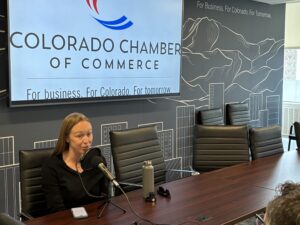
Shawnee Adelson, executive director of the Colorado Brewers Guild, speaks on the “Colorado Chamber Office Hours” podcast.
HB 1301 would fund creation and staffing of a 50- to 70-bed mental-health institute on the Anschutz Medical Campus in Aurora that would supplement the state’s two overcrowded mental-health facilities, Marshall told the Capital Development Committee. Not only would it add significantly to the state’s existing 400 mental-health beds — a total that is way down from the roughly 2,000 that Colorado offered in the 1960s — but it will offer a facility in the Denver area that reduces transportation times to the major facility in Pueblo.
Experts: Too few people get treatment for alcohol disorder
Currently, less than 2% of people suffering from alcohol-use disorder get medication for this highly treatable affliction and less than 15% get any treatment whatsoever, said Dr. Hannan Braun, an addiction-medicine doctor at Denver Health. The funding from HB 1271 would provide resources to get a lot more individuals into varying levels of treatment and could make a “very meaningful” impact through its prevention and community outreach at a time when some data shows the disorder as being more prevalent over the past two decades, he said.

Colorado state Sen. Judy Amabile answers questions from host Ed Sealover on the “Colorado Chamber Office Hours” podcast.
Meanwhile, people can wait for months to get into the state’s two existing mental-health hospitals, which sometimes must release people alleged to have committed criminal behavior because there is no room to hold them, said Sen. Judy Amabile, D-Boulder. Amabile, the only legislator who is a primary sponsor of both bills, said the state needs to find funding for treatment and care despite its budget woes, and in lieu of legislators prioritizing that purpose for existing funds, it must look for alternatives.
“The need to me is just so incredibly dire,” Amabile said on the “Colorado Chamber Office Hours” podcast. “It’s a five-alarm fire for people who have serious mental illness. And we need to do something.”
Are alcohol tax levels too low?
Proponents of both bills point to Colorado’s existing excise tax levels being among the lowest in the nation and say this makes this increase in fees and taxes on the industry something that producers can handle more easily.
According to the Tax Foundation, Colorado ranks 40th among states for its level of taxes on wine, 46th for beer taxes and 47th for spirits taxes.
“Historically in Colorado, alcohol has very low tax, both excise tax and sales tax in relation to other states,” Amabile said, estimating the cost will equate to about a nickel a six-pack or $1 per bottle of liquor. “And so, it’s an opportunity to raise some revenue without actually doing harm to consumers.”
Industry: Tax Levels don’t tell the whole story
Adelson and other alcohol-industry leaders say that math misses several important points, however.
First, producers have dealt over the past half-decade with significantly increasing input costs on everything from equipment to agricultural goods to labor, compounded first by major supply-chain backups and now by rising tariffs. But with consumers showing an unwillingness to pay the same percentage more for beer, wine and spirits as manufacturers have had to pay to make them, costs are up and prices are down, which partly explains the number of closings, Adelson said.

A server pours a glass of wine.
Also, while state excise taxes on their own may be considered low, alcohol production is a capital-intensive industry that requires pricey equipment in a state with significant business personal property taxes. Throw in the higher costs specifically of wine production in a high-altitude, smaller market, and the cost increases could begin to push Colorado toward the higher end of the overall tax burden for that sector, said Cassidee Shull, executive director of the Colorado Association for Viticulture & Enology.
And because of the three-tiered alcohol system that requires a separation of manufacturers, distributors and retailers, an estimated five-cent bump in a six-pack from one of these bills is not nearly so simple, Adelson said. Beer makers will hike prices to their distributors, who in turn will hike them further to retailers, who in turn will hike them again for consumers. The cumulative effect is likely to be closer to a $1 increase in the price of a six-pack, which is likely to reduce consumer demand further, she said.
Big ramifications on small alcohol producers
Walsh estimated that HB 1271 alone will increase his state fees and taxes, which currently come to about $32,000 annually, by $12,000 a year, costs that he will have to eat at least partially because he won’t be able to fully pass them along. The more that breweries must do this, the more they are likely to cut back on jobs to trim their budgets, he said.
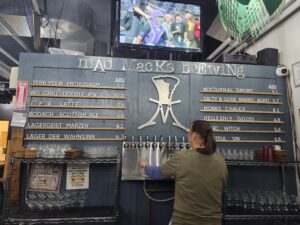
A server pours a beer at Mad Macks Brewing in Golden.
Shull said she expects the cost hikes to have ripple effects, particularly in her sector, where they will curb what vintners can pay to farmers and how much they can help to draw in visitors to places like Mesa County and boost the tourism sector. And while she understands that the state is dealing with a budget shortfall, she thinks that turning to local industries to solve it will result in a lot more harm than budget-balancing.
“The scale of revenue generated from alcohol tax increases is relatively small compared to overall budget needs, while the potential economic impact on small producers, rural employment and tourism could be significant,” she told The Sum & Substance. “From an industry perspective, policies should be data-driven and balanced in a way that avoids unintended consequences such as reduced investment, business closures or long-term revenue loss tied to contraction of the sector.”
One committee blanches at new tax already
It’s unknown how legislators will react to the two proposals, though the first attempt at pitching HB 1301 did not go well.
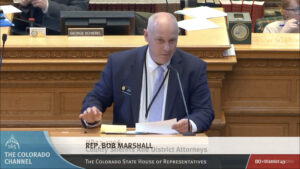
Colorado state Rep. Bob Marshall speaks on the House floor in 2023.
Marshall presented the bill to the Capital Development Committee, which is responsible for recommending state construction projects, and it voted unanimously not to recommend passage to the HHS committee, which will control the fate of the bill. Rep. Tammy Story, D-Evergreen, said she believes alcohol is more a symptom than the cause of mental-health problems and shouldn’t be tied to solving them, and Sen. Kyle Mullica, D-Thornton, said he didn’t want to ask voters to create a revenue stream to fund one project.
HHS Committee members will consider both bills from a broader perspective this week, and it’s possible they may have a different attitude toward raising fees and taxes on producers. But at a time when both substance-abuse-treatment officials and sector leaders are looking for ways to bring in more revenue, it’s likely that one side will not find what they need in the outcome of the discussions.