
Colorado legislators have spent the past four sessions working to boost childcare access and affordability, but even after those efforts, surveys show that most parents still believe the service costs too much — if they can even find a provider.
This session, childcare advocates have introduced a quartet of new bills aiming not only to help providers keep prices down but streamline regulations to make it easier for Coloradans to open and maintain childcare centers. Still, even as these bills are generating bipartisan support, some industry leaders are starting to ask if the best solution would just be for the state government to minimize its role in childcare — or else risk the collapse of the private childcare sector.
Colorado, by all accounts, continues to face a shortage of as many as 70,000 childcare slots as measured against the current need, noted Nicole Riehl, president/CEO of Executives Partnering to Invest in Children, a business-backed organization. A study from ReadyNation assessed the shortage’s economic impact at $3.3 billion annually, a number that takes into account those parents who can’t return to work because of a lack of care, parents who miss substantial time at work and employers getting lower productivity for these reasons.

Nicole Riehl is president and CEO of childcare-focused business group EPIC.
Universal preschool program impacting private childcare
But a February report from the Early Childhood Education Association of Colorado found the biggest problem is declining enrollment that’s left the average childcare center less than three-quarters full and has left centers serving school-aged children at 55% capacity. This, explained executive director Dawn Alexander, is the result of the opening of a slew of new preschool facilities that double as childcare centers at schools, which has left independent centers that compete against these government-run institutions struggling to find enough children to stay afloat, especially at a time of rising regulation.
Between January 2024 and January 2026, 104 childcare centers closed throughout Colorado while 76% of newly licensed facilities are operated by school districts, Alexander noted. While there remain childcare deserts in which both public and private options are hard to find, the shift has made it hard for independent businesses to flourish, which in turn has made it particularly hard for parents of newborns and toddlers to find care and return to the workforce, as most school centers focus on serving three- and four-year-olds.
So, while industry leaders support the legislative efforts this year, they disagree on whether they are enough to spur action where the need is greatest — in childcare centers serving new parents that offer hours that can flex to meet their work schedules. The tax credits and regulatory reform the quartet of 2026 bills offer are valuable, all agreed, but if they can’t reset the unbalanced competitive playing field that now tilts toward school-based centers, even more slots will close.

A child plays at a preschool in Colorado.
“Our industry is at a complete crossroads,” Alexander said in an interview. “Either you believe that the government is going to come rescue everyone or you believe that the free market needs to be left alone.”
Several years of legislative childcare efforts
The state government has taken on an increasing role in childcare funding over the past decade, believing, as many advocates do, that provision of such care is an economic necessity if employers are to have enough workers to expand and succeed in Colorado. Since 2022, it’s created grant programs to help entrepreneurs open childcare centers, launched tax credits for commercial property owners who offer space to such centers and laid out best practices for builders and local governments to incorporate these centers.
The state government also launched a universal pre-kindergarten program designed to provide free schooling for three- and four-year-olds for a certain number of hours, and the federal government boosted funding for provision of childcare to low-income parents. But federal funding came with so many strings — including a requirement that recipient parents pay no more than 7% of income for childcare — that it hiked the price tag of what state and local governments must pay, and most counties now have frozen funding for the program and left parents either to pull kids out or use only school-based facilities, Alexander said.
Those two factors have drained so many kids from independent providers — providers more likely to operate throughout the summer and to have longer hours to accommodate parents — that 25% of respondents to an ECEA Colorado survey said they either are struggling to stay afloat (17%) or are at risk of closure this year (8%). The largest numbers of respondent providers say they’ve had to increase tuition and/or decrease hours of operations to deal with declining revenues, and another 45% said they are managing to get by but are uncertain about the future.
Potential of uneven regulatory playing field

The Colorado Capitol in August 2024
A big problem, Alexander said, is that these independent providers, ranging from large centers to smaller home-based facilities, must compete for three- and four-year-olds against schools that receive public funding and don’t have to pay property taxes. Those older children typically have balanced out the financial losses many centers incur for watching newborns and toddlers, as care of younger children is more highly regulated, requiring facilities to have greater staffing but without raising costs to the point where parents can’t afford to pay them.
A bill that is circulating in draft form proposes to end oversight of school-based centers by the Colorado Department of Early Childhood Education — a change that would give another significant advantage to public centers over private centers because it would reduce regulations on just the public sector, Alexander said. If that were to pass, it may be worth asking if the state wants to just take over childcare duties — and whether any effort would be made to fund care for children under age three, she said.
“Why have a childcare industry at all at that point?” she asked.
Still, childcare advocates are working with legislators this session on several proposals that they believe will boost funding and make it easier to operate a childcare center.
Childcare tax credit extension
House Bill 1004, which passed its first committee unanimously on Feb. 5, would extend an important tax credit for people who contribute money to childcare centers by another 10 years. Senate Bill 20, which is set for its first hearing next week, would ease several regulations on childcare-center operators and set up a task force to recommend changes to boost the sector. Two other proposals — SB 19 and SB 50 — would streamline local organizations that seek to help childcare providers and would provide parents information on how centers that offer live streaming of their children store and use that footage.
HB 1004 is arguably the most impactful of the proposals, as the income-tax credit that is worth 50% of charitable contributions to childcare centers up to $100,000 is now responsible for raising $60 million annually for some 6,000 organizations. By comparison, the state provides about half of that total — about $32 million — in grants to help pay for care for children of lower-income families.
Supporters of the tax credit regaled the House Finance Committee with details about what it’s meant for them. Parent Possible Executive Director Brad Conley said the money raised from donations allows his organization to provide below-market-rate occupational and speech therapy and offer a summer camp for kids with special needs. Big Brothers/Big Sisters of Colorado CEO Elycia Cook said that pitching the credit at a fundraiser helped her organization raise a record $540,000 to serve needy families.
“We absolutely couldn’t do it without the childcare tax credit,” added Stephen LeFaiver, executive director of Teens Inc. in Nederland, who said the proceeds are used to reduce fees and raise wages for his staff. “Without it, we will have to substantially raise our fees and reduce the amount of subsidized care we can afford.”
Regulatory reform in sector
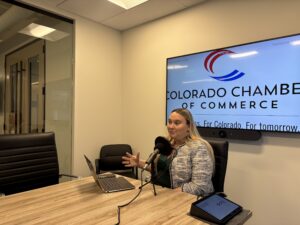
Nicole Riehl, president/CEO of EPIC, discusses childcare on the “Colorado Chamber Office Hours” podcast.
SB 20 — which, like HB 1004, has bipartisan sponsorship — would address several pinch points with which childcare operators have struggled. Chief among them: It would phase out third-party facility inspectors and standardize protocol for investigations, and it would allow centers to operate for as long as nine months under a state permit if they are in a zoning dispute with a local government that has held up opening.
But it also would create a childcare licensure and quality task force to recommend ways to streamline the state’s childcare licensure system and make it easier to use, with findings due by the start of 2027. Riehl said the bill would help existing centers to stay in business and new centers to come online. Alexander said it would allow participants to look at the interactions between the private-sector facilities and the state’s universal preschool program and figure out how the two could work better together.
“These are largely small businesses that are running childcare facilities … and we want to make sure that the regulations are not too overly burdensome,” Riehl said recently on the “Colorado Chamber Office Hours” podcast. “We are taking advantage of technology and streamlining processes where we can, understanding this is usually one business owner who is wearing the typical 20 hats, trying to do all the things at once. And we don’t want it to be so cumbersome or so burdensome for them that they either leave the industry, or they don’t even start a business to begin with.”
Newly opened center offers perspective

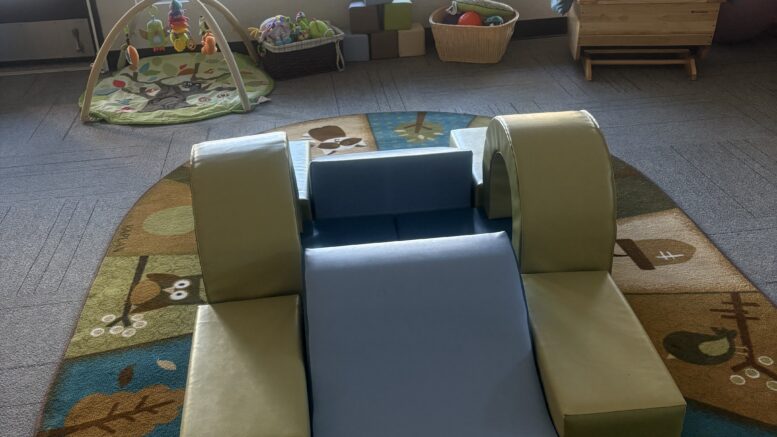
The toddler room in the Gilpin Mountain Kids Early Learning Center
Late last year, Amy Carr opened the Gilpin Mountain Kids Early Learning Center — the only facility serving children from ages two months to six years that is located between Nederland and Idaho Springs. She’s worked closely with local officials and appreciates their cooperation, she said.
However, she was surprised by the amount of regulation that was required to open a childcare center in a facility that housed a separate childcare center just three years ago. She had to get numerous waivers regarding the number of sinks in her facility and the access to an outside door, and she noted that officials only considered and approved such waivers on a monthly basis.
Carr said she hopes that legislators can see the need for streamlining the regulations around the industry so that other entrepreneurs like her can open centers in other counties that now lack them — a key to serving working families across the state. And she hopes to take advantage of the tax credit if it is extended.
“I do think it’s difficult to get funding right now,” Carr said. “I think if folks knew this tax credit was something they could take on their taxes, then it would be an easier sell.”