Colorado legislators spent much of the recently adjourned special session reducing tax breaks for businesses. Now, as part of two bills they passed, they also will turn around and offer new tax credits — including some going first to sectors that just lost tax deductions.
As part of its effort to close a $783 million shortfall, the Legislature approved House Bill 1004, which will allow the sale of as much as $125 million in tax credits to insurers and to C corporations. The idea is that companies with tax liability will purchase the credits now at a discounted rate as low as 80 cents on the dollar and then use them in future tax years to offset their bills to the state.
The program, which also was used to help the state fund grants for small-business recovery in 2020, drew such admiration from Democrats that they decided to duplicate it to raise money for the Health Insurance Affordability Enterprise as well. Through HB 1006, all proceeds from a separate $125 million sale of tax credits will go to fund the enterprise that runs the reinsurance program and offers insurance subsidies — a solution that avoids the enterprise having to consider raising fees or dipping into the holdings of the Unclaimed Property Trust Fund to get the money.
In offering the two sales, each of which are expected to generate as much as $100 million for the state by offering companies $125 million in future tax breaks, legislators settled on a simple proposition. They’re willing to give up future revenues in years where they expect more tax money from other sources in order to plug a hole right now that otherwise could be filled only with spending cuts, revenue increases or a dip into the state’s reserve fund.
Reasoning for the sale of tax credits
To the Democrats who sponsored the bills, the effort reflects creativity in budgeting, particularly when the state is constrained from raising taxes and many fees without a vote of the people because of the Taxpayer’s Bill of Rights. The money is desperately needed now, particularly because the loss of federal funding to the HIAE and subsequent reduction in insurance subsidies was expected to push 100,000 Coloradans to drop private insurance — a number that HB 1006 could cut by some 20,000.
“This is what it looks like to roll up our sleeves and actually govern,” said Rep. Rebekah Stewart, the Lakewood Democrat who cosponsored HB 1004 with Denver Democratic Rep. Sean Camacho.
However, to Republicans, who voted almost unanimously against the two bills, the efforts felt a lot like kicking down the road a funding problem rather than digging in and eliminating more spending right now. They also found it ironic that after Democrats approved tax-break rollbacks that will cost companies $316 million over a full fiscal year, they now will ask some of those same companies to help out the state by buying these new tax credits.
“We’ve spent 10 hours vilifying large corporations and insurance companies, and now we’re crawling them and asking them to bail us out,” observed Rep. Chris Richardson, R-Elizabeth, during House debate Friday on HB 1006.
Insurers lose, gain tax credits in same session
Indeed, HB 1004 is tied directly to one of the four bills that rolled back tax breaks.
HB 1003, which Gov. Jared Polis is expected to sign, would eliminate the 66-year-old regional- and home-office tax reduction which cuts premium taxes from 2% to 1% for insurers that have at least 2.5% of their national workforce in Colorado. While bill sponsors called the tax break a failure, noting that 83% of recipients reduced their in-state employment between 2022 and 2024, insurers warned the increased costs they will face without it could lead to higher premiums for customers.

Colorado state Rep. Sean Camacho speaks about House Bill 1004 on the House floor.
Camacho told The Sum & Substance before the start of the session that he’d linked his sale of tax credits to insurers to the possibility that they could be losing a different tax break, but he made that connection even more explicit during the special session. During House debate, he added an amendment to the bill giving first preference on the sale of tax credits to any insurers who lost their regional- and home-office tax reduction.
The Colorado Treasurer’s office will oversee both tax-credit sales through a bidding process that it will open to eligible companies to see how much they are willing to pay for the credits, though the floor will be 80 cents for a dollar in future tax credits. While only insurers participated in the 2020 sale, Camacho said he wanted to open it to C corporations as well this year to get more bidders and increase sales prices.
The Treasurer’s office and the Office of State Planning and Budgeting then will establish in which future years the companies can use the purchased tax credits, though fiscal notes on the bills assumes that at least 60% will be used in the fiscal year ending in June 2027. Companies must use all the tax credits by 2033.
Good or bad deal for businesses?
It’s unknown exactly how much interest there will be in purchasing the credits, though the success of the 2020 sale leads state officials to believe they can sell all of the credits for as high as 90 cents on the dollar.
“We never know if a tax credit will work,” Camacho said during House debate. “What we’re hoping for is to generate economic activity that will benefit the state.”
Rep. Ken DeGraaf, R-Colorado Springs, complained that the tax-credit sales represent the state taking on debt that it is supposed to get approved by voters under TABOR rules. Beyond that, he questioned how many companies will want to invest in tax credits that lose their return the longer they are held when they could invest in private offerings instead.
“This is not a fix of the debt. This is hoping that somebody will make a bad investment in Colorado,” DeGraaf said.
While HB 1004 takes effect whenever Polis signs it, state officials will determine when they undertake the tax-credit sale. For HB 1006, that tax-credit sale can’t take place until next year, as the bill becomes void if Congress decides before the end of this year to extend the set-to-expire enhanced premium tax credits.
Selling tax credits to fund insurance subsidies
The HIAE funds three programs: The reinsurance program that subsidizes individual premiums in the highest-cost counties; subsidies for individuals earning less than 400% of federal poverty level ($62,600) and the OmniSalud program for undocumented immigrants. It’s funded by a fee (2.1% on all insurance premiums sold by for-profit companies and 1.15% for those sold by nonprofits) and by federal funding that is based largely upon the number of individuals buying health insurance on the state’s exchange.
With the federal House Resolution 1 reducing exchange subsidies and with the expected expiration of the EPTCs, which keep individual-market buyers from paying more than 8.5% of income for insurance plans, insurance rates are expected to skyrocket. Preliminary individual-market rates are expected to rise an average of 28% (though the subsidies funded through HB 1006 may reduce that hike to 16% to 18%), and the lack of EPTCS could double the rates for some higher-earning Coloradans.
Because of this, some 100,000 Coloradans are expected to drop private insurance plans. This, in turn, is expected to have a rolling impact on residents who get their insurance from employer plans as well, as more hospitals will begin treating uninsured patients who can’t pay bills, leaving them with few options but to raise costs for other insured patients.

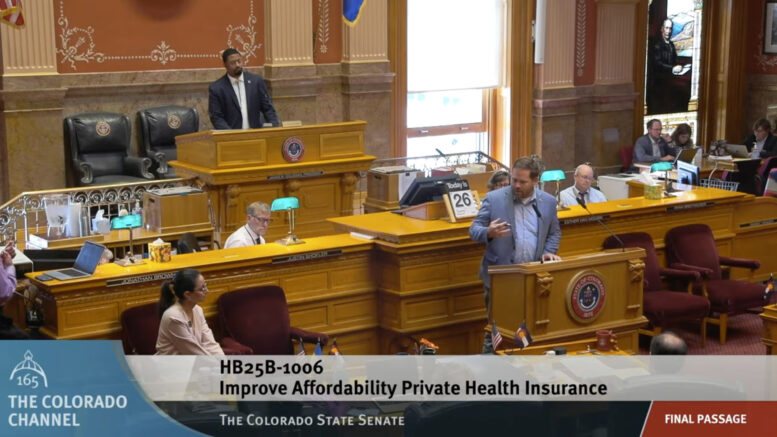
Colorado state Sen. Kyle Mullica discusses House Bill 1006 on the Senate floor.
Impact of credit sales on insurance
HB 1006, sponsored by Democratic Reps. Kyle Brown of Louisville and Lindsay Gilchrist of Denver, would put as much as $50 million from tax-credit sales into both the reinsurance program and the program to boost exchange subsidies for lower-income buyers. It also scrapes $10 million from a special fund that Polis was going to use to build a pedestrian bridge from the Capitol to a park across the street before he killed that plan under a wave of criticism.
The bill allows the HIAE board to spend as much as $15 million in total on any programs they which, including the OmniSalud program that has come up criticism from Republicans in particular. But, thanks to amendments pushed by business groups like the Colorado Chamber of Commerce, it also requires new transparency: The board must make annual reports on its spending to the Legislature, and that spending must undergo a state audit by December 2027.
Legislative Republicans such as Sen. Barbara Kirkmeyer of Brighton said the bill papers over the real problem, which has been a growth of spending on the three insurance-subsidy programs that will reach $594 million this fiscal year and needs to be reduced. Kirkmeyer said she still fears that Polis will reduce Medicaid spending and Medicaid provider rates in order to plug more of the budget shortfall.
Alternative to “doing nothing”
But Sen. Kyle Mullica, the Thornton Democrat who co-sponsored the bill in his chamber, said that before legislators can target spending cuts, they must figure out a way to give a soft landing to the people who count on the programs now to buy insurance. The boost to the reinsurance and exchange-subsidy programs will keep between 20,000 and 25,000 people insured who otherwise would be expected to disenroll, and that will help everyone from those individuals to the hospital system, he said.
“Yeah, cutting Medicaid rates is not the solution. But you know what else isn’t the solution? Doing nothing,” Mullica said Tuesday during debate on the final day of the six-day special session. “This matters to 25,000 people keeping their insurance coverage. This matters to Coloradans who will see less of an increase in their insurance. This matters to the rural hospitals and safety-net clinics who can’t afford to see any more patients who are uninsured.”
Polis is expected to sign both bills in the near future.