The Colorado Treasurer’s office, to be blunt, is a pretty boring post. It invests some $17 billion in state tax revenues and oversees a smattering of financial programs but is largely limited in the things it can do to impact the state and its business community.
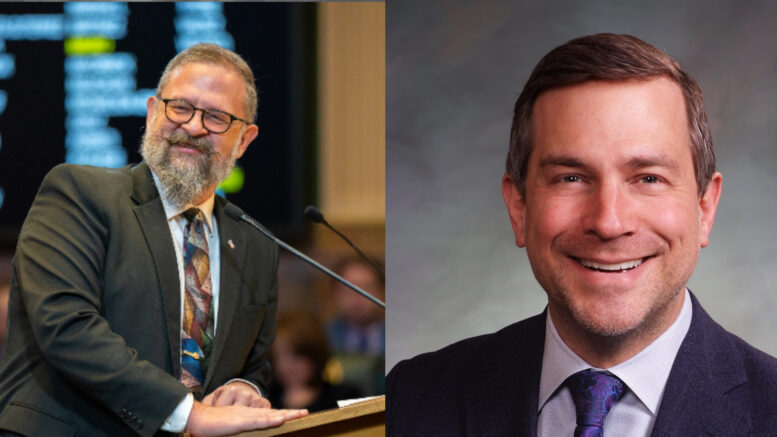
This year’s race for the open office, however, will serve as a referendum of sorts on whether voters want it to keep its traditional focus or would prefer it expand the ways in which it invests and safeguards Colorado taxpayers’ money. That’s because the two men seeking to replace term-limited Democratic Treasurer Dave Young have very different visions for how they intend to use the power of the office.
Kevin Grantham — the last Republican to serve as Colorado Senate president and a current Fremont County commissioner — believes the duties of the treasurer should remain limited to maximizing the investment of state tax dollars. He wants to do what he can as treasurer to keep state expenses in check and make life more affordable for residents, but he largely sees the bully pulpit afforded by the office as his way to weigh in on subjects that don’t fall under its traditional purview.
Jeff Bridges — a Democratic state senator from Greenwood Village and vice chairman of the powerful Joint Budget Committee — believes the treasurer should play a much bigger role in making housing and childcare more affordable and in overseeing state expenditures. Among other changes, he’d like to create a fund of state tax revenues to be invested in housing and infrastructure projects rather than in traditional stocks and bonds and would seek to launch a forensic auditing division to examine other state agencies’ spending.
Should the treasurer have limited duties?
Grantham and Bridges — who served together in the Legislature in 2017 and 2018 — are in many ways the most amicable opponents facing off for statewide office this year, with each pushing for more opportunities to get both of them in front of people to discuss their ideas. But their shared respect for each other belies significantly different approaches to an office that serves as banker for state taxpayers’ money and as a watchdog that is called in frequently to offer advice on financial matters to state boards and committees.
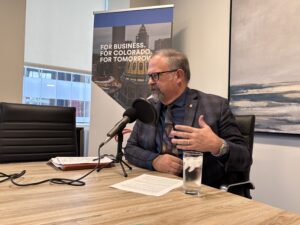
Kevin Grantham answers questions on the “Colorado Chamber Office Hours” podcast.
“From a limited-government standpoint that I have, I don’t think we should be giving ourselves more jobs to do legislatively or in any constitutional offices,” said Grantham, listing investment of state revenues, oversight of the Unclaimed Property Trust Fund and a designated seat on the Public Employees’ Retirement Association board as needed roles. “I don’t think adding to that swath of duties is necessary. In fact, in many cases, less is more.”
Countered Bridges in an interview for the Colorado Chamber Office Hours podcast: “I’m running for treasurer to invest Colorado dollars in Colorado. That’s the whole reason I’m running … Instead of helping Freddie Mac and Fannie Mae get people into homes in Florida, Texas and Ohio, we need to help people get into homes in Colorado.”
Investing in local infrastructure
To that point, Colorado’s investments mirror those of many other states, with money going into large national financial institutions and programs and into AAA-rated funds that are safe, liquid and beneficial to taxpayers, earning steady rates of interest. Bridges, however, would like to move a small percentage of that investment out of large national banks and programs and into areas like local affordable-housing projects or local infrastructure projects that earn smaller financial returns but offer what he believes are other benefits.
This idea, while new to Colorado, isn’t a national anomaly: Both Vermont and Illinois invest between 10% and 20% of their revenues into local projects from housing construction to venture-capital loans to state startups. Bridges proposes working with the Legislature to establish a state fund that would hold some of the state’s tax revenues, work with local financial organizations that would offer first-loan guarantees to ensure some investment is returned and boost housing or childcare inventory with the money.

Sen. Jeff Bridges speaks about the budget proposal in the Senate in 2025.
The Democratic candidate acknowledged that the rate of return for these investments likely would be lower than a bond investment. That’s reasonably insignificant for state purposes, though, because major rates of return count against the Taxpayer’s Bill of Rights revenue cap and go back to voters as tax refunds instead of boosting state spending, he said.
“I think there’s more money that comes back into the treasury pool by investing in Colorado,” Bridges argued. “If we can make Colorado more attractive to businesses by making housing more affordable, by building the infrastructure we need … by making it so that businesses in the state have access to low-cost investments that allow them to grow, that actually pays more into the treasury over the long run.”
Overseeing other agencies’ spending
Grantham said he’s not opposed on the surface to investing some state funds into housing and infrastructure projects. But any local investments should be included in the standard treasury-pool funds, should be just as beneficial as typical investments to state taxpayers and can’t put state tax revenues at any added risk, he said.
Bridges’ other idea for growing the scope of the treasurer’s office is to create a forensic accounting division that could investigate spending being done by other state agencies and ensure it’s done right — oversight more proactive than typically retrospective state audits. Having that kind of oversight could limit instances of questionable financial decisions, such as the overspending that the state Medicaid program undertook on non-emergency ambulance transportation and now is required to repay to the federal government, he said.
Grantham, who led the Senate when Republicans last held power during the 2017-18 session, said that rather than expand the power of the treasurer’s office, he would prefer to expand its influence by using the bully pulpit of it to weigh in on proposed bills. Those would be bills that deal with the state budget or state spending, as well as bills that impact the banking industry or other financial sectors, where he believes legislators may look for guidance from financial leaders, he said.
Unclaimed Property Trust Fund
One area where he’d like to be more active is in bills dealing the Unclaimed Property Trust Fund, a fund within the treasurer’s office where bank accounts, refund checks and other payments from private institutions go when those institutions can’t locate the objects of their payment. Legislators increasingly have taken the interest earned by that fund and used it for purposes ranging from health-insurance subsidies to operations of safety-net clinics, and Grantham said he would stand up to further takings.
In fact, he argues that the largesse of funds remaining in the UPTF — about $2,5 billion —demonstrates that the treasurer’s office needs to concentrate more on core duties such as getting those funds back to their rightful owners rather than adding new responsibilities for the office. This is why he wants to bear down on existing roles that the office plays.
“Getting this money and being the trustee and getting it back into the hands of the people who rightfully own it should be the second (priority) to the state investments, and nothing else should approach that,” Grantham said. “And the treasurer needs to have a larger voice to stand up to the Legislature and the governor when it comes to those important issues.”
Bridges, for his part, said he would like to allow the treasurer’s office to send unclaimed checks and other financial holdings directly to state residents when the office finds them rather than require those residents to come to the office to request their property.
Other duties of the Colorado Treasurer
One other area in which the Treasurer’s Office interacts with the business community is in its management of the Colorado SecureSavings program, which offers opt-out retirement savings plans to all workers who don’t have such an option through their employer. Republicans rejected a bill to launch the program when Grantham was Senate president over concerns that it was an unnecessary imposition to both employers and employees, but Democrats, including Bridges, passed it in 2020.
Both candidates agreed the program has benefitted workers, but only Bridges said that he largely would leave it untouched. Grantham said he would work to find ways to get more employers and their workers to sign up for the program, as he considers the current enrollment too low, and he would also look to make sure that the program’s investments are getting more money to workers and less to the private firms investing their wages.
Both candidates added that they do not see the need to establish a public bank, which is an idea that’s been floated by some legislative candidates. Bridges added that the state investment fund he is proposing would achieve the same ends as a public bank but do it with a far less complicated structure.