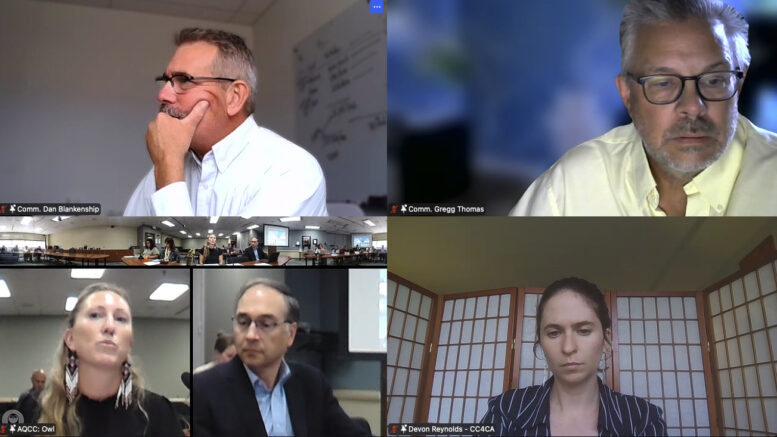
A year-and-a-half after one of Colorado’s most influential rulemaking bodies rewrote its procedural rules to boost transparency and public participation, members heard Thursday from industry and community leaders that the changes have helped but that more reform is needed.
The Colorado Air Quality Control Commission has been operating since early 2025 under new procedures on how it must explain proposed statute changes, take public input and operate during its rulemaking hearings. Changes in those procedures, which were last amended in 1998, included extending the rulemaking process from four months to six months and rearranging the order of testimony so that Air Pollution Control Division staffers no longer got both the first and last word.
One result, lawyers for groups representing heavily regulated industries said Thursday, was that the testimony from APCD staffers has been more substantive and the engagement the division has had with affected parties has become better. Also, environmental and community groups said, those community groups have had more of a voice at hearings and APCD leaders have made more efforts at finding consensus among sparring public groups.
Drawbacks to new procedural rules

Patricia Garcia-Nelson is the Colorado fossil-fuel just-transition advocate for GreenLatinos.
However, community members who have come to give testimony at what often are technical AQCC rulemakings too often leave dismayed that the hearings don’t seem to address their bigger-picture concerns over air quality, said Patricia Garcia-Nelson, Colorado fossil-fuel just transition advocate for GreenLatinos. This is in some sense a reaction to the procedural rule changes, in which the AQCC agreed to set the scope of rules that could be discussed earlier in the process and allow challenges to them only before the actual rulemaking hearings begin.
Meanwhile, the more regimented schedule that requires parties to rulemakings — industry, community and environmental groups — to get filings in earlier has cut down on the ability to negotiate compromises before turning in position statements and alternate proposals, said Ana Gutierrez, who has represented oil-and-gas producers before the AQCC. It also has limited their ability to react to alternate proposals; there is a just a 24-hour period, for example, between when alternate proposals are due to the AQCC and when parties to hearings must turn in their slideshow presentation that may consider such proposals.
With concerns such as that, groups that frequent AQCC hearings offered a slew of proposals for how to once again improve procedural rules at the monthly AQCC meeting on Thursday — ideas that members considered but didn’t act on right away. And far from being just inside-baseball suggestions that impact only lawyers, these ideas could have major impacts, as the AQCC is the lead rulemaking body for air-quality regulations impacting the energy, manufacturing and transportation sectors, among others.
Does public testimony really make a difference?
Garcia-Nelson, for example, asked that AQCC members give more acknowledgment to people who offer public comments and explain how those comments do or don’t factor into the decisions they make. The AQCC now holds public-comment sessions typically on the night before rulemaking hearings and limits participants to three-minute statements, which has left many members of the public unsure if anything they said matters, she said.

An oil pump silhouetted on the sky
Also, while the AQCC frequently debates specific rules for important topics ranging from emissions limits for industrial factories to air-quality controls for oil-and-gas rigs, many community members question why it can’t do more to clean up their air, said Rachael Lehman, policy and advocacy specialist for the Black Parents United Foundation. She would like the AQCC to give more advice on the types of things it wants to hear from community members in testimony, so they can understand what regulations it can and cannot impact.
“Our communities have a lot of fatigue from us asking them to come and share their personal stories and then not getting any results,” Garcia-Nelson said, suggesting that the AQCC take public testimony days before a hearing to digest it further. “For community members, when we come into these spaces, we’re expecting a lot of action … There isn’t a lot of level-setting with community members about what actually can happen.”
Filing deadlines deter consensus negotiations
Industry groups and local-government coalitions, meanwhile, were in agreement on most of their main requests, saying they want more time to be able to react to each others’ proposals and to see if they can negotiate consensus once they know their details. Both also told AQCC members that they would like some feedback from them ahead of rulemakings on what their biggest questions or issues for debate may be, which could help the groups craft presentations that would address commissioners’ concerns.
In addition to wanting more than 24 hours between the deadlines for alternate proposals and slideshow presentations, Gutierrez suggested adding another day to typically two-day rulemaking hearings to give parties more time to explain ideas and answer questions. And Devon Reynolds, representing Colorado Communities for Climate Action, suggested the AQCC make permanent a consensus-seeking meeting among various parties that it first tried during a recent hearing on carbon-credit trading among manufacturing facilities — but do it with enough advanced notice that sparring parties could plan how to work together.
“We’d like drafts of the language earlier and a chance to engage with the division about the scope of that rulemaking,” said Chris Colclasure, who frequently represents the Colorado Oil & Gas Association at such hearings. “If we had more ability to understand what the division’s goals are, I think industry would have more opportunity to get (to agreement).”
Procedural work for Air Pollution Control Division way up

Stefanie Shoup, manager of the Colorado Department of Health and Environment’s office of innovations in planning and air-quality assessment, speaks at an online Colorado Air Quality Control Commission meeting in August 2025.
The one group that seemed a bit reluctant to add more time and work to the hearing process, however, was the Air Pollution Control Division.
The division spends about 3,700 staff hours on each rulemaking, beginning work six to 12 months before putting together the regulatory proposal that kicks off the four-month rulemaking process, said Stefanie Shoup, APCD deputy director for regulatory affairs. Rulemakings have gotten more frequent in recent years as legislators have directed the AQCC to craft regulations on sectors ranging from commercial buildings to lawn-and-garden equipment; there are now an average of 10 rulemakings a year, noted APCD planning and policy program manager Jessica Ferko.
Both Shoup and Ferko, for example, blanched at a suggestion from AQCC member Jana Milford that they add to the current list of filings a new plain-language document informing community members in a less formal way what a rule plans to do. Ferko said it would be tough to make even more demands on a staff that already has to do so much for rules procedures, and Shoup suggested that while some documents could be less formalized, there already is a lot of explanation that the division offers.
“When each (rulemaking) takes a year, when they take such a significant amount of hours … it really does give us some level of pause to how much more we can do,” Shoup said.
Trying to get communities more involved
She also responded to community groups by noting that APCD offers typically three community meetings before each rulemaking to try to explain what is at issue and how it can impact their areas. But such meetings are often lightly attended, and the groups that show up in most force to them are not community members but industry leaders and local government officials, she added.
“It’s hit or miss,” Shoup said. “We’re obviously not hitting that mark (of connecting fully with affected communities) in some way. And we’re trying to figure out how.”
Commissioners did not set any time frame to consider formal changes to procedural rules, but they likely will have a chance to judge further how these rulemakings are going in the coming months. They are scheduled to hold a November rulemaking hearing on lowering emissions from lawn-and-garden equipment and a February hearing on raising Air Pollution Emission Notice fees, among other subjects.