
The federal government has designated a Colorado college to be one of just seven NASA Space Hubs, awarding it $1.3 million over the next three years to create career pathways for learners to become skilled technicians in the state’s booming aerospace industry.
This selection comes as Americans’ interest in space exploration is once again taking off, fueled by the Artemis moon missions that Colorado companies such as Lockheed Martin Space and United Launch Alliance are involved in heavily. And it comes as Gov. Jared Polis and state business leaders continue to boost Colorado’s workforce-development system by giving students more pathways into good-paying careers, particularly those careers that don’t require four-year degrees.
The NASA Space Hub designation goes specifically to Arapahoe Community College and its Colorado Space Institute, which is set to begin offering an first-of-its-kind Associate of Applied Science degree in Space Science Technology beginning in the fall of 2027. The degree will focus on preparing students to work in aerospace through courses that include computer-aided design, Python programming, technical writing, business and data ethics and specialized soldering certifications for aerospace applications.
What being a NASA State Hub means
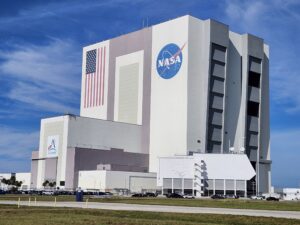
A rocket hangar at Cape Canaveral Space Force Station bears the flag of Artemis, the moon mission that involved numerous Colorado companies.
NASA, which has seemingly never faced a shortage of people wanting to be astronauts, launched its state hubs program because the industry needs more of the professionals who can get those explorers into space — welders, electricians, machinists, and other highly trained workers who use advanced technical skills in their occupations. Elaine Ho, associate administrator for NASA’s Office of STEM Engagement, said in a Wednesday news release that the need for technical workers is “urgent” and explained that the state hubs will act as conveners for employers and educational institutions to boost this workforce.
With the new funding, the Space Institute will bring together these key players to build needed training pathways industry demand, connecting high school coursework with community college credentials, industry certifications and employment opportunities, according to a news release from Polis’ office. The students going through this training will work on real-world projects addressing industry challenges and will use the certifications or degrees that they achieve to enter the industry and start building stackable credentials that will let them advance in their employment.
“By aligning training with employer needs, we can prepare more students for careers that support both Colorado’s aerospace economy and NASA’s mission,” said Grace Cain-Wright, director of the Space Institute. “Being selected as a NASA State Hub allows CSI to bring together education, industry and workforce partners across Colorado to create clear pathways into high-demand aerospace technician careers.”
A special focus on technicians with STEM skills
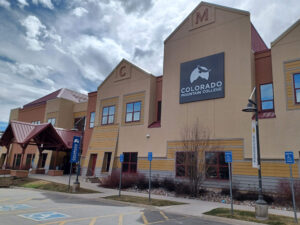
Universities and colleges like Colorado Mountain College in Edwards could be involved in the NASA Space Hub initiative.
Colorado already has plenty of job opportunities in the sector — the roughly 55,000 direct jobs and 184,000 indirect jobs offered across some 2,000 aerospace businesses give it the highest per-capita employment in the industry of any state. But while employers and organizations like the Colorado Springs-based Space Foundation have expanded their reach into schools to get more students interested in the sector, the pipeline has always fallen somewhat short of needs as the number of state-based companies grew by 24% over the past five years.
While institutions like University of Colorado-Boulder and Colorado School of Mines churn out many of the engineers who design vehicles for space travel, this new initiative is aimed at students who can enter the workforce with less than four years of training. Students can learn technician skills particular to aerospace and ease into employment more quickly via courses for which the Space Institute will lead development and other K-12 and higher-education institutions, as well as workforce-training programs, will partner to offer.
Colorado has been able to grow its aerospace sector because of a deep ecosystem that includes federal research institutions, aerospace-focused higher-ed programs, military assets and a strong startup community, said Rachel Beck, Colorado Chamber Foundation executive director and head of the organization’s Aerospace and Defense Alliance. The selection of ACC and its Space Institute as one of just seven national hubs will foster even more growth in this industry, she predicted.
NASA designation aims to keep Colorado atop national industry
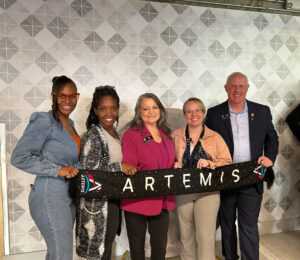
Colorado legislators pose at an Artemis return watch party hosted in 2025 by the Colorado Chamber Foundation.
“One of the top concerns the Chamber hears from businesses is that we need to strengthen partnerships between educators and employers,” Beck said Friday. “The NASA State Hub … will do just that, ensuring that our more than 2,000 aerospace businesses have the skilled technical workers they need to continue to build satellites, launch rockets, write software and more to advance technological innovation for everyone from astronauts to all of us who use smart phones.”
The three-year funding will help the Space Institute, already set to offer for-credit programming by Spring 2027, to convene more partners and connect more Coloradans with training and career pathways. Colorado leaders are working to develop the state into a similar hub in the emerging quantum sector, fueled also by a federal designation in mid-2024, and such central systems will benefit workers and students along all parts of the educational-degree spectrum, Polis and Lt. Gov. Dianne Primavera said.
“Colorado is a national leader in aerospace, and this exciting designation will help more Coloradans build the skills needed to launch rewarding careers in this growing industry,” the Democratic governor said in a news release. “Together, we are expanding affordable training, strengthening our economy and helping ensure Colorado remains at the forefront of American leadership in aerospace.”