
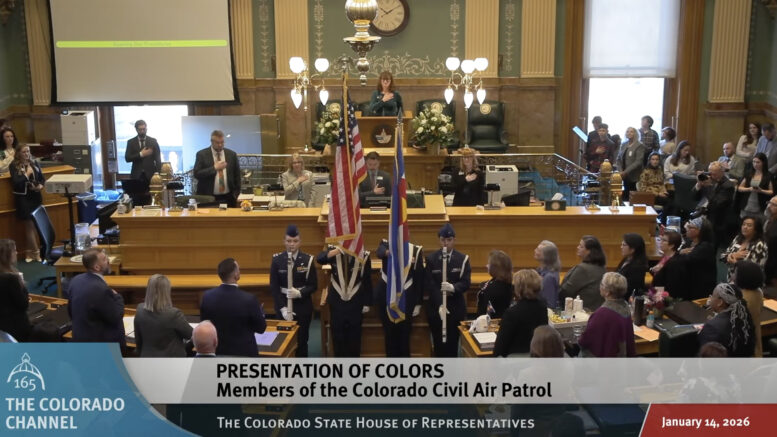
With affordability topping their priorities, Colorado House and Senate Democratic leaders further narrowed their focus to housing and healthcare costs in opening-day speeches Wednesday — even as Republicans argued more attention is needed toward energy bills.
The addresses by the party leaders in both legislative chambers seemed geared to set the tone for the next 120 days rather than to get into specific details of the bills that are coming. But they also showed some of the particular priorities that will grab the attention of the leaders — as well as the ways in which those priorities will lead to coalescence or clashes between the parties.
Affordability, as expected, was one of the most common words on everyone’s lips, as Colorado has become one of the most expensive states to both work and do business — the third least-affordable for housing, House Minority Leader Jarvis Caldwell noted. And even after a multi-year period in which legislators have focused on trying to bring down housing and healthcare costs, those two areas once again will take up much of their attention, leaders said.
Housing and healthcare affordability
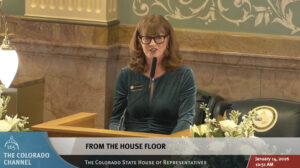
Colorado House Speaker Julie McCluskie offers opening-day remarks on Wednesday.
On housing, House Speaker Julie McCluskie said Democrats will seek to unlock new financing mechanisms to get more affordable housing built, try to remove obstacles to certain groups building homes on their land and aim to reduce property-insurance costs. House Bill 1001 — traditionally a symbolic bill signaling a caucus’ priority — would override some local rules to let schools, nonprofits and transit districts put up houses and apartments more easily on their property.
On health care, both McCluskie, D-Dillon, and Senate President James Coleman, D-Denver, vowed to take new steps to keep down health-insurance costs, even as Congress has failed to extend premium tax credits that many people rely on for greater affordability. While neither divulged the details of their plans, McCluskie said legislators need to look at “options,” which last year included a failed effort to raise fees on all insurance policies to subsidize the most expensive premiums, if Congress does not extend the credits soon.
“We know that health care and housing represent the biggest squeezes on working people’s budgets,” McCluskie said. “That is why we keep coming back to these policy issues, with the fortitude to both make big changes and get it right.”
The question of energy affordability
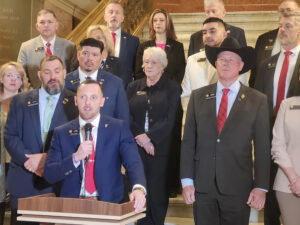
Colorado House Minority Leader Jarvis Caldwell offers remarks at a House Republicans’ news conference on Wednesday morning.
Caldwell, R-Monument, and Senate Minority Leader Cleave Simpson, R-Alamosa, also touched on those areas, particularly housing. But both men elevated energy affordability to the same level of concern, particularly after the Colorado Public Utilities Commission last month approved a Clean Heat Plan to eliminate gas heating of buildings by 2050, leading Black Hills Corp. to say it could boost energy bills by $215 a month.
To be sure, Coleman also listed a goal “to drive down utility costs,” but he and McCluskie emphasized continuing to push to reach climate goals that Republicans have said are making energy less affordable by moving away from cheaper, less renewable sources. Caldwell responded that while Republicans also want to clean up the environment, the state can’t continue to push unrealistic goals that drive up utility bills when more measured rules could lead to both emissions reductions and costs that don’t break budgets.
That was part of a bigger theme for his speech that mounting regulations — Colorado is the sixth-most regulated state, according to a study commissioned by the Colorado Chamber of Commerce — are responsible for many of the suffocating cost hikes. To bring down the rising cost of living, legislators must stop foisting mandates upon employers that boost the cost of their doing business and bleed into the costs of everyday goods, he said.
The impact of costs on jobs
“We’ve noticed that the more bills we pass in the name of affordability, the less affordable Colorado becomes,” said Caldwell, who is entering his first session leading his caucus. “Overburdensome regulations and unprecedented government growth from this building stifles economic prosperity, causes businesses to close or leave, and drives up the costs for everyone.”
Once again, Republicans face a daunting task in asserting their priorities when they are in opposition to Democrats’ goals. Democrats hold a 43-22 advantage in seats in the House and a 23-12 advantage in seats in the Senate, in addition to counting Gov. Jared Polis as a member of their party.
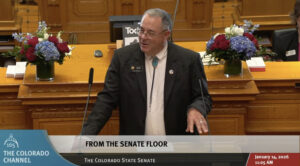
Colorado Senate Minority Leader Cleave Simpson offers opening-day remarks on Wednesday.
McCluskie, for her part, did state a similar goal to Caldwell in seeking to “lower costs and create good-paying jobs. And she sounded offered words like Simpson’s in saying that Colorado should be a place where entrepreneurs can take risks and start businesses.
The speaker also added that her affordability agenda includes support for bringing down the cost of childcare. Another of the first 10 bills that Democrats rolled out in the House was HB 1004, a proposed extension of an income-tax credit that goes to people who help to fund childcare facilities.
Price gouging a likely point of conflict
But Caldwell’s statements on the cost of government regulations could put his party on a collision course with Democrats, based on one of Coleman’s other priorities that he listed in his opening-day remarks. The Senate president said his caucus “will continue to take on deceptive pricing practices and hold corporations accountable who pad their pockets at the expense of working families.”
Coleman was referring to the newly introduced HB 1012, which seeks to prohibit companies from charging excessive prices to captive consumers at places such as airports, hospitals, event venues and outdoor festivals. It defines this act as a deceptive trade practice that is punishable with potential consumer lawsuits and defines “excessive” as more than the average price charged for a good or service in that county — a standard difficult for most vendors who pay fees to operate at such venues to meet.
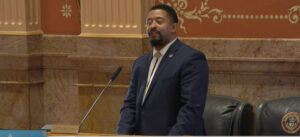
Colorado Senate President James Coleman offers opening-day remarks on Wednesday.
“Do we accept being the sixth most-regulated state for business, with approximately 45% of our regulations being excessive or duplicative?” Caldwell asked.
Civil discourse
One area of commonality among the four leaders’ speeches was a call for more civil discourse after an offseason that saw the killings of both former Minnesota House speaker Melissa Hortman and conservative activist Charlie Kirk. McCluskie said that legislators must work together to fight against political violence, and Caldwell commended House majority-party leaders for working across the aisle in recent months to explore how they can lower the political temperature.
But even with that cooperation and with similar big-picture goals on affordability, it appears that Democratic and Republican leaders are seeking different paths to reach those goals — paths that could lead to substantial debate in the months ahead.
“Folks, we have big things to do this session,” McCluskie said.