
Local governments seeking additional revenue for housing and other priorities want to ask legislators next year to let them assess several new taxes and fees — including levies on vacant homes and real-estate sales — that could run into stiff resistance.
The new revenue-raising efforts come as both the federal and state governments are cutting funds for numerous programs, contributing to more cities and counties being unable to pay for all the services they want to offer. And they come as Colorado continues to grapple with rising costs of living and of housing — financial burdens that both proponents and opponents of the new taxes and fees use to justify their stances.
Colorado Municipal League leaders are searching for sponsors for three bills that cleared their policy committee — a proposal to let local governments assess real-estate transfer fees, an initiative to let cities and counties ask voters to approve taxes on vacant homes and an effort to expand the types of cities that can impose short-term rental taxes. Meanwhile, Rep. Kyle Brown is working at the behest of some county leaders to draft a bill that would let counties ask voters to approve excise taxes on specific goods or services.
A question of how to boost workforce housing
The three potential CML bills came to the organization from the Colorado Association of Ski Towns, whose members are focused particularly on ways to create or preserve affordable housing that can be used by local workers, CAST Executive Director Margaret Bowes said. The issue has been festering since at least 2019, which is when Bowes can remember walking through tourist-destination towns and seeing shops and restaurants operating on limited hours because they couldn’t find staff that could afford to live in the area.
“When you can’t house your employees, it really threatens a tourism-based economy,” Bowes said in an interview. “It’s also about the fabric of a community. How does a community continue to function without its policeman and nurses and teachers being able to afford to live there?”
Nobody disputes that Colorado is in the midst of an affordable-housing crisis, especially as the issue has consumed much of the debate at the Capitol for the past three years. But Brian Tanner, vice president of public policy for the Colorado Association of Realtors, said he gets frustrated that every proposed solution seems to involve raising fees on people living in this state rather than rolling back regulations that contribute to high costs.
“There are other tools to increase affordable housing. Let’s find incentives to reduce permitting time,” Tanner said. “There’s other approaches out there that, rather than adding onto the cost of housing, would work to encourage builders and developers to get homes in those markets.”
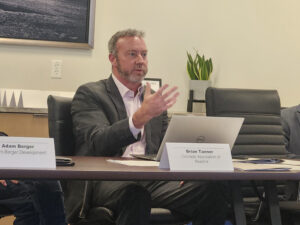
Brian Tanner, vice president of public policy for the Colorado Association of Realtors, speaks during a recent Colorado Chamber of Commerce housing roundtable.
Vacancy taxes
Maybe the most controversial of the proposals will be the effort to allow cities and counties to impose vacancy taxes on the owners of homes that sit empty for a good portion of the year. Crested Butte asked voters to do just that in 2021 but met stiff resistance. Municipal leaders say other home-rule cities could do the same, but passage of a bill would add the presumption of legality into state law and help to ward off potential lawsuits.
The legislation that CAST officials want to see passed would not define what “vacant” homes are, leaving that to be done on a city-by-city basis when local officials put the question to voters. But Bowes said the idea is not to target active short-term rentals so much as the second-and-third homes that may sit empty for a quarter or half of a year or more — with the hopes that a tax would spur homeowners to rent properties long-term to local workers.
Such a tax could raise money for affordable housing, or it could target other specific areas of need, such as upgrading of local streets that are worn thin as much by visitors as by local residents, Crested Butte Mayor Ian Billick said. And it could bolster the coffers of a city like his, where some 95% of the local budget is derived from sales taxes, by assuring that there are both people in those houses generating tax revenue and places where service-industry workers catering to visitors can live.
“I’m a big believer in local government. And I’m a big believer that local communities should have control over their future,” Billick said. “I think it’s a potential mechanism to think about funding critical services addressing the challenges we have.”
Many questions on how vacancy taxes would work
But Vail Valley Partnership President/CEO Chris Romer said the idea of a vacancy tax — particularly allowance of a concept that is so undefined — “makes the hair on the back of my neck stand up.” On a basic level, he said, it seems an affront to private property rights in that it allows local governments to dictate to some extent how they believe local homes should be used.
Beyond that, though, Romer questioned what conditions what need to exist for a home to be considered “vacant” for a period and how local governments would police and enforce that. Potential penalties could nudge second-home owners to rent their homes more on a short-term basis to avoid the tax — a move that could disrupt the character of communities — but he doesn’t believe that most would rent long-term, as that would negate their opportunities to come up and use their destination homes.

Chris Romer is president/CEO of the Vail Valley Partnership.
“If you have it under renovation, is it vacant? If you have it in probate, is it vacant? Or if my wife and I go on vacation for two weeks, is it then vacant,” Romer asked before adding: “A property is never going to be a long-term rental if the owners want to use it even a weekend a month.”
Real-estate transfer fees
In contrast to that untried concept, 12 mountain cities now impose real-estate transfer taxes — municipalities that put them in place and had them grandfathered in before the 1992 passage of the Taxpayer’s Bill of Rights specifically banned such taxes. The tax — typically an assessment of 1% to 3% on the price of a home sale, tacked on at the time of transaction — can be lucrative, raising $10.4 million annually for Vail and $31.9 million for Aspen, according to figures supplied by a CAST official.
Municipal leaders believe local governments could get around the TABOR prohibition by calling the assessment a fee and putting the new revenues to a program with a nexus to the fee, such as affordable housing — a maneuver that legislators have used since a 2018 Colorado Supreme Court decision explicitly allowed such fees. Mountain Village Town Manager Paul Wisor explained that the bill they would ask to pass would not require voter approval but would just clarify that local governments could impose such a fee.
Tanner argued that despite the semantics, the “fee” would come quickly under a legal challenge for being a tax that violated TABOR, and he also warned that it could stunt real estate sales by adding an extra cost at a time of already elevated housing prices. Gov. Jared Polis also is not a fan, having told municipal leaders earlier this year when they first suggested introducing such a bill that he would veto it because it adds housing costs.
Impacts of such fees
“And even in the communities where they’ve implemented this tax, we still don’t have enough affordable housing,” Tanner said, pointing to places like Avon and Breckenridge and Telluride that assess the taxes and say they need more help in adding workforce housing. “Those communities are still some of th most expensive places to live.”
Wisor, however, notes that those communities are also ones that saw record home sales in the past half-decade, a fact that he believes should douse any argument that such a fee will slow home sales. And allowing more cities to generate revenue that could be put to building or preserving housing would be at least as helpful to mountain towns as Polis’ push to reform land-use laws will be to boosting housing in Front Range cities, he said.
“The reality is that it really takes a lot of revenue to make these projects pencil,” Wisor said. “And nobody’s making decisions in those communities not to buy or sell a house based on the real-estate transfer tax.”
A third CAST/CML bill likely would be less controversial. That one would seek to allow statutory counties and municipalities — often smaller cities like Fraser or Salida or Granby — to ask voters to approve short-term rental taxes, just as home-rule cities can do.

Properties abut a lake in a tourist destination in southwest Colorado.
Excise taxes
The bill that is specifically county-focused, however, could generate opposition.
That is a measure, still in the development phase, that could allow counties to ask voters to approve excise taxes on certain goods and services that would go to fund specific programs. Some cities impose excise taxes now on goods like alcohol or tobacco sales, but each county could determine what it could seek to tax, and the list could range from ski-lift ticket sales to services that contribute to transportation-infrastructure degradation.
Brown, D-Louisville, said he’s working with Boulder County leaders on the bill in part because he believes it’s a matter of parity that those governments should be able to pass such a tax in the same way that home-rule cities can. But the representative, who is a member of the Joint Budget Committee, said that counties need the help too because they are being asked to bear the costs of jails, road repairs and even behavioral-health systems at a time when government funding is ebbing from several directions.
New revenues or new fiscal constraint?
“Counties are uniquely challenged in our local-government environment because they are responsible for implementing so much of the services and benefits that Coloradans need and rely upon,” Brown said. “I would anticipate that counties are hearing from their constituents, hearing from their residents, that services aren’t what they want them to be.”
Romer acknowledged that may be true, even as he also expressed fear that rising costs on housing and goods could scare visitors away from travelling to areas like his. But he offered a counterargument likely to be echoed by legislators and by the companies targeted by the proposed fees and taxes: Government needs to think less about how to raise money in new ways and more about how to live within the financial constraints facing state residents and business owners.
“I think the question becomes: How does government live within its means?” he said. “At what point does government just decide to focus on its budget and the revenues they already have versus focusing on new revenues?”