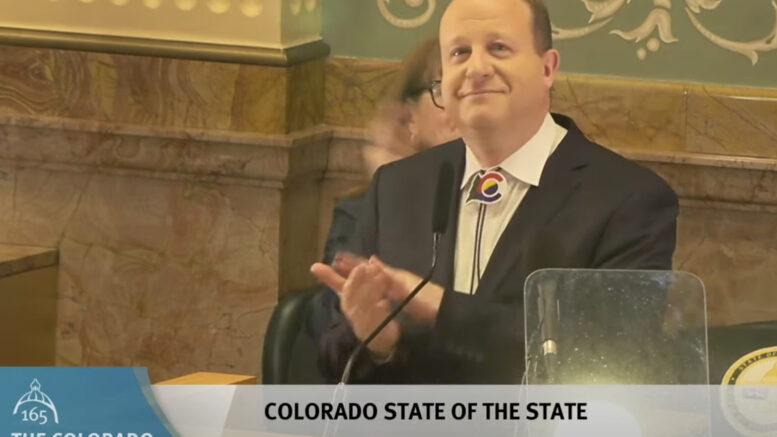
Gov. Jared Polis offered his final State of the State Address Thursday, calling for legislators to make additional progress on clean energy, workforce development and affordable housing while celebrating his accomplishments and lambasting the cost of health care.
The one-hour, 22-minute address to a joint session of the General Assembly had fewer specific legislative requests than the Democratic governor traditionally has made but more big-picture visioning that seemed to be aimed also at his successor and future legislatures. He expressed, in turn, pride at what state officials have accomplished since his 2019 inauguration, urgency to advance progress on housing construction and student success, and frustration that the healthcare price cuts he’s sought have run into so much resistance.
The term-limited governor — whose tenure has seen lows like the coronavirus pandemic and the most destructive wildfires in state history, as well as highs like attracting the Sundance Film Festival and the MLB All-Star Game — said that Colorado is succeeding. He praised the “strong business-friendly ecosystem,” a description that will draw pushback from employers who’ve said in surveys that Colorado has become more expensive and more difficult to operate in, and he called for more progress over his final year in office.
“When it comes to turning my bold agenda into a better daily life for Coloradans, we haven’t always succeeded on our first try,” Polis said. “But we’ve always stepped back up to the plate — because that’s what we do in Colorado. We are in this work to make life better, more affordable and safer for all Coloradans.”
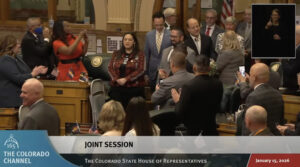
Gov. Jared Polis shakes hands with legislators as he enters the House chamber on Thursday to deliver his final State of the State Address.
Housing still a priority for Polis
At the start of the annual address, Polis took a victory lap of sorts, recounting what he feels are the biggest accomplishments of his two terms. He noted the launch of free kindergarten and preschool, the buildout of clean-energy infrastructure, the numerous low-cost programs he launched for people to receive workforce training, three income-tax cuts and five property-tax cuts.
But then he spent the rest of the speech both reviewing his initiatives and asking the Legislature to give him one more victory — victories he argued would be bipartisan wins — in several areas.
After passing bills in 2024 and 2025 to remove some barriers to housing construction and reform the state’s construction-defects laws, he outlined two housing goals for his final year. He said that legislators must work to bring down the cost of homeowners insurance by making hail-resistant roofs and defensive wildfire preventions more attainable for residents, and he backed a newly introduced bill that would allow nonprofits and schools to construct housing on land they own.
Before describing these proposals, he noted that he’s run into roadblocks to trying to increase housing density, which he views as a key to slowing Colorado’s precipitously rising home prices through market competition. And he specifically called out the executive director of the Colorado Municipal League, which has pushed back against his housing-density mandates as many city leaders have argued that they are violations of cities’ home-rule power.
“It reminds me of the words of Taylor Swift and maybe even Kevin Bommer too: ‘I’ll sue you if you step on my lawn,’” Polis said. “Not us — we say, ‘Let us build!’”
Energy concerns
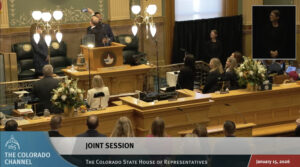
Gov. Jared Polis takes a selfie with the Legislature, an annual tradition, before delivering his final State of the State Address.
Polis also seemed later in the address to insinuate that legislators should work this year to standardize permitting for transmission lines that must be run through multiple jurisdictions to connect windmills to power grids or drilling rigs to electricity lines. However, he stopped short of calling for specific action.
“Now is the time to double down on investment and innovation to build more of what’s needed to power our homes and businesses, including power lines and power plants,” Polis said. “Local governments play a key role in moving energy and transmission projects along, but there is room to grow to ensure permitting across the state is clear, fast and consistent.”
The governor also vowed to continue pushing the state’s utility sector toward net-zero emissions, though he similarly stopped short of asking for that deadline to be sped up from 2050 to 2040, as some environmental advocates have pushed him to do. Instead, he said that he will work with a trio of Democrats this year to “maintain the important goal of 100% clean energy while building in needed flexibility to adapt to the realities of federal headwinds” such as President Donald Trump’s efforts to reignite the coal sector.
A definitive workforce-development plan

Gov. Jared Polis points to legislators during his final State of the State Address on Thursday.
Polis was more definitive in his primary educational and workforce-development goal for this year, reiterating his support for a soon-to-be-introduced bill that would combine all the state’s workforce-training programs with higher education in a new state agency. Such a move would create a “one-stop” destination where employers and students could learn about degree and non-degree pathways to careers and “help unlock more prosperity and opportunity for Coloradans,” the former Colorado Board of Education member said.
The governor spoke more broadly on what’s been a very important issue for him since 2024 — rewriting the state’s comprehensive but yet-to-be-enacted artificial-intelligence regulations to make them more workable for the growing AI sector. Saying that his early career as an internet entrepreneur taught him that technology is a tool that must be used to maximize opportunity and innovation, he implored legislators to break an 18-month stalemate and reach consensus on the issue.
“Today we are called upon to ensure Colorado remains a leading state for artificial intelligence for both businesses and consumers,” Polis intoned. “Now is the time to get this done in a way that drives innovation and protects Coloradans.”
Polis’ transportation plans
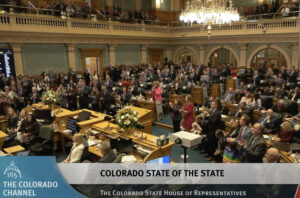
Democratic legislators stand and applaud while Republicans stay seated after one of Gov. Jared Polis’ policy appeals during his State of the State Address on Thursday.
Discussing transportation, Polis spent most of his time lauding the growth of electric-vehicle sales in Colorado, which is now the top state for percentage of car sales that are zero-emission vehicles, and he urged state and local officials to complete the Front Range Passenger Rail now in planning. But he also argued that the state is putting substantial resources to roadway construction — a sentiment that highway proponents disagree with so much that they are running a ballot initiative to increase roadway funding — and touted progress on expanding Interstate 70 through the Floyd Hill chokepoint.
Though Polis imbued most of the address with optimism, the man who created the Office of Saving People Money on Health Care back in 2019 voiced frustration with the obstacles to achieving his goals in this area. He accused big hospitals, insurers and pharmaceutical companies of fighting reforms like his stalled efforts to import prescription drugs from Canada out of self-interest and said they’ve teamed with the federal government to keep their prices and profits high.
“High-powered and well-funded corporate interests have proven to be deeply entrenched in our politics. It’s like the Avengers fighting Thanos,” the self-described sci-fi fan said. “The reality is the incentives are simply FUBAR. Americans are getting screwed on health care.”
Governor’s healthcare frustrations
Insurers and hospitals have argued in turn that the more mandates that the federal government throws on them, the more expensive it gets to offer services. And legislators once again this year are proposing bills that would add more required coverage for insurers and would make it harder for hospitals to acquire primary- or specialty-care practices that create economies of scale and help to minimize cost hikes.
Still, to that end, Polis argued that the changes that are needed must occur at the federal rather than state level — specifically creation of a single-payer government-funded health insurance system available to some or all Americans, like other countries have. While a bill he signed last year authorized a study on implementing a universal health-insurance system in Colorado and is due to be delivered to the Legislature by the end of the year, Polis did not make mention of that.
After two days of speeches to begin the legislative session, elected officials will move over the next two weeks into the business of debating bills, including many of those mentioned Thursday by Polis. The session, expected to be packed with issues that featured in the address and many that did not touch upon — including union organizing and regulatory reform — is scheduled to run through May 13.