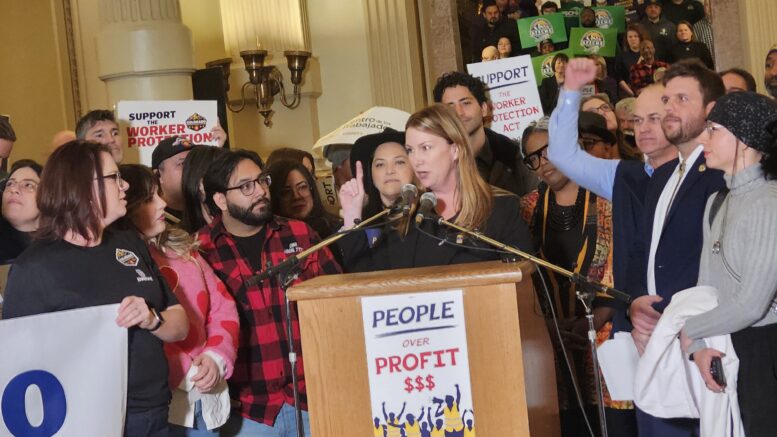
Colorado legislative Democrats will try once more this year to nix the second-election-for-unionization requirement in the Labor Peace Act, emphasizing at a news conference Thursday that they’ll work to convince Gov. Jared Polis not to veto the bill again.
Surrounded by unionized workers in the west foyer of the state Capitol, sponsors of the coming bill said they don’t plan any changes to a proposal that passed with full partisan support but died at the hands of Polis. The Democratic governor had urged business and labor leaders to reach a consensus, and when none was achieved, he wrote in his veto letter that he feared the change in law could be detrimental to business and workers.
In fact, their messaging at Thursday’s event, which reverberated with the noise of a protest rally, was almost identical to that of the November 2024 news conference at which they first rolled out the bill. Making it easier for workers to organize unions will raise salaries and help Coloradans struggling through the ongoing affordability crisis, they said. And this one change in law will lead to more organization in a state where less than 7% of private-sector workers belong to a union.
“Prices are only one side of the equation. Wages are the other half,” said Sen. Jessie Danielson, the Wheat Ridge Democrat who will cosponsor the bill in her chamber, in speaking about the cost-of-living obstacles facing Coloradans. “And wages do not rise by any kind of accident. They rise when workers have the right to speak up together.”
Business leaders opposed to proposed changes
Once again, business leaders will oppose the effort vociferously, positing that greater union demands for wage hikes outside the scope of what the market will allow will exacerbate the similar ongoing crisis in the cost of doing business in this state. Industry leaders last year also argued that increased insertion of unions into workplaces breaks down the relationship between management and workers and will make the state less attractive for companies as its business competitiveness already is falling.
“The Colorado Chamber’s priority is to preserve the balance in Colorado labor laws that keeps us competitive, respects employee autonomy and attracts top businesses to the state,” said Loren Furman, president/CEO of the Colorado Chamber of Commerce. “The Chamber has not been included in any discussions to collaborate or work through concerns we had from last year’s bill. We will oppose any legislation that runs counter to our priorities and threatens our business climate.”
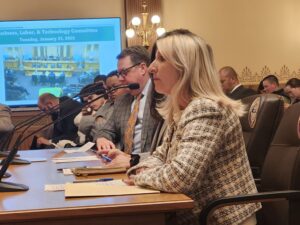
Colorado Chamber of Commerce President/CEO Loren Furman testifies in January 2025 with a panel of business leaders against the proposed overhaul of the Labor Peace Act.
Twenty-six states have right-to-work laws that bar any requirement that workers must be part of a union to work for a certain company. Twenty-three states, meanwhile, have laws requiring that employees at unionized companies must belong to that union to work there.
Colorado’s Labor Peace Act, passed in 1943, is meant as a compromise, though union leaders increasingly say it serves as a de facto right-to-work law.
What the changes to unionization process could mean
It requires two votes by workers at a company considering unionizing. The first vote requires a majority of participants in the organizing election to support unionization, just as every other state mandates. The second, unique vote requires 75% support to achieve “union security” — the ability of unions to take negotiating fees directly from the paychecks of workers, whether or not they supported unionization, or even to seek such ability during bargaining talks.
Business leaders argue that the second vote is necessary to preserve the economic liberty of workers opposed to unionization and to stop them from being forced to pay union fees when they don’t want to do so. They also say the law gives Colorado an edge over union states in attracting jobs — one of the few edges it retains as increasing housing costs and regulations now rank the state as having the fourth-highest cost of living and 13th-highest cost of doing business.
Labor leaders say the second vote is an already difficult hurdle that is routinely made harder by employers who ramp up intimidation campaigns between votes to get employees to vote “no.” And without the fees generated by union security, unions don’t have the resources to properly represent workers in hard-fought negotiations, leaders say.
After Polis vetoed the bill to upend the Labor Peace Act last year, the Colorado AFL-CIO and other organizations announced they would move ahead with a nationally precedent-setting ballot initiative that would require employers to give “just cause” before firing a worker. That initiative was withdrawn after they received a title for it, but labor leaders have said they could try to resubmit it for the 2026 ballot.
Governor still an obstacle
While Thursday’s announcement was full of arguments why Polis should sign the bill into law, supporters didn’t offer hints as to how they plan to bring about this change of heart in the increasingly independent-minded governor, who vetoed 11 bills last year. While Polis offered several compromise proposals during negotiations between labor and business last year and even wrote in his veto letter that he is open to changes in the law short of the one that passed in 2025, sponsors don’t seem to have offered such changes.
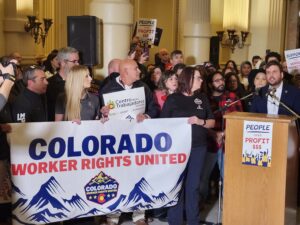
Rep. Javier Mabrey, the Denver Democrat who once again will cosponsor the measure in the House, instead argued that politicians pay too much attention to “millionaires and billionaires” and not enough to working-class voters. He pointed to a Colorado Fiscal Institute report from 2024 showing that union workers in similar jobs as non-union workers earn 10% more — enough that Colorado workers could earn an average of $2,300 more annually if organized.
“We passed the Worker Protection Act, and then the governor vetoed it,” Mabrey said, drawing a stream of boos from the large assembled crowd. “Let’s be absolutely clear about one thing. We don’t need another task force to figure this out. We need a governor who stands with workers.”
Bill to send political message about unionization
The bill’s sponsors also will include Democratic Rep. Jennifer Bacon of Denver and Democratic Sen. Iman Jodeh of Aurora. Jodeh is the only new member of the sponsoring quartet, replacing Senate Majority Leader Robert Rodriguez of Denver.
Other legislative supporters attended Thursday’s announcement, including Democratic Sen. Julie Gonzales of Denver and Democratic Rep. Manny Rutinel of Commerce City.
The announcement of the bill comes six days before Wednesday’s launch of the 120-day legislative session. And it comes during an election year when progressive Democrats — including Gonzales, who is challenging Democratic U.S. Sen. John Hickenlooper in a primary — seek to send a message that their party must pay more attention to working-class Coloradans.
It is extremely likely that the new bill to upend the Labor Peace Act once again will pass both legislative chambers and land on Polis’ desk. The question now is whether the proposal is more of a messaging bill about the party’s intentions ahead of an election to choose the term-limited Polis’ successor or whether sponsors will find a new pathway to pass it into law.