
Last year, supporters of a bill to protect workers laboring in extreme temperatures brought forth a bill that even sponsoring Rep. Meg Froelich called “incredibly prescriptive.” They ended up killing it themselves after they saw it “set the business community on fire.”
Version 2.0 of the bill, now House Bill 1272, will go for its first committee hearing Wednesday, with the successor proposal focusing a lot more on data gathering and a lot less on new rules for employers to follow. But business groups still plan to show up and oppose a measure that many fear is just a first step toward regulation, disguised as best-practices legislation.
The bill, which changed significantly from its 2025 form to its draft form and then changed again as it moved from draft form to the introduced version, is set to evolve once again, Froelich told The Sum & Substance. In making further amendments, she’s looking to quell opposition that includes business groups, contractors’ associations, local governments, public-safety groups, agricultural interests and companies from airlines to ski resorts whose employees work outside.
As introduced, HB 1272 requires the state to get data from employers and public agencies on workplace heat- and cold-related injuries and develop model injury-prevention plans, make employers craft their own safety plans and then write universal training standards. However, Froelich and cosponsoring Rep. Elizabeth Velasco plan in committee to remove the requirements for employers to report injuries and develop individualized safety plans and for state regulators to implement training standards.
Less regulations with similar impact?
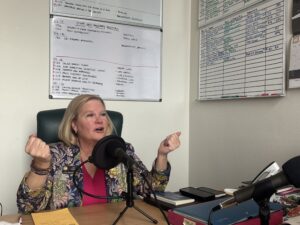
Colorado state Rep. Meg Froelich discusses her extreme temperatures bill on the “Colorado Chamber Office Hours” podcast.
The aim now, Froelich said, is to prove that workers are suffering from more heat- or cold-related injuries during a time of climate change — or to disprove that theory — and then to create and circulate to employers what their minimum standards of precaution should be.
“I think it’s an acknowledgement that we need to be reactive,” the Greenwood Village Democrat said. “We’re going to have hotter and hotter days … and workers deserve to be protected.”
Employers don’t disagree with the need to protect workers, but they disagree with the way that legislators are going about doing so, for several reasons.
First, the federal Occupational Safety and Health Administration already oversees worker safety, meaning that any involvement from the state government is going to duplicate those efforts and confuse employers on what standard they should follow, said Michael Gifford, advocacy director for the Associated General Contractors of Colorado.
Second, while contractor groups have tried to be responsive to concerns from labor groups, there doesn’t appear to be a push among labor organizations to pass the bill, Gifford said. Just one labor group is registered as backing HB 1272 — Teamsters Local 455 — as most supporting organizations are environmental groups like Conservation Colorado and GreenLatinos or Latino advocacy groups like COLOR Action Fund and Voices Unidas Action Fund.
A distrust of proposal on extreme temperatures by business leaders
Lastly, particularly after last year’s conflagration, business groups don’t trust that the data the bill seeks to collect is information for information’s sake or even for the sake of just creating best practices. Too often, discussions like this lead to new regulations, and Western Slope business advocates in particular worry about how any new requirements could impact small farmers, landscape companies or even restaurants that already are struggling to stay afloat.
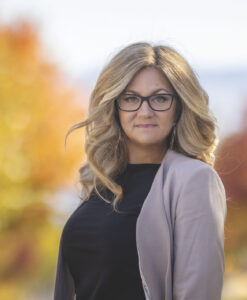
Candace Carnahan is president/CEO of the Grand Junction Area Chamber of Commerce.
“They’ve discussed it as ‘We’re just here to collect data and keep it simple’ and ‘Don’t worry, we’re going to create a model plan for you,’ but I think that’s much of the same as we’ve heard before,” said Candace Carnahan, president/CEO of the Grand Junction Area Chamber of Commerce. “At least we knew what the bad was in the last bill. This version is ‘Trust us.’”
Froelich, however, said the parts of the bill she hopes to push forward are needed so that nobody will just have to trust anyone else. By collecting data on workplace injuries, the state will, for the first time, know exactly how serious the impacts of extreme weather are on workers, she said.
And by requiring the Colorado Department of Labor and Employment to develop one model temperature-related injury and illness prevention plan for all employers — what she calls a “TRIIP in the box” — the state would help employers of all sizes without forcing anything on them, she said. These efforts, she believes, fulfill the mandate she got from the business community after the death of last year’s bill to be more collaborative and less regulatory.
Latino groups lead charge for extreme temperatures bill
The bill is particularly important to groups like Voices Unidas, a Western Slope Latino organization, because Latinos and Latinas are proportionally overrepresented in jobs where extreme temperatures become a problem, president/CEO Alex Sanchez said. In fact, national research shows that heat is the number-one cause of on-the-job injuries for people of color is heat, which makes it so important that the state step in and advise businesses about how they can work better to protect those workers, he said.
“This is not an everyday worker problem,” Sanchez said in an interview. “This is when a business chooses to keep an employee working outside when other companies tell their workers to stay home.”
Gifford acknowledged that the 2026 version of the bill is far less regulatory than the 2025 version, which required, for example, that employers supply at least 32 ounces of water per worker, chilled to no less than 60 degrees, when temperatures reached 80 degrees. But it still ignores the fact that industries such as his already have created model policies for providing warming opportunities when it’s cold and providing shelter and water when it’s hot — and have stood up one of 28 OSHA training institutes in the United States, he said.
Overregulation even without specific regulations?
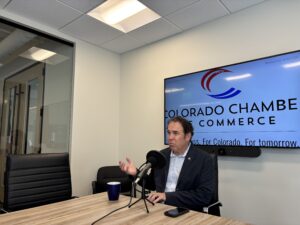
Michael Gifford, advocacy director for the Associated General Contractors of Colorado, discusses the bill on extreme temperatures on the “Colorado Chamber Office Hours” podcast.
This year’s bill represents duplication of those efforts that could create increased costs, particularly if the model plans do end up leading to mandatory training, Gifford said on the “Colorado Chamber Office Hours” podcast. He wants to tell legislators that the private sector is taking the lead on things that state has recommended that it do and that raising government involvement, even if it only leads to model plans and data collection, is not helpful when employers are struggling with other regulations and increasing costs.
“It seems like we’re starting to see these bills about the state wanting to get into the safety business,” he said, referencing the passage last month of HB 1054, which would allow the state to enact workplace-safety rules if the federal government rolls any back. “This is duplication of effort because we are still regulated under federal OSHA.”
The hearing on HB 1272 is scheduled for 1:30 p.m. Wednesday in the House Health and Human Services Committee. It is slotted for fifth on the agenda.