Following a debate that seemed almost muted compared to last year’s spirited slugfest, the Colorado Senate passed a bill Friday to overhaul the Labor Peace Act that governs private-sector unionization in Colorado, sending the measure to Gov. Jared Polis.
The Democratic governor has said since before this year’s introduction of House Bill 1005 that he’s very likely to veto the bill, as he did in 2025 over concerns that it doesn’t represent consensus between business and labor and could hurt Colorado’s economy. The fact that union and employer representatives haven’t sat down with him to negotiate a potential compromise — something they did last year — reinforces the notion that Polis has no inclination to take a different tact to what would be a major shift in state labor policy.
With so much uncertainty last year surrounding the fate of the bill — which was almost a mirror image of what was introduced and passed through both legislative chambers this year on a Democrat-led, fully party-line vote — tension during 2025 floor debate was high. But while the House revisited that dynamic the year, the Senate engaged in just over an hour of debate on Thursday, followed by a final tally Friday before which no Republicans felt the need to get up and speak against HB 1005.
Those who spoke for the bill argued that the 83-year-old LPA is an antiquated law aimed at giving employers an advantage over union organizers, despite business calling it a unique law that brings an unusual balance to workplace negotiations in Colorado. The law requires a majority vote of workers to unionize, as do rules in all other states, but then mandates a second election that must get 75% support if labor groups are to get “union security” and have negotiating dues taken directly from all workers’ paychecks.
“Creative union-busting”

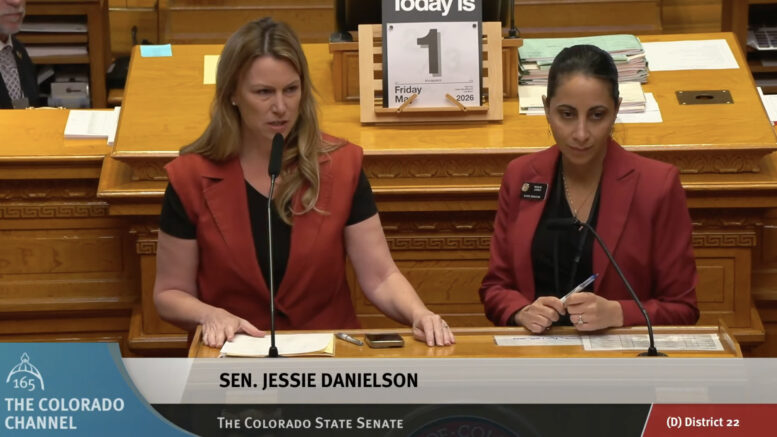
Colorado state Sen. Jessie Danielson speaks to a large group of union supporters in January about the need to rewrite the Colorado Labor Peace Act.
Requiring a second vote gives anti-union employers months to intimidate workers into rejecting union security, and it’s left Colorado with the lowest private-sector unionization rates of any non-right-to-work state, said cosponsoring Sen. Jessie Danielson, D-Wheat Ridge. Eliminating it will give unions a chance to begin negotiating higher wages and better benefits for workers once the first vote is certified, and that will lead to safer workplaces and higher pay at a time when too many workers struggle to afford to live in this state.
“In Colorado we have a unique barrier that was designed to prevent people from joining unions. It’s creative union-busting, but it’s union-busting nonetheless,” she said Friday, wearing the traditional red colors of May Day that signify worker solidarity. “It works very, very, very well for the billionaires, for the corporations, for the elite and for the wealthy. It does not work for the workers.”
Business leaders maintain, however, that Colorado, despite its rising cost of living and doing business, holds a competitive job-growth advantage over states that require just one vote to unionize and implement union security, as the Labor Peace Act creates stability. A total of 22 states require just that single vote, while 27 right-to-work states bar workplaces or workforces from requiring union membership as a condition of employment.
Shortly after Friday’s 23-12 approval of HB 1005, also sponsored by Democratic Sen. Iman Jodeh of Aurora, National Federation of Independent Business state director Michael Smith urged Polis to veto the effort again this year and protect the Labor Peace Act.
Affordability and the Labor Peace Act
Employment attorney Stacey Campbell, third from left, speaks as part of a business panel opposing changes to the Colorado Labor Peace Act during a legislative committee hearing in February.
“The overwhelming majority of Coloradans oppose removing the second-vote requirement of the Labor Peace Act,” Smith said, harkening back to polling done during the more intense battle over the bill last year. “Removing the second-vote requirement would make it significantly more difficult for job creators to manage their workforce, control costs and keep their doors open.”
As with many bills this year, both opponents and proponents invoked Colorado’s high cost of living — the state is ranked third- or fourth-most expensive in most studies — to justify their position on the bill.
Backers pointed to a 2025 Colorado Fiscal Institute study noting that union workers earn an average of 10% more than non-unionized workers doing the same jobs nationally and estimated Colorado workers could earn $2,350 more annually if the Labor Peace Act is overturned. That boost in salaries would give workers more of a chance at buying a house in a state where the average single-family home price exceeds $560,000, and it would give them a better shot at getting good health and retirement benefits, union leaders said.
Business leaders noted that the median Colorado salary already exceeds the national average and warned the rise in labor expenses that would come with easier union security would put another strain on businesses struggling with rising operating costs, likely causing some to stop hiring or close altogether. Also, they argued that while a majority vote is fine for unionization, the bar should be higher for allowing unions to take negotiating fees of around 2% directly from paychecks, particularly those of workers who oppose the union.
“What’s the need for change?”
Republicans tried and failed to make several amendments during Senate debate Thursday to narrow the scope of the bill. Those included efforts to exempt businesses with less than 50 workers, businesses that are less than 10 years old and businesses earning less than $10 million in annual revenue from the proposed new rules allowing unionization and union security in a single vote.
Sen. John Carson, R-Highlands Ranch, pointed to a recent Colorado Chamber of Commerce study that noted 98 employers either relocated or expanded out of state since 2019, costing Colorado 13,607 jobs. HB 1005 would represent another hit to Colorado’s business atmosphere and likely would push more companies to move out of state or at least not consider adding workers here, he said.
“To me, this is one of the pieces of legislation where you have to ask yourself, ‘What’s the need for change?’” Carson said on Thursday. “I think it’s pretty clear that Colorado is becoming a less desirable state for companies to move to and remain in and create jobs. The entrepreneurial Western spirit that we’ve clung to for so many years is fading.”
Labor Peace Act debate likely to return in 2027
Labor leaders, however, say the ‘why’ in their push is to wrest back power from wealthy corporations who have kept pay growth below the rising cost of living and have made it harder for workers to climb into the middle class. They have called the current system “rigged” and said the state needs to do more to honor the contributions of its workforce.
“Colorado law should protect the freedom of workers to band together to fight for workplace safety, benefits and the chance to earn a decent wage — not get in their way,” Jodeh said. “This bill puts Colorado in line with other states and creates opportunities for Colorado workers to realize their American dream.”
With Polis very likely to veto the bill again, many observers have asked if the point of this year’s debate is to raise the profile of the issue for the two Democrats running this year to succeed the term-limited Polis, U.S. Sen. Michael Bennet and Attorney General Phil Weiser. Both have said they believe the Labor Peace Act should be amended, but both have so far stopped short of supporting the full repeal of the second vote the Legislative Democrats have championed.