

With less than two weeks remaining in the 2026 legislative session, Colorado Senate Majority Leader Robert Rodriguez introduced one of the most anticipated bills of the year Friday, setting the stage for critical reform of the state’s artificial-intelligence regulations.
Senate Bill 189 is the culmination of two years of efforts to fix a 2024 law that represents the most comprehensive AI regulation in the nation but is viewed by everyone from technology leaders to school districts as being too burdensome. Both a task force and a governor-appointed working group have endeavored to come up with solutions, and the working group put forward a detailed framework six weeks ago that largely got incorporated into the new bill, which is expected to get its first committee hearing early next week.
SB 189 seeks to regulate automated decision-making technology that specifically is used to make consequential decisions regarding individuals and ensure that its output does not involve algorithmic discrimination. It defines consequential decisions as those impacting education, employment, housing, financial services, insurance, health care and essential government services — everything from consideration of a job application to critical decisions on medical procedures.
Rodriguez, in an interview for the “Colorado Chamber Office Hours” podcast, said the tone and focus of this new bill are different than Senate Bill 24-205, whose enforcement a federal court recently halted. That law is supposed to go into effect on June 30, but Attorney General Phil Weiser has delayed rulemaking while legislators look to come up with an alternative, represented now by SB 189.
How this changes existing AI law
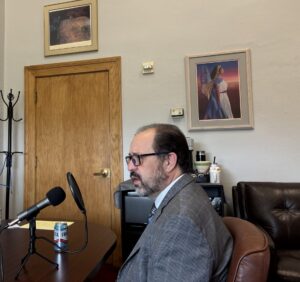
Colorado Senate Majority Leader Robert Rodriguez discusses his AI bill on the “Colorado Chamber Office Hours” podcast.
The 2024 law sought to make developers and deployers undertake comprehensive assessments of discrimination risks of their AI systems and to lay out for users and the Attorney General’s Office potential algorithmic problems. SB 189, however, is focused more on ensuring people know that AI is assisting in making critical decisions about them and allowing them, in the case of adverse decisions, to fix information that the systems have about them.
“It’s not as much of a comprehensive disclosure bill. It’s more just like a notice bill,” Rodriguez said. “It is a lot less rigorous requirements, but I think it still gets at some of the basic goals.
“It doesn’t have everything I want, it doesn’t have everything the consumer groups want. And it doesn’t have everything business wants … And sometimes when not everybody’s happy, you’re in a good place,” the Denver Democrat continued. “I feel comfortable that while I didn’t get everything I wanted, neither did everybody else.”
That sense of effective compromise is shared by Liz Peetz, the vice president of government and community affairs for Comcast who was very involved in negotiations.
“The product of a lot of compromises”
Every industry will have to determine how the requirements of the bill will change the way they operate, including small businesses who may use AI for nothing more than screening resumes, she said. But unlike some of the mandates in the 2024 law, these regulations seem doable for all sizes of companies, she said.

Liz Peetz, Comcast vice president of government and community affairs, discusses the AI bill on the “Colorado Chamber Office Hours” podcast.
“What is good about this bill is that more businesses are in the position where we are saying ‘This is slightly better than 205,’” Peetz said. “The liability was the hardest part to figure out for both consumers and the business groups because we were so far apart. And this bill was the product of a lot of compromises.”
After Polis signed the 2024 law with reservations, he put together a task force that tried to iron out issues during the 2025 regular and special legislative sessions, but no agreement could be reached. After that, he organized the working group, which met in private and spent long hours debating until it could find consensus.
The issue of liability was one of the biggest sticking points during debate in last year’s special session.
SB 189 throws out the proposed joint and several liability that tripped up the special-session efforts and replaces it with provisions that allocate fault between developers and deployers of AI systems based on the intended use of an AI system in a consequential decision. The Attorney General’s Office has sole responsibility for enforcing the law under the Colorado Anti-Discrimination Act, and there is no new private right of action enabled in the bill.
Responsibilities of AI developers, deployers
Developers of AI systems — a nascent but growing industry that neither Polis nor business leaders wanted to scare off with overregulation — must provide deployers with a description of the technology’s intended uses. Deployers — any business, nonprofit or governmental organization using AI in consequential decisions — must inform consumers of the presence of the automated decision-making technology at their point of interaction with a covered AI system.
Within 30 days of a consequential decision, deployers must inform consumers of the AI system’s role in that decision and offer consumers the right to meaningful human review of an adverse decision as well as the right to correct inaccurate personal data that may have been used in the decision. Such requirements are far less burdensome than those outlined in the 2024 law, which some critics said could have required the allowance of individual consumer appeals of any adverse decision to both developers and deployers of the AI.
Lastly, the new bill, at the working group’s request, would offer deployers or developers a right to cure identified violations, though Rodriguez added a three-year sunset on that provision so that affected parties didn’t have an indefinite get-out-of-jail card, he said. SB 189 would require the Attorney General’s Office to complete rulemaking on the specific provisions of the law, such as how adverse-income notifications must be handled, by the end of this year, in time for the law to go into place on Jan. 1.
Less stringent but no less effective?

Colorado Senate Majority Leader Robert Rodriguez speaks about his AI bill on the Senate floor in 2024.
Rodriguez, a leader in national discussions about AI regulations, acknowledged that he originally wanted a more stringent framework that included requirements like developer testing of algorithms for potential discrimination. But he believes the liability requirements that remain in the bill will serve as incentives to those companies to ensure before the products go onto the market that they don’t cause harm.
And while the U.S. Department of Justice has joined in a lawsuit filed against the 2024 law by Elon Musk’s xAI that claims the law violates developers’ First Amendment rights, Rodriguez said he did not structure SB 189 to meet federal concerns. He believes the lawsuit is without merit and that courts will find that states — and, maybe, eventually the federal government — have the right to regulate artificial intelligence to protect their residents from harms that can be done to them.
“If you look at polling, most people think we don’t regulate AI enough … I think technology should be built on trust,” said Rodriguez, who has brought on Senate President James Coleman as his primary cosponsor for the bill. “Is it a perfect bill? No. But nothing ever is. And the technology is going to change a lot.”
SB 189 got an initial vote of confidence Friday from The People’s Alliance for Responsible Technology, a coalition of labor and civic organizations that formed after the working group offered its recommendation to demand transparency and accountability from Big Tech. The group issued a statement saying it is “cautiously optimistic” about the bill because it “provides a path to hold developers and businesses using AI accountable” for consequential decisions.
Other AI bills continue to be debated too

Colorado state Reps. Javier Mabrey and Gretchen Rydin discuss their bill to regulate AI in psychotherapy on the House floor last month.
The consumer worries that led to development of SB 189 have spawned other AI-focused bills this legislative session, including measures to regulate its usage in health care and psychotherapy and to put more guardrails around increasingly ubiquitous chatbots. All three bills remain on the move through the General Assembly.
Peetz said that individual businesses must look at the bill now to understand how it will affect them and whether those regulations are acceptable. While the biggest impact for her company likely will involve its use of AI in hiring, everyone from home sellers to insurance company executives to loan officers would be touched differently by SB 189, and they must understand what they have to do in reaction.
But in general, she feels that this proposal will be easier for smaller companies to comply with than the existing law, especially in the way they do not have to do the same extensive assessment of AI systems’ potential faults. And after what has now been almost four years of work on the issue, stretching back to the original two-year process to develop SB 24-205, she feels this new bill has settled in a good place.
“What the business community has focused on is: ‘Are the disclosures something we can comply with?’” she said. “Is it perfect? No. But I think that everybody feels that they got a little something out of the process.”