Gov. Jared Polis began his post-session bill-signing spree with a laser focus on business Thursday, inking laws that require more frequent regulatory reviews by state agencies and that rewrite artificial-intelligence guardrails to make them more industry-friendly.
By choosing those two bills as his first laws to highlight the day after the 2026 legislative session adjourned, the Democratic governor sent a signal that he wants to make Colorado a better place to do business by cutting regulations and making it easier to operate here. One law, signed just two days after its final passage, sends an immediate signal to a skeptical tech industry that Polis is trying to revamp the state’s reputation with it, and the other tells all employers that Colorado will look to ensure they’re not overburdened.
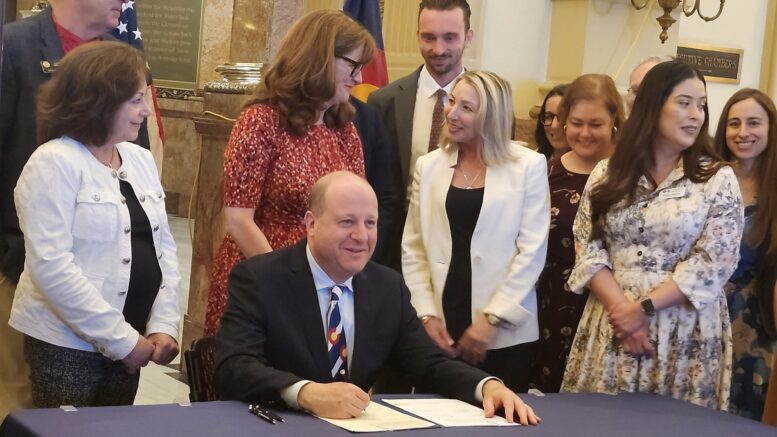
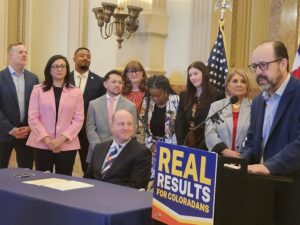
“I’m so excited to be lowering the cost of doing business in Colorado and streamlining regulation,” Polis said before he made into law the regulatory-review bill, Senate Bill 137, in front of supporters and media in the west foyer of the Capitol. “There’s always talking points about ‘We need more regulation or less regulation.’ It’s about smarter regulations.”

Gov. Jared Polis discusses the merits of a new regulatory-review law at a Capitol news conference on Thursday.
A bipartisan call for regulatory change
Regulations were one of the primary themes of this year’s legislative session, as business groups argued that excessive rules have made Colorado a more expensive and less attractive place to do business and contributed heavily to the 11,000 jobs lost in 2025. A study commissioned by the Colorado Chamber of Commerce found that the Centennial State is the sixth-most-regulated in America, and another study done by the organization found that 98 major employers have moved or expanded out of state since 2019 because of these burdens, taking with them more than 13,000 jobs.
Senate Bill 137, said House Speaker Julie McCluskie — who sponsored it with Senate President James Coleman, House Minority Leader Jarvis Caldwell and Senate Minority Leader Cleave Simpson — is not about slashing regulations so much as it’s about “good governance.” It will require state agencies to review all their regulations at least once every five years for rules that may be redundant, outdated or missing the aim of the law and to present reviews to legislative committees that can then seek audits or sunset reviews of the rules.
Polis, McCluskie and Coleman all singled out the Colorado Chamber for bringing the idea to them and said discussions caused them to ask whether government oversight can be done in a way that encourages rather than ties down job creators. Simpson said it answers calls he too has heard from businesses that are overburdened, and Caldwell said the bipartisan sponsorship from all four legislative leaders should send the signal that businesses can feel more confident about their relationship with the state.
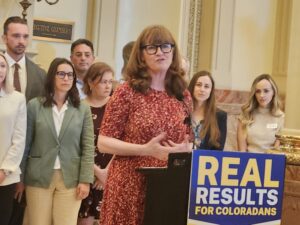
Colorado House Speak Julie McCluskie discusses the regulatory reform bill that she sponsored during a Capitol news conference on Thursday.
Seeking to improve economic competitiveness
“We have heard the message clearly: Government should be a partner, not an obstacle,” Coleman said. “Good policy doesn’t just create new programs. Sometimes good policy removes barriers that stand in the way of innovation.”
SB 137 was the Colorado Chamber’s priority bill for the 2026 session, an effort to get state leaders to rethink the rules that govern employers and find a way to make them less costly and more efficient without diminishing public safety or health. The bill passed the two chambers by a combined margin of 90-8, drawing support even from legislators who have authored substantial new regulations in recent years but said the state still should examine them to ensure they are working as intended.
In addition to being the sixth-most-regulated state in American by the StratAcumen study, Colorado ranks as the third or fourth most expensive state to live, depending on the source, and in the top quartile of states for the cost of doing business. Where it formerly was a regular near the top of CNBC’s Top States for Business rankings, it’s now fallen out of the top 10.
“It’s become abundantly clear that in order to improve our competitiveness as a state, proactive regulatory reform had to be our top priority,” Colorado Chamber President/CEO Loren Furman said before the signing. “This is a critical step in improving our economic climate and positioning Colorado as a top state for business once again.”
In need of a new AI regulatory framework
The same could be said — and was said by several people on Thursday, including Polis — about SB 189, which overhauls Colorado’s regulations around AI. Legislators passed a 2024 law viewed as the most comprehensive set of AI rules by any state, but after technology-industry leaders and even school districts said the law was too burdensome, Polis put together a working group last fall to recommend changes.
Where the 2024 law was focused on requiring assessment and disclosure by AI developers and deployers on how their systems work and where they could discriminate against people, SB 189 is more of transparency bill around consequential decisions AI makes.
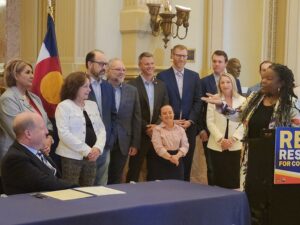
Colorado state Rep. Jennifer Bacon, cosponsor of the AI regulatory bill, explains Thursday about how opposing groups came together to work out a compromise on the proposal.
It requires users to be informed when AI plays a major role in decision-making on subjects from job interviews to loan applications and allows aggrieved parties to request human review and correct erroneous information used by the AI system in its calculations. The law requires developers to explain their systems to deployers — from big corporations to small employers winnowing resumes — and gives the Colorado Attorney General enforcement authority to prevent discrimination by automated decision-making technology.
“Business and consumers came together”
Participants from Big Tech firms to the ACLU of Colorado and from business associations to the Colorado Cross-Disability Coalition spent six months working to hammer out the new rules and all stood by Polis as he signed SB 189 on Thursday. Cosponsoring Rep. Jennifer Bacon, D-Denver, said she believes that the thorough debates and discussions that led to the final product should serve as a model for how legislation can be developed.
“I think it’s very important that businesses and consumers came together. Hopefully, this is an example of how we can walk together in a Colorado environment we are proud of,” she said. “Despite the back-and-forth that has happened since 2024, I think we learned here what is positive when we have these conversations.”
To understand what the law is meant to prevent, one needs only go back to the first hearing for SB 189 — before the Senate Business, Labor and Technology Committee — and remember the testimony of Dr. Michelle Daily, an attorney and veterinarian who decided to start a third career at age 60 and applied for scientific-writing jobs. She couldn’t get a single interview and later learned from a career coach that AI programs were rejecting her because she had too much experience and because her range of degrees were outside the narrow window in which they were taught to look.
“SB 189 is not ideal. But in my case, it would have made a difference,” said Daily, pointing to its allowance for a request by human review.
“The way these smart policies go”
Colorado Senate Majority Leader Robert Rodriguez discusses his AI regulatory bill before Gov. Jared Polis signs it on Thursday.
Senate Majority Leader Robert Rodriguez, the sponsor of both the 2024 law and SB 189 who is term-limited from running again and will have to watch implementation of his efforts from afar, said he believes the consensus around the new bill testifies to its efficacy. It passed the two chambers on a combined vote of 91-7 and will launch rulemaking by the AG’s office later this summer before it goes into effect on Jan. 1.
“We got a bill across the finish line that nobody’s thrilled with but that everyone can live with. And that’s the way these smart policies go,” said Rodriguez, D-Denver. “AI isn’t going anywhere as it seeps further into the lives of the people of Colorado.”
Polis has until June 12 to sign or veto the rest of the bills passed this year by legislators. Asked on Thursday whether he has specific plans to veto any of them, he demurred, saying his staff will undertake legal and implementation analyses of each of the bills.