
Regulation of artificial intelligence — which has been one of the most divisive legislative subjects in recent years, producing several failed efforts at consensus in 2025 — is sailing through the final days of the 2026 session with a surprising unanimity.
Members of the Senate Business, Labor & Technology Committee advanced Senate Bill 189, the recently introduced proposal to update the state’s much-criticized 2024 regulatory framework, out of its first hearing on a 5-0 vote on Tuesday. And while several groups, including both labor advocates and technology associations, asked for amendments to the measure, no one stepped up to testify in opposition to the effort.
While SB 189 still must pass the Senate and the House in the remaining eight days of this session, the bipartisan support in the first hearing was a huge juxtaposition from last year, when three attempts to reform the 2024 law failed under criticism from multiple interests. And it demonstrated that after years of fits and starts, including the passage of the original bill that immediately drew criticism from Gov. Jared Polis and led to creation of a special task force to fix it, Senate Majority Leader Robert Rodriguez may have found the bones of a regulatory structure that everyone can support.
The roots of that consensus came when Polis, frustrated by the unhealed divisions of that original task force that debated in public, called together a second working group last summer that began meeting in private and hashing out differences outside the spotlight. After meeting for several months longer than originally planned, that group offered a working document in March that was signed off on by all its members — from unions to consumer groups to business associations — that largely became SB 189.
How the new bill changes the existing AI regulatory framework
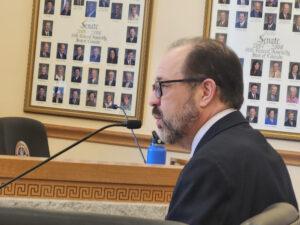
Colorado Senate Majority Leader Robert Rodriguez explains Senate Bill 189 to the Senate Business, Labor & Technology Committee on Tuesday.
“Every substantive element of this framework represents a significant compromise,” said Berrick Abramson, the president of Confluence Policy & Strategy Group who facilitated the working group, during Tuesday’s committee hearing.
Business and technology leaders, as well as Polis, criticized the 2024 law as being too burdensome for AI developers and deployers, as it required completion by both of extensive risk analyses to determine the possibility of algorithmic discrimination. It also offered an appeal process for consumers upset by a consequential decision influenced by AI that could have inundated everyone from tech giants developing automated decision-making technology to school districts experimenting with it.
SB 189 scraps the risk-assessment requirements in favor of transparency, mandating that AI deployers inform affected parties when the systems help to make a consequential decision and then report what information it used to reach that decision. Consequential decisions include those involving employment, housing, financial or lending services, insurance, healthcare services, education and essential government services, and those unhappy with the outcomes can ask to review and change the factual data on them.
Diverse interest groups come together to back bill
Developers are not off the hook, however. The bill would require them to provide deployers — everyone from major healthcare systems to small employers using AI to sift through job applicants — of the technology’s intended uses, its known limitations and risks, the categories used to train the AI and instructions for its appropriate use. Both developers and deployers still could be held liable for violations of the Colorado Anti-Discrimination Act if the systems show harmful bias, with liability assigned based upon their relative fault.
If SB 189 passes, the Colorado Attorney General’s Office would begin rulemaking right away and be required to finish it by the end of this year in order for the law to be implemented in January.
Organizations representing the most likely deployers of AI systems and groups affected by consequential decisions — including hospitals, educators and advocates for low-income and disabled people — said the framework is more workable than that of SB 205. And business leaders, stinging from the out-of-state move of software giant Palantir because of the 2024 AI law and other companies expressing hesitation to grow in Colorado because of it — said Tuesday that the new bill corrects the biggest existing issues.
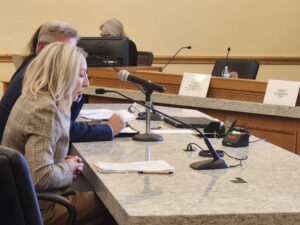
Colorado Chamber of Commerce President/CEO Loren Furman testifies for SB 189 on Tuesday.
“We found the balance that addresses the interests of businesses and consumers and keeps Colorado a place where companies want to do business,” Colorado Chamber of Commerce President/CEO Loren Furman told the committee.
Slew of amendments requested for AI bill
But while no one stepped out to ask that the bill be rejected, numerous groups asked Tuesday for changes. And while Rodriguez made only two small amendments in committee, it’s likely that such pleas will continue over the next week-plus.
Several labor groups, including the Colorado AFL-CIO and CWA Local 7799, requested the removal from the bill of a right to cure that gives developers and deployers 60 days to fix identified problems — and that would sunset in three years, at Rodriguez’s urging. That right strips workers and consumers of one of their primary protections against discrimination, CWAA Local 7799 President Jade Kelly said.
AFL-CIO communications director Robert Lindgren said that without the required risk analyses, impact assessments and annual reports from AI developers and deployers that are mandated under SB 205, workers have fewer protections and need changes to the new bill. Serena Oduro, policy manager at the Data & Society Research Institute, said she would like to see requirements added to make both developers and deployers audit their systems and report the results on an annual basis.
Private right of action?

Colorado state Sen. Nick Hinrichsen listens as University of Colorado Boulder associate professor Jed Brown testifies on SB 189 Tuesday.
Jed Brown, a University of Colorado Boulder associate professor of computer science, said that he expects legions of complaints to come in from impacted state residents based on studies that have found widespread algorithmic discrimination in such programs. He asked that sponsors add a provision to the bill allowing private lawsuits against those parties rather than leaving enforcement of the law in the hands of the Attorney General’s office — a provision business leaders fought hard to keep out of SB 189.
“The AG’s office is not resourced for the massive scale of violations needing remedies,” Brown predicted. “I recommend a private right of action.”
Several technology-sector leaders also are seeking changes.
Andrew Wood, regional executive director for industry group TechNet, warned that reports required from deployers to consumers who experience adverse impacts from consequential AI-made decisions could require disclosure of proprietary information. He asked that they be scaled back to require explanation only of the categories of information on individuals that informed the decision, not the sources and types of information as the bill now requires.
“Not about stopping innovation”
And while labor groups pushed for elimination of the right to cure in the bill, Cameron Onumah of the American Innovators Network asked Rodriguez not to sunset that right in just three years. Receiving notice to cure is a “critical Band-Aid” for an industry that will be adjusting to the most comprehensive regulations in the nation, particularly for smaller developers whose products will be used by much larger companies, he said.
Rodriguez — who is cosponsoring SB 189 with Senate President James Coleman, a fellow Denver Democrat — said he wrote the bill to focus on consumer protections rather than to focus on employment concerns. Colorado will be the only state that mandates disclosure notices when AI is making consequential decisions, he noted, and that should be viewed as a first step in protecting residents who express increasing unease about the power of automated decision-making systems.
“This is not about stopping innovation. It is about guiding it and establishing guardrails,” Coleman added. “We would not allow a human being to operate without standards of recourse, and we should not allow a machine to either.”

Colorado Senate Majority Leader Robert Rodriguez and President James Coleman, the sponsors of Senate Bill 189, confer during a break in a committee hearing on Tuesday.
Not the only AI bill under consideration
Three other bills seeking to regulate AI usage in certain situations also are moving through the Legislature, and all are, likewise, gaining significant support.
The same Senate committee on Tuesday gave unanimous backing to House Bill 1263, which would set guardrails for AI chatbots, particularly as they interact with minors and if the minor expresses any suicidal ideation. The bill is moving forward despite protests from several parent groups who say that it does nothing to rein in chatbots that have sexualized and depressed teens to the point where they killed themselves but only offers legal protection to the big tech companies that develop them.
Committee members also gave a 5-0 vote Tuesday to HB 1139, which would ensure that any use of AI in health care is transparent and that any decisions made regarding insurance coverage are subject to human review. Bill sponsors say they are working to ensure that patients are not subject to life-altering decisions made solely by a technology system.
Finally, the Senate Health & Human Services Committee is scheduled Wednesday to hear HB 1195, which would prohibit psychologists and psychotherapists from allowing AI systems to interact with clients without a human involved in real time and would bar systems from coming up with treatment plans without human oversight. That bill passed out of the House unanimously on April 16.