After a six-year period in which Colorado has seen a substantial increase in the number of regulations it imposes, a bill is on its way to Gov. Jared Polis’ desk that would require state agencies to review the impacts of those rules more often and more comprehensively.
Senate Bill 137 passed the House by an overwhelming 55-8 margin on Tuesday, with most, if not all, of its opposition, based on a clause in the bill that seeks to conform discovery rules involving cases brought by the Attorney General’s office to a recent court ruling. And after passing unanimously through the Senate and getting support from one of the Democratic governor’s cabinet directors, it seems certain that Polis will sign it into law.
SB 137, sponsored by the heads of the majority and minority caucuses in both chambers, would require state agencies to review rules at least every five years to determine if any are redundant, outdated or funded inadequately to support their functioning. Those reviews must ask also whether there are opportunities to improve the effectiveness of the rule.
Department officials then must present those rule reviews, which were supported by Colorado Department of Regulatory Agencies Executive Director Patty Salazar, to legislative committees during the annual SMART Act hearings that kick off each session. Committee members can request that DORA perform a sunset review to determine whether the rules should continue and can request audits on the regulations as well.
Regulatory overload leads to introduction of bill
Colorado state Rep. Ryan Gonzalez speaks for Senate Bill 137 on the House floor Monday.
The bill, supported by a litany of business groups, came after the Colorado Chamber of Commerce commissioned a 2024 study that found this to be the sixth-most-regulated state, with some 45% of the roughly 200,000 rules being outdated, redundant or excessive. The StratAcumen study found too that rules grew 7.1% from 2019 to 2023 — and grew again through 2025, according to a follow-up report — and that each 10% increase in regulations can lead employers to divert resources to compliance, costing some 36,000 jobs.
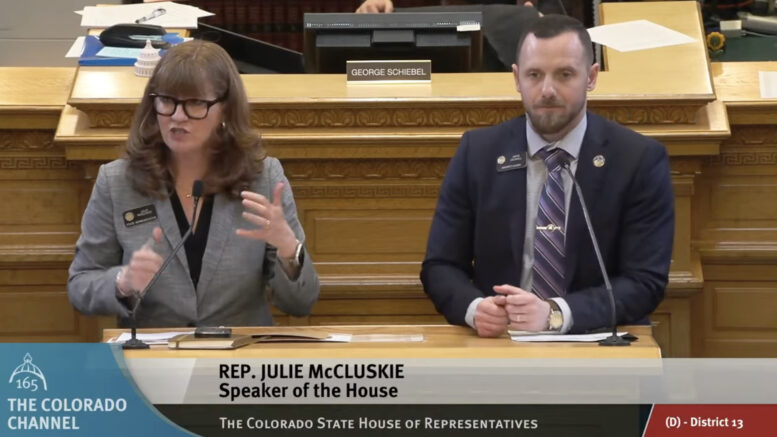
SB 137’s House sponsors — Democratic Speaker Julie McCluskie of Dillon and Republican Minority Leader Jarvis Caldwell of Monument — both used the same term during debate Monday to sum up the bill — “good governance.” McCluskie said this will give legislators a chance to ensure the bills they pass are working as intended, and Caldwell said these reviews ultimately will lead to a reduction in administrative burden.
“We have good bills come out of here. But we also have a lot of bad bills come out of the Legislature. So, we need to look at our regulatory climate,” added Rep. Ryan Gonzalez, R-Greeley. “I think we will see businesses continue to leave the state if we continue the trajectory we’re on with adding more rules and regulations.”
Regulations affecting companies’ location decisions
A recent report from the Colorado Chamber found 98 companies that either relocated away from Colorado or expanded outside the state since 2019, costing 13,607 jobs. Legislators and Polis have talked numerous times this session about making the state’s business environment more conducive for companies to move and grow here.
Through the House and Senate committee hearings, numerous groups discussed the impact of current regulations.
Colorado Bioscience Association Vice President Amy Goodman noted the state lost some $500 million in capital investment and more than 1,000 jobs in the past year as companies said they chose to expand elsewhere because of Colorado’s regulatory and cost burdens.
Colorado Association of Home Builders CEO Ted Leighty said that regulations add $93,870 to the cost of the average new residence in Colorado — 25% of construction costs for a single-family home and 40% of those costs for multifamily structures.
“The passage of Senate Bill 137 is an important step toward a more transparent and accountable regulatory system in Colorado,” Colorado Chamber President/CEO Loren Furman said. “As regulations continue to grow, it is critical to ensure they are working as intended and not creating unnecessary burdens for the business community.”
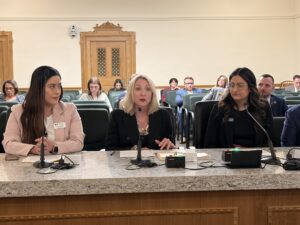
Colorado Chamber of Commerce President/CEO Loren Furman testifies for SB 137 in a House committee Wednesday while surrounded by fellow proponents Patty Salazar, the executive director of the Colorado Department of Regulatory Agencies, and Kara van Stralen, a business lobbyist.
Pushback on discovery provision
SB 137 passed unanimously through the House Business Affairs and Labor Committee on Wednesday and only got significant pushback from a cadre of conservative Republicans when it hit the floor. But that pushback had nothing to do with regulatory reviews.
Instead, GOP Reps. Stephanie Luck of Penrose and Ken DeGraaf of Colorado Springs railed against a provision in the bill that sought to clarify the powers and duties of the attorney general. Specifically, it states that the AG’s office is not deemed to be in possession of any record that is kept by another state agency for the purpose of discovery when the AG is bringing a case against an outside party.
Caldwell explained that the provision sprang from a judicial decision that found that parties seeking discovery of state records when sued by the Attorney General must use the process of third-party discovery on individual state agencies that hold those records rather than demanding that the AG’s office gather the records. Demanding such work from the Attorney General’s office is an administrative burden like the ones that the bill is trying to reduce, and the process can be “very expensive” for the state, he said.
Regulatory bill is “good governance”
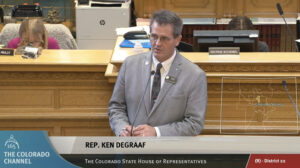
Colorado state Rep. Ken DeGraaf criticizes a provision in SB 137 on Monday that involves the Colorado Attorney General’s office and requests for discovery during legal actions.
Luck, however, said that the use of third-party discovery can be a lot more difficult for defendants. And DeGraaf, who said this provision had the potential of making public records less accessible for companies or individuals being sued by the state, tried unsuccessfully to remove it from the bill.
While those two were among the octet of Republicans who voted against SB 137 on Wednesday, others, such as GOP Rep. Chris Richardson of Elbert County, said that the main provisions of the bill are “a good first step” at reforming the regulatory process. And the sponsors said they believe SB 137 will end up streamlining regulations and increasing transparency around state rules.
“This is a good governance bill that would strengthen the regulatory review process to make our government more effective,” McCluskie said after its passage. “Our bipartisan effort would help ensure that Colorado’s regulatory system is working as intended.”