Roughly one month after Gov. Jared Polis warned while signing a bill regulating disposal of plastic pellets that the new law already needed a critical fix, Colorado legislators began the process of doing just that on Monday.
The Senate Transportation & Energy Committee gave unanimous approval to Senate Bill 171, which fixes a provision of the now-enacted Senate Bill 16 that the Democratic governor warned would make it difficult to dispose of the pellets at all. The Plastics Industry Association asked the committee to go further and relax some of the most punitive enforcement measures in the original bill, but members seemed more interested in just correcting a mistake in the bill and moving forward.
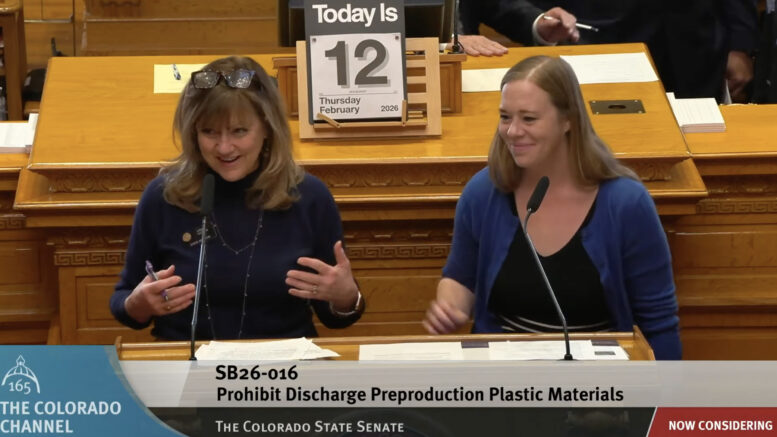
SB 16, sponsored like its successor bill by Democratic Sens. Lisa Cutter of Morrison and Katie Wallace of Longmont, bans the discharge of plastic pellets — lentil-sized pieces of material that are melted down by manufacturers to make everything from toys to kitchenware to computers — into Colorado waters, wastewater and stormwater runoff. Aimed at protecting animals and humans from ingesting the non-biodegradable materials that cause health problems, the law also prohibits the Colorado Department of Public Health and Environment from issuing permits for this type of discharge.
However, a provision in the law bars discharge of the pellets into land-based locations that can’t hold hazardous waste — a very limiting provision, as only a small percentage of landfills are permitted to take hazardous waste. And when Polis signed SB 16 on March 30, he took the unusual additional step of asking for an immediate follow-up bill to fix this particular provision.
Why existing law on is problematic
Not only would the provision have made it very difficult to dispose of preproduction plastic material anywhere, but it could have gutted state efforts to attract plastic recyclers who can take larger plastic materials and get them to manufacturers, often in pellet form. The creation of such an “end market” is one of the main goals of a statewide residential recycling program that is slated to launch later this year.
So, SB 171 removes its predecessor bill’s prohibition of disposing of these preproduction plastic materials anywhere that doesn’t have a state permit for the storage of hazardous waste. Cutter called it a very narrow bill just looking to clarify a section of a law that’s already in place, though other state officials described the change as consequential.
“Preproduction plastic materials are not listed as hazardous waste and are not characterized as hazardous waste. Yet SB 26-16 requires their disposal at hazardous waste landfills,” said David Snapp, who manages the solid-waste materials management program in the Colorado Department of Public Health and Environment’s hazardous materials and waste management division. “Requiring plastic recyclers and plastic product manufacturers to dispose of the waste generated from the plastic recycling process at hazardous waste landfills will likely place a large financial burden on plastics processors.”
Plastics industry is seeking more changes
Charlotte Dreizen, director of Operation Clean Sweep for the Plastics Industry Association, said that sector leaders supported SB 171 but also would like further changes to a law that they consider to be overly punitive. SB 16 carries administrative penalties of as much as $15,000 per violation and civil penalties of as much as $25,000 per violation, though sponsors removed proposed criminal penalties from the bill before it got to Polis’ desk.
Dreizen urged committee members on Monday to replace the penalties with what she called more productive solutions, including requiring manufacturers to train employees on plastic resin loss-prevention practices and conducting risk assessments at facilities. The current law contradicts with the federal framework for stormwater permits and, as such, will make it difficult for Colorado to attract plastic recyclers, she warned.
“With a goal of preventing plastic resin loss, it’s a little bit confusing to us why proactive strategies to do better and to be even more proactive didn’t seem to fit with that end goal,” Dreizen said.
However, Cutter any amendments to that effect would be outside the scope of the bill and would conflict with a law that’s already been signed.
The 2026 regular legislative session must end no later than May 13, giving the General Assembly just over two more weeks to pass the bill and get it to Polis.