
Gov. Jared Polis on Wednesday signed the last major effort of his tenure as Colorado’s top elected official to boost affordable housing, following a legislative session in which Democrats lost several big battles on the issue after a more-than-two-year run of success.
The Democratic governor inked House Bill 1065, which allows select local governments to use sales-tax-increment financing to boost transportation infrastructure within two miles of major transit hubs and offers tax credits for residences built within those zones. It follows the signing of three other laws that will permit by-right housing construction on land owned by government agencies and nonprofits, let county governments spend general-fund money on housing and make more people eligible for state housing assistance.
But it also follows the late-session defeats of bills that would have limited the minimum lot size local governments could demand in zoning ordinances and would have let property owners split their lots by right and sell portions for development of other homes. And legislators quietly killed a bill announced by Polis during the first week of the session that would have created new tax benefits for developers of affordable rental housing that would have been equal to tax breaks given to developers of owner-occupied housing.
What passed and what died
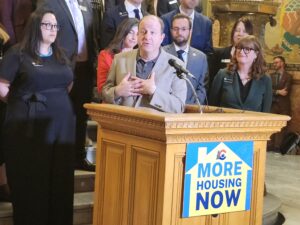
Gov. Jared Polis speaks Jan. 22 at a Capitol news conference on Democrats’ affordable-housing package for the 2026 session.
After two years in which Polis and legislative allies pushed through laws aimed at boosting the production of lower-cost housing around transit centers and at reviving a moribund condominium-construction market, this session represented a letdown of sorts for them. Yes, the governor was able to sign his signature bill of the session, but the constant fighting over the need to build more homes in Colorado versus the need to permit local control of community development seemed to tire even Polis’ biggest supporters.
What’s more, the killing of House Bills 1144 (limiting minimum lot size) and 1308 (allowing lot-splitting) ended the biggest efforts in years to boost market-rate housing rather than just subsidized housing, Colorado Association of Home Builders CEO Ted Leighty said. CAHB and other groups have argued that producing more market-rate housing will slow or reverse the rising costs for residences, as the competition will reduce the estimated 106,000-unit shortage of homes that keeps prices high due to product scarcity.
Leighty and Jia Meeks, a policy adviser and attorney with Brownstein Hyatt Farber Schreck, both said that after four years of local-control battles, those who had backed state pre-emption appeared they just wanted the fighting to end, even without passage of more laws.
“This year was more of a story of what didn’t get done. I think there was exhaustion and local-versus-state-control fatigue,” Leighty said in an interview after the May 13 adjournment of the session. “I think even those that supported previous bills with elements of pre-emption in them said, ‘We’ve done too much pre-emption.’”
Explanation of new housing laws
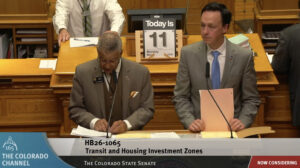
Colorado state Sens. Tony Exum and Dylan Roberts explain House Bill 1065 to the Senate earlier this month.
What did get done was:
- HB 1001, the HOME Act, permits school districts, colleges, housing districts, transportation agencies and other nonprofits to build housing up to three stories by right on five or fewer vacant acres of land they own, bypassing local land-use approval processes.
- Senate Bill 1 permits county governments to use general-fund revenues toward housing creation, allows the sale or acquisition of public property for housing and gives them more flexibility in the use of Middle-Income Housing Tax Credits.
- SB 40 expands eligibility for state affordable-home-ownership assistance to families making 120% of area median income, up from the current figure of 100%, and allows waivers to let people put more than 35% of their income to the prices in some instances.
- HB 1065 allows cities to apply to the state to create new investment zones in which they could use state sales-tax-increment financing to boost safety improvements and add transit stops within two miles of a transit hub. New housing projects focused on low- and middle-income earners within those zones then could generate new tax credits for developers — a total that could reach $50 million annually and $350 million over the next seven years before the credits expire.
Polis and sponsors celebrated the latest law at a signing Wednesday, saying that it added to previous laws focused on creating more affordable housing near transit stops that can allow residents to save money by going without a car. Laws passed in 2024 require greater building density near transit hubs, remove minimum-parking requirements from some urban multifamily housing developments and remove restrictions on the number of non-family members living together.
Different dynamics in housing debates

Gov. Jared Polis signs House Bill 1065 while surrounded by supporters of the housing bill on Wednesday.
“In Colorado, we are reenergizing our urban and rural communities to help more Coloradans live where we want to live in the communities we love,” Polis said, noting sponsorship of the bill by several mountain-town Democrats as well. “Transportation and housing go hand-in-hand. Unleashing amazing livable and workable spaces for people to thrive is what Colorado is all about.”
But while the bills could jolt new development, they are unlikely to change the dynamics of more established neighborhoods that make it harder for Coloradans to afford those homes or to build there. Only one bill passed so far — the 2024 law giving most homeowners the right to build accessory dwelling units like granny flats on their properties — is likely to impact that.
HB 1144 would have banned local governments from requiring minimum lot sizes any larger than 2,000 square feet; it wouldn’t have banned people from building on bigger lots, but it would have stopped the zoning of neighborhoods with only large lots. HB 1308, meanwhile, would have permitted existing property owners to split off portions of lots and sell those for greater home construction.
Backers said allowing construction on smaller lots is a key to slowing average home prices that now exceed $560,000 statewide. Housing economist Luke Teter noted land values rose 466% between 2012 and 2024, essentially necessitating that the only construction on larger lots would be of more expensive and larger homes. Jeff Handlin, a homebuilder representing CAHB at that same Feb. 18 committee hearing on HB 1144, said allowance of smaller lots would accommodate what many consumers want but can’t now afford.
A variety of reasons for failed bills
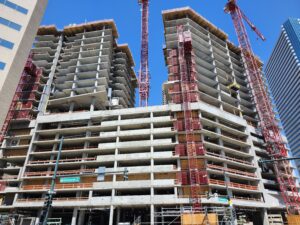
Multifamily housing goes up in downtown Denver.
But Bev Stables, the legislative advocacy manager for the Colorado Municipal League, said such changes that boost density in established neighborhoods also would impact water availability, transportation infrastructure and other factors that could change communities. And legislative opponents like Sen. Janice Rich, R-Grand Junction, said that the bills would yank the rug out from under people who had moved to communities because they had a certain feel and would undermine locals from designing their areas as they please.
Both bills passed the House but died in committees in the more moderate Senate. Meeks offered the supposition that they encountered more opposition precisely because rather than setting the tone for new construction, they would have impacted areas that long have been established.
“(House Bills) 1114 and 1308 were different in that you were really talking about existing residential property. Had those bills passed, you’re talking about changing the character of certain neighborhoods overnight,” he said. “At that point, you’re not talking only about local governments expressing an objection because local control is being eroded.”
HB 1066, the bill to extend tax credits now given to nonprofits developing affordable owner-occupied housing to those building affordable rental housing, died for a different reason: It carried a $432,000 fiscal note as the state faced a $1.5 billion budget shortfall. Sen. Cathy Kipp, chairwoman of the Senate Finance Committee, told the Colorado Chamber of Commerce Tax Council back in February that she didn’t “see the tax credits getting handed out like candy like they have been in the last several years.”
Efforts that pushed too far
Then there was HB 1119 — a bill that would have allowed local governments to impose property taxes on land and improvements at different rates, mirroring efforts like those in rebuilding cities like Detroit to impose land-value taxes that assess rates on the highest-value use of land and essentially penalize owners of underdeveloped land. While advocates said this could push owners of surface parking lots in some areas to develop multifamily housing instead, too many people said it would burden small businesses and inner-city homeowners, and it died in a bipartisan vote.
Finally, legislators who were advancing a separate bill that could have slowed housing development changed course in the final days of the session to avert a potential problem.
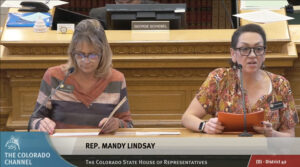
Colorado state Reps. Tisha Mauro and Mandy Lindsay explain Senate Bill 93 to the House earlier this month.
SB 93 sought to require local governments to ensure all contractors and subcontractors working on construction projects have workers’ compensation insurance by forbidding cities from offering building permits until they have checked that of each firm. Contractors warned this could grind permitting to a halt, and a fiscal note from the nonpartisan Legislative Council stated: “It may decrease municipal permit revenue and sales and use tax by limiting the ability to issue permits or discouraging applications for permits.”
But in the House Business Affairs and Labor Committee on May 6, cosponsoring Rep. Tisha Mauro, D-Pueblo, changed the bill so that building-permit applicants just must sign an affidavit that each contractor will provider workers’ comp insurance — and requiring cities to forward any violation allegations they receive to the state government. Mauro acknowledged as she did this that her goal for the bill is to protect workers and not to slow construction.
Polis has until June 12 to sign or veto SB 93 and all other bills passed during the 2026 legislative session.