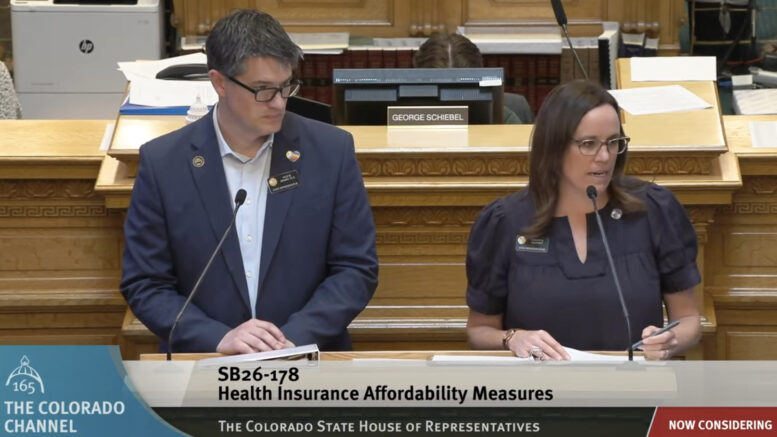
Gov. Jared Polis signed a bill Tuesday to give Colorado’s health-insurance subsidy program a one-time $140 million infusion to keep it solvent for one more year, temporarily ending a contentious debate on how to sustain the ailing Health Insurance Affordability Enterprise.
Senate Bill 178 originally sought to charge a fee to health insurers and their customers to foot the bill for some of the HIAE’s shortfall before pushback over the already rising cost of living in this state forced sponsors to rethink how to pay for it. What Democratic Sens. Kyle Mullica of Thornton and Iman Jodeh of Aurora settled on was the sale of as much as $140 million in bonds — $40 million funded by taking money from the reserve portion of the Marijuana Tax Cash Fund — to cover the costs.
What that solution nixed a proposed $40 million assessment on the state’s five largest health insurers — a fee that would’ve been passed along and raised premiums specifically for Aetna customers by $480 next year, company officials said — it still drew criticism. Sen. Jeff Bridges, a Greenwood Village Democrat and vice chairman of the Joint Budget Committee, described selling bonds repayable over 15 to 20 years to plug a one-year budget gap as “one of the craziest fiscal procedures I’ve heard in my tenure.”
But backers said such an out-of-the-box solution was needed because the HIAE found itself in a $140 million hole because the federal government last year failed to continue funding enhanced premium tax credits that were used by the enterprise. Without stopgap funding, average premiums for Coloradans buying individual health-insurance policies could have risen $2,000 next year, and 22,000 residents likely would have lost or dropped policies, flooding emergency rooms with uninsured, non-paying patients, they said.
Why supporters say the health-insurance subsidies are needed
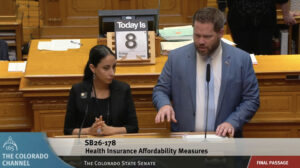
Colorado state Sens. Iman Jodeh and Kyle Mullica explain Senate Bill 178 to the Senate.
“We need to recognize that all of us, covered or otherwise, we are all one sickness or one devastating thing from needing an emergency room. We need health insurance, and when we don’t have those things, that’s when it becomes dangerous,” Jodeh told the Senate during debate on May 8. “I want to stress how hard we worked to get to this moment, knowing we will need to come back and work hard on it.”
The HIAE, which is funded by fees on insurance premiums and by federal dollars, oversees three programs designed to help lower-income Coloradans pay for policies. Those are:
- The reinsurance program that pools money from all insurers to pay for the highest-cost individual claims— those, say, to treat someone with a life-threatening condition or incident — and has cut individual-market premiums in the highest-cost counties by 20%;
- The OmniSalud program that offers private-market policies to a limited number of lower-income undocumented immigrants through a lottery system; and,
- Subsidies for lower-income individual-market policy purchasers on the Connect for Health Colorado exchange.
After Congress failed in 2025 to extend the federal Enhanced Premium Tax Credits that ensured that no individual-market purchasers paid more than 9% of their annual income toward insurance, the state allowed the HIAE board to sell tax credits close a funding gap. But the board also made significant cuts in the subsidies offered to individual buyers, and it reduced the number of people covered by OmniSalud from about 12,000 to about 6,700.
Is temporary funding solution “bananas”?

Colorado state Sen. Jeff Bridges speaks about Senate Bill 178 on the Senate floor.
With the state finding that the sale of tax credits was not as popular a revenue-raising mechanism as it had hoped it would be and with the HIAE facing a growing shortfall this year, Mullica said a different solution was needed. The $40 million fee, he emphasized, was a one-year funding mechanism to give legislators time to craft a long-term solution and originally was planned in conjunction with a $100 million bond sale.
However, during a heated Senate Appropriations Committee meeting during the session’s final week-and-a-half, Bridges made it clear that he would vote with Republicans to kill the bill unless efforts were made to reduce its costs. He was particularly exasperated, he said, that he had asked Colorado Division of Insurance leaders repeatedly how they planned to rein in costs for what has become an unsustainable program without the enhanced premium tax-credit funding and had gotten no answer.
The new funding mechanism was enough to win backing from Bridges and other skeptical Democrats, despite him calling it “bananas” on the Senate floor.
In response to the request to cut costs immediately (and reduce the size of the planned bond sale), sponsors also added an amendment that the reinsurance program will seek to reduce individual-market premiums in high-cost counties by 18% rather than 20% in 2027. That, Mullica explained, will cut the HIAE’s spending by about $10 million to $15 million.
More cost-cutting changes coming to health-insurance enterprise
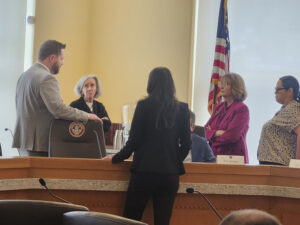
Colorado state Sens. Kyle Mullica (left) and Iman Jodeh (back to camera) heatedly discuss with members of the Joint Budget Committee a proposed amendment to their Senate Bill 178 by Sen. Barbara Kirkmeyer (purple jacket) that would limit spending by the Health Insurance Affordability Enterprise on May 6.
Another amendment mandated the Division of Insurance to propose a plan next year on how it will require OmniSalud members to pay a portion of the premiums for their policies. Backers of the program had testified to the Senate Finance Committee that they thought this is reasonable, but the state had not come up with a way to require those premium payments this year.
If legislators could not figure out a way to boost program spending by $140 million this session, Coloradans who benefit from the HIAE programs could have been hit hard financially, cosponsoring Rep. Lindsay Gilchrist, D-Denver, said. Premiums for reinsurance beneficiaries would have risen by $4,000 annually for a family of four, subsidies would have dipped to just $10 for some low-income individual-market buyers and the OmniSalud program would have shrunk again to 3,900 participants.
“I’m disappointed that we don’t have a long-term solution today, but it’s absolutely necessary that we pass this bill,” Gilchrist said during House debate on May 11.
Republicans still opposed SB 178 en masse — only GOP Rep. Rick Taggart of Grand Junction voted for the bill, while all Democrats except Rep. Bob Marshall of Highlands Ranch backed it — because they said it did too little to rein in runaway costs. Sen. Barbara Kirkmeyer, R-Brighton, argued that with the number of complaints that had surfaced that the HIAE violates the Taxpayer’s Bill of Rights by charging fees to insurers who don’t benefit from the services provided by the fees, including insurers not in the individual market, continuing the program without major reform opens it to lawsuits.
Polis defends scope of enterprise

Colorado Gov. Jared Polis signs Senate Bill 178 in front of supporters on Tuesday.
“Higher insurance costs for tens of thousands of people turn into benefits for only a select few thousand,” Rep. Brandi Bradley, R-Roxborough Park, added in criticism of the funding structure, which currently includes 2.1% fees on all policies sold by for-profit insurers and 1.15% fees on policies from nonprofit insurers, all passed along to customers. “Colorado families don’t need more accounting maneuvers. They need lower costs.”
But after all this debate, Polis signed SB 178 on Tuesday, noting that the total savings offered by HIAE programs to individual-market Coloradans last year reached $500 million.
“As the federal government cuts healthcare for Coloradans, we are making progress to save people money on health care while protecting access to the care people need to stay healthy,” the Democratic governor said in a news release.
Polis has until June 12 to sign or veto bills passed this year by the Legislature.