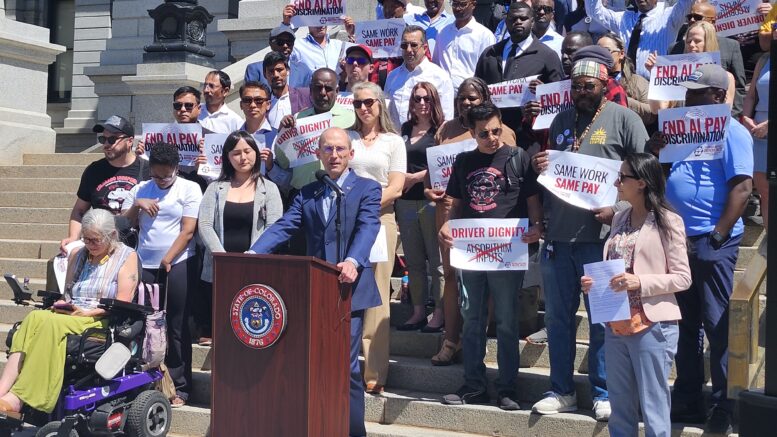
Gov. Jared Polis on Tuesday vetoed bills that would have banned the use of surveillance data in individualized price setting and reformed state law on arbitration — two of the final proposals on his desk that business organizations had fought this legislative session.
In both cases, the Democratic governor wrote in separate veto letters, the bills could have hurt consumers that the legislation espoused they were aiming to protect. Regarding the surveillance-data bill, House Bill 1210, it could have banned a range of discounts, and on the arbitration-reform bill, HB 1236, it could have made it harder for consumers to access a dispute-resolution alternative that can be faster and fairer, he wrote.
After Polis used his influence to tamp down or kill several proposed regulatory increases and tax-break rollbacks, House Bills 1210 and 1236 were among the few bills that arrived on his desk, along with HB 1005, that employers called hurtful to the business ecosystem. The governor vetoed HB 1005 — the proposal to remove the required second election in private-sector unionization — on Friday but waited just a little longer to reject the others.
What the surveillance-data bill proposed
HB 1210, sponsored by Denver Democratic Reps. Javier Mabrey and Jennifer Bacon, sought to ban companies that collected or bought surveillance data — individuals’ online search history, purchase history or geolocation history — from using it to craft price or wage offers specific to those people. Backers said the practice has been misused to charge higher prices on infant goods to new mothers, to boost airline ticket costs for people searching for funeral information and to lower pay offers for potentially desperate job seekers searching for payday loans or divorce attorneys.
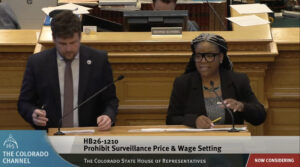
Colorado state Reps. Javier Mabrey and Jennifer Bacon explain their bill on surveillance data to the House in March.
But business and tech firms said the wording of the bill, which would have required any specialized pricing be offered across the board to all members of a consumer class, would have banned tiered retail loyalty programs or prevented discount offers to people who may left an item in an e-tail cart without buying it. It also would have put Colorado companies at a disadvantage by banning increasingly common digital marketing techniques and opening them to liability, according to a veto-request letter from eight business groups, including the Colorado Chamber of Commerce and Colorado Retail Council.
Polis jumped behind these arguments in his veto letter, writing that the broad wording in the bill could have ensnared companies innocuously using technology without looking to harm anyone and could have barred a wide range of discounting programs. He wrote that rather than focusing the bill on bad actions, sponsors discouraged “perfectly acceptable uses of technology to set an appropriate price or wage,” and he argued he already had protected consumers from abuses in signing an AI regulatory bill last month.
Polis: We should find ways to help consumers save money
Polis noted, as sponsors have, that the bill sought to carve out certain discounts, such as loyalty clubs or special veterans pricing. But rather than salvage the bill, these provisions clouded it even more, seemingly limiting what data-generated discounts were allowable and subjecting anything outside those parameters to being potentially illegal, he wrote.

Colorado state Sen. Iman Jodeh, a cosponsor of the bill in her chamber, touts House Bill 1210 at an April event at the Capitol.
“I find little comfort in the State defining in statute legally acceptable consumer discounts,” the governor wrote. “This opens the door to some perfectly acceptable consumer discount, if not appropriately captured by the definitions in this bill, being subject to scrutiny and enforcement under the Consumer Protection Act. We should be championing, not deterring, opportunities for Coloradans to save money.”
In vetoing HB 1236, which also was sponsored by Mabrey along with Democratic Rep. Yara Zokaie of Fort Collins, Polis wrote less about the provisions of the bill that missed the mark and criticized the general concept of trying to rein in uses of arbitration.
Bill supporters, including consumer-rights groups and trial lawyers, argued arbitration clauses now found in most employer-employee contracts and most product-purchase agreements, are hidden and ubiquitous and prevent people from taking cases to court. While they conceded that they couldn’t bar such agreements in Colorado because most are governed by federal arbitration law, they sought through HB 1236 to put guardrails on the practice to prevent what they consider instances of abuse.
What the arbitration bill sought to change
The bill would have disallowed mandatory arbitration if the cost of the service was more expensive for the consumer than going to court. It would have allowed parties to disqualify arbitrators with histories of bias that are proven through denial of parties’ rights. And it would have required losers of arbitration cases to pay winners within 120 days or face a doubling of penalties.
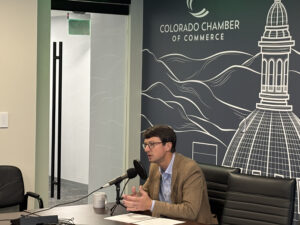
Attorney Julian Ellis speaks about problems with the arbitration reform bill on “Colorado Chamber Office Hours” in April.
Defense attorneys and business groups argued that the details in the bill, which cleared the House by just one vote, were vague and could make it harder for many businesses and employers to enforce arbitration provisions without facing legal action. They also cited a Consumer Financial Protection Bureau study finding that consumers and employees won in arbitration more often than they won in court and that the average time of dispute resolution was 108 days lower in arbitration.
Polis, acknowledging himself as “a consistent and vocal supporter of arbitration” because of its ability to save money and time for all parties, said his overarching concern with the bill was that it would make it more difficult for parties to use arbitration. He too criticized the “vagueness” of the provision regarding discriminatory conduct of arbitrators and said allowing arbitrators to award exemplary damages could discourage the use of arbitration.
“Making it harder to use arbitration will push more cases into litigation, raising costs, adding delays and increasing uncertainty for Colorado consumers, workers and businesses alike,” the governor wrote.
Controversial bills Polis continues to consider
With those vetoes, only a handful of bills that stoked opposition from major parts of the business community remain in front of Polis as he faces a June 12 deadline to sign or veto bills from this session.
HB 1272, a one-time regulatory measure aimed at protecting workers in extreme heat or cold, was amended into a bill that just collects data on temperature-related workplace injuries and directs the state to draw up a model plan that employers could choose to use. However, some industries still worry that the proposal sets the stage for future regulations.
And HB 1430 reduces transportation funding by about $700 million if voters choose to pass Initiative 175, a proposal to redirect vehicle-sales and auto-parts sales-tax collections to roads and thus boost that funding by about $700 million from elsewhere in the budget. It seems very unlikely that Polis would veto that, however, after sponsors reported that they consulted with his budgeting office to determine how the bill could work.