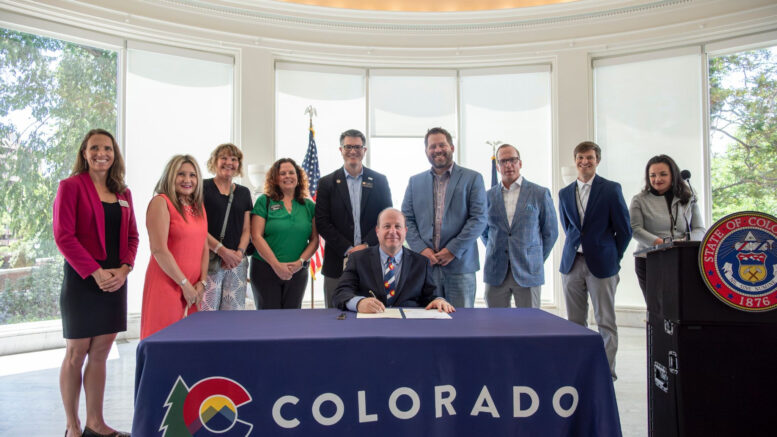
Gov. Jared Polis completed his bill-signing and veto actions for the 2026 legislative session Thursday by inking 41 new laws, including measures to remove a tax-exemption for downloadable software, protect workers laboring in extreme conditions and cut road funding by $700 million if voters approve a road-funding ballot measure in November.
The actions capped a hectic 22-day period in which the Democratic governor vetoed a personal-record 12 bills, including several that were opposed heavily by business interests, and signed regulatory and artificial-intelligence-rules reform sought by employers. However, his final day of action largely involved the administrative signing of several pieces of legislation that were not favored by the full business community, even if a number of the proposals included significant compromises.
A primary example of the negotiated bills is House Bill 1272, which pushes the state to be more proactive in protecting employees who are doing their jobs outside in hot or cold temperatures, from landscapers to construction workers to ski-resort employees. The bill requires the state to collect data on temperature-related illnesses and injuries at worksites and to develop a model temperature-related injury and illness prevention plan that employers can use for a guide on providing shade, water and acclimatization.
“The first step” toward potential regulations
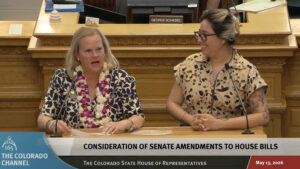
Colorado state Reps. Meg Froelich and Elizabeth Velasco discuss HB 1272 in the House on the final day of the 2026 legislative session.
HB 1272 is a very different bill from a 2025 proposal from the same sponsors — Democratic Reps. Meg Froelich of Greenwood Village and Elizabeth Velasco of Glenwood Springs — that sought to attack the issue with very prescriptive regulations. One provision in the bill, which died in its first committee, would have required employers to furnish workers laboring outdoors in temperatures above 80 degrees with at least 32 ounces of water each hour, chilled to no less than 60 degrees.
But while HB 1272 transformed after several major amendments into a data-collection and advisory bill, causing most business groups to back away from opposition, sponsors have emphasized that the research could lay the groundwork for future regulations. And they doubled down on that Friday in a news release, saying that this law is just a baseline for future rulemaking that is needed, especially as the federal government eases up on regulation of workplace safety.
“This new law takes the first step by collecting data on how workers are impacted by extreme temperatures and creating recommendations,” said cosponsoring Sen. Mike Weissman, D-Aurora. “This will lay the groundwork for evidence-based policies that keep workers safe amid Colorado’s new normal.”
Rising taxes on downloadable software
HB 1223 similarly was a bill that businesses opposed forcefully upon its introduction, as it sought to eliminate a state sales-tax exemption on downloadable software, a change that would have cost Colorado software buyers some $100 million annually and hit businesses of all sizes. It was part of a three-bill package in which legislative Democrats sought to roll back $555 million in existing tax breaks and put the money to a new Family Affordability Credit that would be offered to families making less than $100,000 annually. Two of the three bills died under veto threats from Polis.
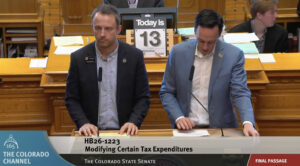
Colorado state Sens. Matt Ball and Dylan Roberts discuss House Bill 1223 in the Senate.
However, HB 1223 underwent two changes when it hit the Senate. First, sponsors added an exemption for sale of software that is either governed by a negotiable license agreement or developed for a particular user. Then, they redirected about $15 million of the $92 million expected to be saved by the state to restaurants via a boost in the tax deductions they can take for energy usage and an allowance for them to keep state sales-tax revenues for four months of the year.
While the original messaging around the three tax-break rollback proposals was about the amount of money the bills would redirect from corporate tax breaks to children, the final impact of HB 1223 will be a maximum credit of about $250 for a child under age 6. Restaurants are expected to keep about $14,000 a month under the new deduction.
“This is a win-win-win for hardworking Coloradans, for local restaurants and for modernizing our tax code,” cosponsoring Sen. Dylan Roberts, D-Frisco, said in a news release Friday. “It is narrowly focused on one outdated statute that taxes software differently based on where and how it is purchased.”
Provisional transportation-funding cuts
Polis also signed HB 1430, a controversial late-session bill that seeks to neutralize the potential impact of Initiative 175, which would redirect all sales-tax revenue from automobile and car-parts sales to roads — about $700 million annually. A coalition led by the Colorado Contractors Association recently turned in the required signatures to get the initiative onto the November ballot and is waiting for confirmation of their validity from the Secretary of State’s Office.
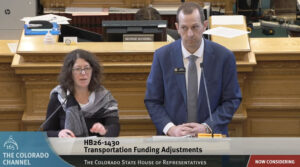
Colorado state Reps. Emily Sirota and Andy Boesenecker explain their House Bill 1430 in the chamber on May 8.
Concerned that this funding would require cuts to Medicaid, K-12 and higher education, legislators structured the bill to reduce current transportation funding by an equal amount if the voters adopt the initiative, essentially preserving funding for those other sources and leaving roads with no net gain. HB 1430 does this by reducing the gas and special-fuel excise taxes, cutting vehicle-registration fees and road-safety surcharges and reducing the per-gallon road-usage fee on gasoline sales that functions like a tax.
Backers of Initiative 175 and legislative Republicans accused HB 1430 sponsors of undermining the will of voters by cutting the knees out from the ballot measure before they even will have a chance to cast ballots on it. Bill supporters say that the ballot measure does not tell the full story of how legislators will have to consider cutting funding to other areas if the funding boost for roads is approved.
Homeowners’ insurance fees
Polis also signed Senate Bill 155, which seeks to address the skyrocketing price of homeowners’ insurance that adds to the state’s housing crisis — doing so by creating a new grant fund to help residents put hail-resistant roofs onto homes. It sets up the funding pool by assessing a 0.5% fee on each homeowner’s insurance policy sold in this state.
The idea behind SB 155 is that the more that hardened roofs can go up across the hail-prone state, the less claims homeowners will file after storms and the less risk that insurers will have to build into each policy. The bill requires insurers to show in rate filings how they are using the savings generated by these roofs to reduce premiums.

Hail litters the streets and sidewalks of downtown Denver after a spring storm in 2026.
Sponsoring Democratic Sens. Kyle Mullica of Thornton and Janice Marchman of Loveland also included a provision in the bill that bars insurers from passing the fee along to customers. This provision drew significant skepticism from legislators who view it as one more fee that is being foisted on Colorado consumers to launch an enterprise at a time when the rising cost of living is harming residents financially.
Debate about impact of laws
“That fee will ultimately be borne by a consumer — there’s no two ways about it,” Rep. Anthony Hartsook, R-Parker, said during House debate on the bill on May 11.
Polis, however, said he believes the bill will result in cost savings for Coloradans, and he’s included it as a key provision of his plan to move the state from having the 6th-highest average homeowners’ insurance premiums to having a ranking no higher than 13th. The bill also requires the new Strengthen Colorado Homes Enterprise to study how to bring down the cost of homeowners’ insurance in high-risk wildfire areas.
“If we are serious about affordability, we have to be serious about reducing the losses that are pushing rates up,” Marchman said in a news release Friday. “This law does that.”
Regulations on ownership of firms focused on laws
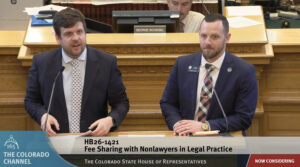
Colorado state Reps. Javier Mabrey and Jarvis Caldwell explain House Bill 1421 to the House on May 1.
Finally, Polis also signed in his final group of bills a measure, HB 1421, that bars Colorado law firms from being owned by non-attorneys or from entering into fee-sharing agreements with out-of-state, non-lawyer-owned firms. The bill was a joint effort of the Colorado Chamber of Commerce and the Colorado Trial Lawyers Association.
The unusual partnership came about because Colorado employers and law firms are increasingly worried about states like Arizona, where private-equity ownership of firms has led to more nuclear verdicts and to instances in which agreed-upon settlements were scuttled by investors who said they wanted more money. While non-attorney ownership of law firms already is barred in Colorado, local firms could — until now — enter agreements where out-of-state firms fund their marketing or other costs in exchange for a percentage of the winnings they receive from cases that those out-of-state firms direct to them.
“HB 1421 addresses a growing challenge in our legal system by reinforcing a simple but critical principle that legal decisions should be made by attorneys, not outside investors,” Colorado Chamber President/CEO Loren Furman said. “As private equity continues to find ways to enter the legal market, it is important that those decisions remain focused on the best interest of Coloradans rather than profit.”