
A tax-break rollback package that was set to generate a half-billion dollars for a new Family Affordability Credit began taking cuts itself on Thursday — and the largest parts of the package may not pass, according to a key member of the Senate Finance Committee.
House Democrats on Monday pushed through three bills that would reduce a series of business tax breaks by $555 million, sending almost all that money to a new tax credit for families making less than $100,000 a year. With Democrats lamenting that this year’s budget shortfall is pausing the existing Family Affordability Tax Credit — and blaming corporate tax cuts in the federal One Big Beautiful Bill for causing the shortfall — the package seemed destined at the time for Gov. Jared Polis’ desk.
But on Thursday night, the Senate Finance Committee made two changes to the bill of the trio with the smallest fiscal impact — House Bill 1223, which would eliminate the sales-tax exemption for downloadable software — that lowered revenue going to the new credit. The amendments would permit some business-to-business software sales to retain the tax exemption, and they redirected a portion of the state’s increased revenue from the tax-break rollback away from the new credit and toward tax relief for struggling restaurants.
As Sen. Adrienne Benavidez, D-Adams County, aired her concerns with those changes, she added that those concerns are heightened by information conveyed to her that House Bills 1221 and 1222, which were pulled off the committee schedule Thursday, may not move forward. Those bills are estimated to raise a combined $453.3 million by limiting business tax deductions and redirecting money to the new tax credit.

Colorado state Sen. Adrienne Benavidez listens as Colorado Chamber of Commerce President/CEO Loren Furman testifies in March for a regulatory reform bill.
“Two are at risk of getting nothing”
“These bills sort of come together as a set” to reduce these tax breaks and put the money to the new break, Benavidez said early on during discussion of HB 1223. “I personally like that. But I don’t know that the other two are going to move at all.”
Then, later, before she voted with other Democrats to advance HB 1223 to the Senate Appropriations Committee, she said: “I’m going to vote for the bill. I don’t like the changes to the bill. I think the FATC tax credit is really at risk, and it’s going to be very minimal. I heard one witness say even one dollar is better than nothing. Sometimes, that’s not really true — and I think this is one of those times, especially when there was three bills in this, and two are at risk of getting nothing.”
Her statements, and the unexplained delay of HB 1221 and HB 1222, are the first indications that the business-opposed tax package may be in trouble.
It’s well known that Gov. Jared Polis has asked fellow Democrats at other times when they have considered rolling back tax breaks to use some of the revenue gained by the state to reduce the state income tax, which he’s called a hindrance to productivity. Sponsors of the tax-package bills have been adamant, however, about creating this new tax credit to replace the FATC because that credit, which can’t come back until state revenues once again exceed the Taxpayer’s Bill of Rights cap, accomplished so much.

Gov. Jared Polis speaks to the Colorado Chamber of Commerce board meeting in April 2025.
Benefits of family-affordability credit
Zach Martinez — director of policy and advocacy at Gary Community Ventures, which worked with legislators to create FATC in 2024 — noted that more than 300,000 households claimed the credit that year, including 48% of Colorado households with children. The savings, which provided as much as $3,273 per child, brought 37% of kids who were living below the poverty level in 2024 above that level last year, and Colorado in 2025 had the lowest percentage of children living in poverty of any state.
But as advocates of such a tax credit have extolled its virtues, business leaders have warned that peeling back more tax credits could continue the state’s precipitous slide into having an unfriendly business atmosphere.
HB 1221 would reduce the net-operating-loss deduction allowable to companies from a maximum of 80% of a newly profitable company’s income over as much as 20 years to a cap of 70% of a company’s income over a period of 10 years. It also would reduce the maximum deduction that a company could take for executive salaries from $1 million per position to $250,000.
HB 1222 decouples state tax policy from four tax breaks that expanded in the One Big Beautiful Bill, potentially generating $329.2 million in revenues for the new tax credit. Those include sped-up depreciation schedules for manufacturing equipment, new buildings and research-and-development investments and an expanded deduction for loan and mortgage interest.
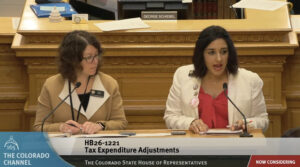
Colorado state Reps. Emily Sirota and Yara Zokaie speak on May 1 about their to end some state tax deductions.
Rollback could raise corporate income taxes substantially
Colorado Competitive Council lobbyist Patrick Boyle noted during the first House committee hearing for the bills that the state brings in about $1 billion annually from corporate income taxes, meaning that the package would increase that tax by 50%. Colorado Chamber of Commerce members have said the cuts would hit different sectors hard, from capital-heavy startups that rely on recouping early losses via the net-operating-loss deduction to manufacturers looking to reshore facilities who could lose major short-term tax advantages due to the decoupling.
Business leaders also had said the ending of the downloadable-software tax exemption in HB 1223, expected to cost state companies and individuals $92.2 million a year, would raise costs for employers of all sizes. But both the Colorado Chamber and the Colorado Competitive Council told committee members that they would drop opposition to the bill if business-to-business transactions remain tax-exempt, and an amendment added Thursday will do just that.
The amendment specifically keeps tax-exempt the sale of software that is either governed by a negotiable license agreement or developed for a particular user — not just the online purchase of QuickBooks by an employer. That will narrow the companies that can still get the exemption but relieve enough businesses of paying taxes on pricey systems that the business groups said they believe it is a good compromise, and the amendment even got support from the Colorado Fiscal Institute, a primary author of the tax package.
Help for eateries

Servers take care of a table of customers at The Greenwich restaurant in Denver.
The other major amendment added to the bill was done to help restaurants that have been struggling with rising operational costs and decreasing customer traffic, particularly in Denver and tourist communities.
It would allow restaurants in 2027 and 2028 to retain as much as $17,500 of the sales taxes that they owe to the state in the high-traffic months of July, August, November and December — and for food trucks and caterers to keep as much as $14,000 then. And it also would allow restaurants, which now can deduct a maximum of 55% of their gas and electricity costs, to deduct 100% instead, beginning in July of this year.
The changes will save restaurants a cumulative $12 million to $15 million annually, said Sen. Matt Ball, the Denver Democrat who is sponsoring HB 1223 with Democratic Sen. Dylan Roberts of Frisco. The two did not identify how much the business-to-business sales exemption would save, and the Legislative Council had not produced a new fiscal note for the bill by late Friday afternoon.
Rollback package has just three days to advance
“We have a historic number of restaurants that have closed, and the recovery coming out of the pandemic has been very difficult,” Ball told the committee. “Part of this attempt has been to give our restaurant community a lifeline.”
With the Senate having broken for the weekend, HB 1223 is likely to get its appropriations-committee hearing Monday morning and then be debated on the floor that day. It sets up well to complete its legislative journey — along with HB 1289, a bill that tweaks a number of existing tax laws but has not been viewed as being as detrimental to the wide swath of the business community — by the time the Legislature must adjourn Wednesday night.
HB 1221 and HB 1222 must clear committee and receive preliminary Senate OK by Tuesday for them to get a final Senate vote on Wednesday — a schedule that could be tougher to meet, especially as they haven’t been rescheduled for a finance committee hearing. Even were they to get through committee, Senate Republicans likely will put up a fierce and lengthy battle against them on the Senate floor, meaning that leadership in that chamber must determine how big a priority those bills are with the limited time that is left.