
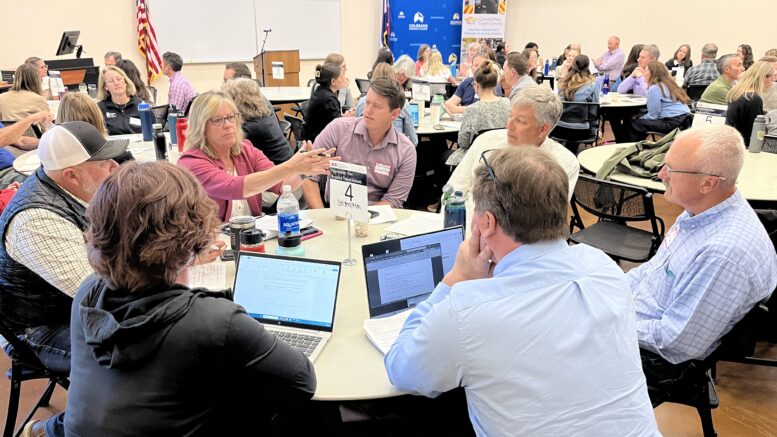
Six months after state workforce-development leaders unfurled a list of 232 proposed tactics to boost career pipelines into high-demand sectors, they are taking the first tangible steps this week to make these plans a reality — and are asking employers to be involved.
The Colorado Workforce Development Council and Colorado Office of Economic Development and International Trade will host a webinar Tuesday on how they’ll advance tactical workforce plans coming from the 2025 Opportunity Now Regional Talent Summits. The summits, which were a key recommendation of the business-led Education to Employment Alliance, drew together employers and educators in seven parts of the state to discuss three priority industries in each area.
Plans ranged from broad ideas like creating a marketing campaign to inform students and parents statewide on the viability of manufacturing careers to specific proposals like directing tech-focused students on how to get federal background checks for aerospace jobs. But with the 2024 law that spawned the summits not being able to set aside money at the time for implementation of the ideas, each of the plans will need some degree of employer resources to progress now.
In some cases, those resources will be time and thoughts. Before new programs can launch in high schools or community colleges to develop students for the trades, educators need to understand what skills they need to develop in those students, said Bobbie Wolfe, the CWDC’s senior consultant for sector partnerships and industry. Having employers to advise on new curricula is invaluable.
Requests of employers will be diverse but also specific

Bobbie Wolfe of the Colorado Workforce Development Council speaks on the June 1 “Colorado Chamber Office Hours” podcast.
In some other cases the needed resources will involve a commitment from employers who may help to shape workforce-training pathways to offering work-based learning experiences such as internships and apprenticeships to students picking up these skills. These are win-win scenarios for employers who now list skills gaps as an obstacle for expansion, as they can help to imbue incoming workers with appropriate training and use their services, said Traci Marques, executive director of the Pikes Peak Workforce Center.
But it starts with employers stepping up to ensure that job prospects are being trained in the right areas — and Tuesday’s 1 p.m. online meeting will lay out what paths participating employers can take in areas from Durango to Fort Collins.
“We look in our region at K-12 (schools) as they are producing a product that businesses want to buy,” said Marques, who led the June 2025 summit in the Pikes Peak area. “And K-12 education, they need to know what businesses want.”
Employers wanting to register for the webinar can do so for free.
How this workforce-development process will unfold

Traci Marques, CEO/executive director of the Pikes Peak Workforce Center, talks with Ed Sealover for the “Colorado Chamber Office Hours” podcast.
Even before Tuesday’s meeting, the Regional Action Committees — composed of business leaders and educators in seven different areas of the state — have been discussing how to implement some of the two- and five-year suggestions in the action plans, Wolfe noted. And the webinar is aimed at bringing more employers into the fold and allowing them to participate in this process.
Marques acknowledged that employers in her area talk to her about the fatigue they encounter from being asked by a variety of workforce-development groups to come to meetings and discuss big ideas that may or may not come to fruition. With the webinar, though, she believes employers can learn where they are needed, go directly to the lead of the Regional Action Committee and get a specific assignment that will lead to a near-term result rather than be asked to give hours for an unspecified outcome.
Wolfe is working hard also to bring education partners to this table, allowing them to match up with employers and discuss how to develop everything from the high-school trades classes to the college certification courses that will produce skilled workers. And for those who want to tackle the bigger-picture issues, most of the regional action committees will also begin longer-term work on how to boost childcare, affordable housing and transportation options that workers also need.
Goal: A better workforce-development process for employers
Asked on the “Colorado Chamber Office Hours” podcast what will be different in seven to 10 years for employers because of the developing plants, Wolfe said that the input they give will be coordinated between many agencies working in different ways for the same goal. That should mean that employers will have to work less hard to find qualified job applicants across industries from construction to health care to technology, will have to spend less time training new workers and can retain workers longer, she surmised.
Marques repeated that employers who now may be weary of getting involved in the process of developing career pipelines will have a direct pipeline to educators and job trainers rather than spending hours in meetings. And for many of the focus industries, there also will be an effort to develop direct communications and collaboration pipelines from industry sectors to educational leaders, so that the new curricula can benefit employers large and small statewide.
“The goal, for me, is to reduce employer fatigue by having that true one-stop, navigation-type hub,” Marques said. “What they can get out of this is future employees.”