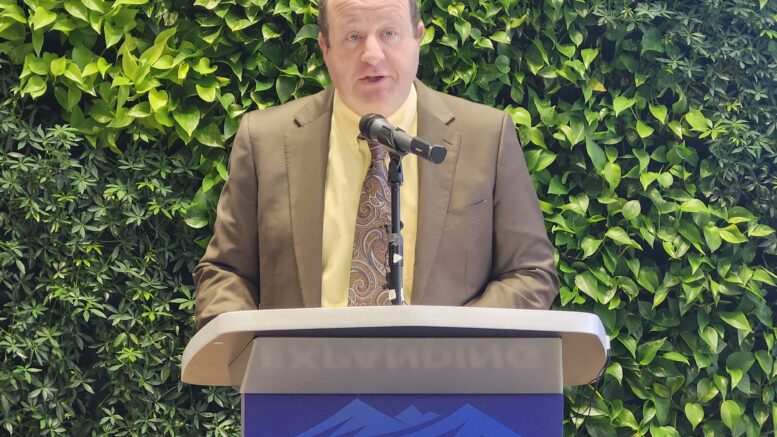
Saying that faster permitting and siting is needed for Colorado to stay competitive for national job expansions, Gov. Jared Polis issued an executive order Thursday creating a pilot project to speed government reviews of permit applications in strategic industries.
The order establishes a single statewide online portal into which applicants can submit materials to be considered simultaneously by multiple state agencies that are working in conjunction with each other. The portal would share documents between the relevant state agencies, would allow centralized tracking of permit status and ensure that a staffer with visibility into the entire permitting workflow for each program in each responsible agency will prioritize and assign work on the application.
While the order envisions that the portal would be used for air-quality, water-quality, hazardous-materials and Energy and Carbon Management Commission permits needed by applicants in seven different sectors, state leaders will choose just one of those sectors by Aug. 15 for implementation of the pilot program. The options include advanced manufacturing, aerospace, bioscience, energy and natural resources, technology and information, electronics and infrastructure engineering.
The order comes as multiple national observers have noted a significant reduction in Colorado’s business atmosphere, including CNBC, which dropped the state from No. 11 to No. 25 last month in its Top States for Business list, citing high costs and regulations. Polis has asked several groups to tackle the issue, including an Environmental & Sustainability Working Group launched in April and a Competitiveness Council convened in July, but the pilot project represents an even more concrete plan to try to boost competitiveness.
Targeting businesses’ permitting concerns
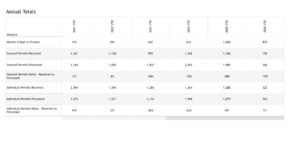
A chart shows the growth of time needed to process air-quality permits over the past six years.
“In today’s nationally competitive environment, the ability to quickly site and permit major projects has become a decisive factor in where new jobs, critical infrastructure and private investment are created,” the Democratic governor wrote in his order. “Colorado must be able to compete for these opportunities to support its residents and its communities.”
Though Polis is term-limited and will leave office in January, the order envisions a quick launch of the pilot project, funded by a recent Statewide Internet Portal Authority grant, to test its efficacy. After a sector is chosen by next week, the Office of Information Technology will work with the Office of Economic Development and International Trade, the Colorado Energy Office and affected permitting agencies to set up the portal and report to Polis by Dec. 15 on its progress.
The order calls also for expansion of the pilot project to other industries in 2027 and beyond if the portal proves successful. And it directs agencies — including the ECMC, the Air Pollution Control Division, the Water Quality Control Division and the Hazardous Materials and Waste Management Division — to make more modernization improvements, including digitizing operations, boosting efficiency of underlying processes and finding ways to reduce unnecessary regulatory complexity.
While limited in its initial scope, the portal could address some of the biggest concerns that business leaders have expressed about operating in Colorado
“A more competitive and predictable state”
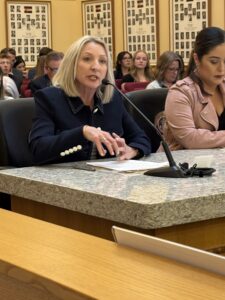
Colorado Chamber of Commerce President/CEO Loren Furman testifies in March before the Senate Finance Committee for a bill to boost the review of state regulations.
Businesses — particularly those seeking air-quality permits — have noted that average permitting times for significant projects have grown to more than two years, making Colorado less attractive for companies that can consider multiple states. They’ve complained too that different state agencies can give separate and sometimes conflicting directions on what must be done to get a permit approved. And they’ve noted that even permits for projects to reduce emissions can take years — a factor that disincentivizes such projects and led to the creation of the Environmental & Sustainability Working Group, which includes business leaders, state-agency heads and some environmental groups.
Colorado Chamber of Commerce President/CEO Loren Furman applauded the pilot project, particularly as it comes on the heels of Polis signing a bipartisan law in May that requires more frequent and through regulatory reviews by state agencies. Her organization led the development of Senate Bill 137 and was as organization of the Environmental & Sustainability Working Group.
“This is an important step toward making Colorado a more competitive and predictable state for companies to invest, grow and create jobs,” Furman said. “Modernizing these systems will lead to better outcomes for businesses, communities and the state, and we appreciate Governor Polis’ leadership in advancing reforms that will make it easier to invest and create opportunity here in Colorado.”
The portal won’t address every obstacle that has made it less attractive for businesses to launch and grow in Colorado in recent years. It only involves state agencies, meaning that the permitting pace of local governments could still be an issue. And while it could reduce regulatory burdens, it likely won’t affect the high cost of property that’s played a role in CNBC ranking Colorado the 13th-most-expensive state for the cost of doing business.
How success will be measured
To support timely permit processing for all strategic industries, going beyond just the portal project, Polis directed agency heads through the executive order to come up with performance metrics measuring average permit processing time, applicant satisfaction and staff processing productivity, among other factors.
He also ordered the establishment of productivity benchmarks for permitting teams and the development of recommendations for permit streamlining where targeted changes to laws and regulations could improve permitting efficiency and clarity “while maintaining the integrity and purpose of permitting reviews.” Such changes could include the enabling of parallel reviews by multiple permitting agencies and the standardizing of internal policies and processes, he wrote.
“The Pilot Portal Project will serve as a single digital front door for business applicants in the chosen Strategic Industry, testing the efficacy of a unified solution to replace our current fragmented, multi-agency process,” Polis wrote.
Tech CEO: Modern permitting system could attract businesses
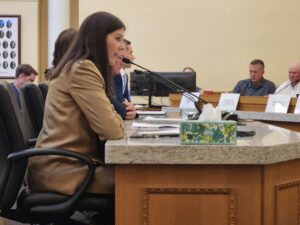
Colorado Technology Association President/CEO Brittany Morris Saunders testifies on a bill to reform AI regulations during the 2025 special legislative session.
Identified sectors likely will watch closely to see whether the pilot project can boost the national competitiveness of their industries.
For example, Polis called out artificial intelligence, semiconductors, computer storage devices and electronic components as technology and electronics industry subsectors for which he’d like to boost the speed and simplicity of permitting.
Colorado Technology Association President/CEO Brittany Morris Saunders noted that the need to streamline permitting already has come up during discussions of the Colorado Competitiveness Council, on which she sits. This further step in the executive order can turn talk into meaningful action in creating a modern permitting system, she said.
“Colorado’s technology industry competes nationally for investment and the companies shaping our future,” Morris Saunders said. “Making permitting more efficient and predictable will help Colorado attract and grow strategic industries.”
During a committee hearing on SB 137 in March, Colorado Bioscience Association Vice President Amy Goodman noted the state had lost some $500 million in capital investment and more than 1,000 jobs in the past year as companies said they chose to expand elsewhere because of Colorado’s regulatory and cost burdens. Following the executive order, CSBA President/CEO Elyse Blazevich said in an email to The Sum & Substance that while the Denver/Boulder area still ranks among the top 20 clusters for life sciences research and development in the world, moves like this will help considerably as it fights to remain a leading hub for health innovation.
“Colorado’s convergence of innovation industries makes our state unique. We support a coordinated approach and sufficient resources to expedite permitting and support company attraction, expansion and retention,” Blazevich said. “Steps like these are critical to ensure Colorado is competitive and ready for growth.”