
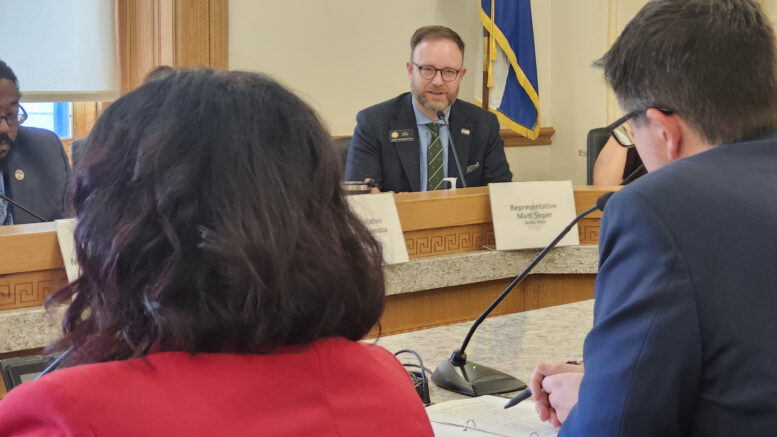
Legislators who’ve backed efforts to hold down housing or utility costs in the name of affordability declined to do the same for Denver International Airport meals and sports-stadium beers Tuesday, rejecting a bill to expand enforcement of price-gouging laws.
Three Democrats joined with all four of the Republicans on the House Judiciary Committee to kill House Bill 1012, which sought to limit the pricing of goods in “captive-consumer” facilities such as event venues, airports, outdoor festivals, hospitals and jails. In doing so, they questioned exactly how unable those consumers are to make choices about what is affordable to them, and they also questioned whether the proposal would backfire and hurt the small vendors that already are struggling with costs of running a business.
The bill, sponsored by Democratic Reps. Yara Zokaie of Fort Collins and Kyle Brown of Louisville, was one of the most uniquely consumer-focused proposals of the years-long effort to halt the rising cost of living in one of the country’s most expensive states. It sought, under a clarifying amendment introduced Tuesday, to declare it a deceptive trade practice if vendors at these high-traffic locations sold goods for more than 10% above the average price for similar food and items in the surrounding county.
Clashes over the effects of price-gouging bill
Brown emphasized that excessive pricing already is illegal under the Colorado Consumer Protection Act and said the bill sought to lay out exactly what that pricing was and how it could be combatted by civil actions from state residents or the Colorado Attorney General. Zokaie, meanwhile, said the legislation was a way to fight for middle- or working-class families who are being shut out of enjoying what should be accessible activities during a time of growth wealth inequality in the country — fighting “fun-flation,” as she said on the “Colorado Chamber Office Hours” podcast.
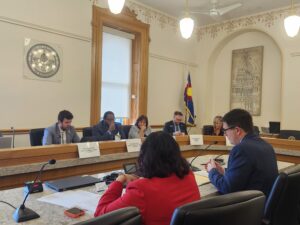
Colorado state Reps. Yara Zokaie and Kyle Brown present their price-gouging bill to the House Judiciary Committee on Tuesday.
But business groups and committee members from both parties raised numerous objections about the practicality of enforcing such a law.
Colorado Restaurant Association Government Affairs Director Nick Hoover noted that restaurants operating at places like sports and entertainment venues must pay extra to have much of the food prepped or cooked offsite and transported to those facilities. They also must pay fees of $10,000 or more to operate in high-profile locations and must keep stadium locations always staffed despite traffic flow — costs that wouldn’t go away even if they were limited in what they could charge for their items.
Duane Nava — president/CEO of the Greater Pueblo Chamber of Commerce, organizer of the annual Pueblo Chile & Frijoles Festival — said festivals must charge fees to vendors that impact what the vendors then can charge to the public. Those festival fees pay for security, grounds maintenance, entertainment and other amenities that festivals offer, and eliminating them to bring down vendors’ costs could lead to less secure events without the cost-free shows that draw families to them, he said.
Do such vendors operate in a free market?
“There is no standardized price for a funnel cake, roasted green chile or a specialized service,” Nava said, pointing to the enforcement mechanism for determining whether vendor prices are excessive and therefore subject to legal action. “Mobile vendors do not operate in a static market. They operate in a high-overhead, short-duration market.”
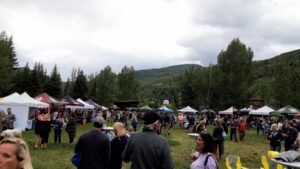
Large outdoor festivals would fall under the jurisdiction of the proposed price-grouping bill as well.
Zokaie had argued, to the contrary, that vendors in these captive-consumer facilities needed regulation because they did not operate in a free-market situation where competition helps to determine the prices they can charge. Instead, consumers who can’t leave a football stadium or airport to get cheap food and bring it back in have been objects of gouging by operators of those facilities, whom she believes would have to reduce vendors fees if “street pricing” limited what their vendors can charge.
Testifying for the bill were a number of consumer advocates and university students who complained of paying for $10 drinks and $20 meals at ballgames and having to buy airport snacks that cost twice what they would have to pay anywhere else.
“You are forced to either spend, starve or miss critical moments of the game,” Colorado State University graduate student Michael May told the committee. “Watching the CSU Rams lose to the CU Buffs is easier with a $5.50 beer than a $9.50 beer.”
Are consumers really captive to high prices?
But Rep. Cecelia Espinosa, D-Denver said there already is competition at a place like DIA, where vendors can get a leg up based on price and where she knows how to find the lowest-price coffee for her flights. And Rep. Michael Carter, D-Aurora, questioned exactly how captive the consumers in most of the named facilities are compared to prisoners who literally have no option to leave the facilities they are in, even if the commissary charges 10 times the price they would pay for a good as the local grocery store.

Coors Field is one of the venues that could have been impacted by proposed price-gouging rules for captive-consumer facilities.
Rep. Matt Soper, R-Delta, engaged in a philosophical debate with Zokaie about how much the consumers she sought to protect in her bill needed protection. He noted that those consumers who decided to purchase pricey tickets to a concert or game already had made a deliberate decision to spend more on the activity that the average cost of doing something in this state.
“Even upstream of the (vendor) competition that is going on inside the arena, you made a choice to go there,” Soper said. “And you made a choice eyes wide open that you would be spending a lot of money to do that.”
“I think that just because someone knows they are being gouged doesn’t mean they should be gouged,” Zokaie responded. “We as a Legislature come in many times and regulate where we don’t think things are fair for consumers. And this is one of those situations.”
Bill also sought food-delivery app transparency
Several proponents also showed up to argue that hospitals in particular need regulation because of the high prices that they charge for medical supplies to patients who have no choice once they are there to leave and get those supplies at a store. However, Brown offered an amendment that limited the price-gouging rules regarding hospitals to what they sell in cafeterias and gift shops, opining that the way that healthcare payments work is too difficult to regulate as part of a standard market.
HB 1012 also contained a provision that would have required food-delivery apps that feature higher prices for goods than the prices on those goods in stores or restaurants to list those lower in-store prices on their sites. But while there was some debate on this part of the bill — advocates said transparency is needed for consumers without transportation options, while opponents said that stores constantly change prices and would have difficulty complying with the rule — less attention focused on that area.
In the end, a quartet of Democrats backed HB 1012. But it fell on a 7-4 margin after Espinosa, Carter and Democratic Rep. Chad Clifford of Centennial joined with Republicans to say that they thought the bill either would not be able to bring down prices or, worse, could lead small vendors to close shop and would drive up prices more because of its additional regulation on businesses.