For several years, Colorado legislators from both parties have vowed to tackle the state’s affordability crisis, only to butt heads over how to do that as they watched the state suffer more in terms of cost of living, cost of doing business and business competitiveness.
In separate interviews, all four of the legislative caucus leaders last month said that making Colorado more affordable is, once again, their top goal for the legislative session, which kicks off Wednesday and extends through May 13. And the divide certainly remains over whether the state must boost revenues to provide more safety-net services (largely a Democratic idea) or cut its own spending to allow overburdened Coloradans to keep their money (a tenet of Republicans).
But the same leaders struck a common chord in saying that they believe it’s time for the state to re-examine many of the recently passed regulations that business leaders have decried as raising the cost of operations, hiking prices to customers while limiting hiring. Each went so far as to say they would support an effort to investigate the state’s current regulatory structure and, if it is overburdening employers, commit to getting rid of some rules that don’t boost public health and safety.
Concerted effort at regulatory reform
Senate President James Coleman, D-Denver, will run a bill this year to look at recent regulations “in almost an audit form” and determine which are needed and which are, in fact, excessive. And legislators can use those findings to determine if changes need to be made to current rules — and can also employ the learnings from the study as they consider future rules.

Colorado state Sen. James Coleman speaks in 2024 in the Senate about his construction-defects reform bill.
Make no mistake, more regulatory bills will be coming this, including proposals to put significant rules on employees working in “extreme temperatures,” make it easier to unionize and potentially require employers to help fund Medicaid. And the debate around artificial-intelligence regulation will come to a head after two years of debate — in a way that will impact companies far beyond just the technology sector.
But rather than just asking whether the state needs to stop price-gouging or limit what businesses can charge for their services, bipartisan legislators appear ready finally to ask how the state can limit the less-often-discussed sources of price increases to businesses.
“It would be great to really do a full assessment of (the regulatory impacts), so that when we’re making those decisions on regulations, we could then say, ‘Look, this is based off of a policy we set where we sat down and really deep-dived into the regulatory space for business and we’ve determined now that we actually do need this regulation because it benefits us but this one does not,” Coleman said. “So, it’s less of an impulse on regulation audit and it’s more of an informed decision on which regulations we do and do not need.”
Regulations impact affordability
That proposal comes in part from a 2024 study commissioned by the Colorado Chamber of Commerce that found that the Centennial State is the sixth-most regulated state in the country and that excessive regulations keep employers from growing or relocating here. That study led to a 2025 law boosting audits on two agencies that have promulgated many new regulations, including the Air Pollution Control Division, and will require “more transparency and review of state agency programs to ensure our regulations are meeting their intent and aren’t overly burdensome,” Chamber President/CEO Loren Furman said.

Colorado Senate Minority Leader Cleave Simpson speaks to the Colorado Chamber of Commerce Board of Directors in December.
“I think folks are a little bit more ready to have a serious conversation on the regulatory environment in Colorado and its impact on businesses and customers,” added Senate Minority Leader Cleave Simpson, R-Alamosa. “I think everybody, generally, we’re trying to accomplish the same thing and make life better for Coloradans. And then we differ on that path to get there.”
And if the ideological desire to cut costs or regulations may bring Democrats who hold substantial majorities in both chambers together with Republicans this year, it’s the details of their plans that will keep debate pointed all session.
Take, for example, the shared goal to reform a 2024 regulatory framework imposed on artificial-intelligence program developers and deployers — one that isn’t set to be enacted until June 30 — that most everyone feels needs to be loosened somewhat. Efforts to roll back some of those regulations failed both in the 2025 regular session and an August special session when competing sides couldn’t agree on specifics, however, making the issue one of the most important to be decided this year.
AI regulations
The standing law requires developers to disclose detailed information about AI systems to deployers, provide documentation assessing discrimination risks, publish a statement summarizing the risk management of systems and inform the Attorney General’s office of any discovery of significant risk of discrimination. And it requires deployers of high-risk AI to implement comprehensive risk-management policies, conduct annual reviews to prevent algorithmic discrimination, notify consumers when AI is making consequential decisions and offer appeals processes to affected consumers.
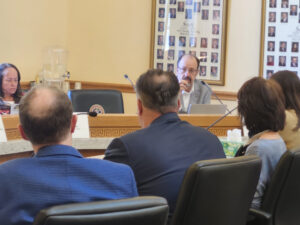
Senate Majority Leader Robert Rodriguez questions a panel of tech-industry leaders skeptical of his AI regulatory proposal during a committee hearing during the 2025 legislative special session.
All sides agree that some provisions need to be peeled back, such as a requirement that developers and deployers hear and answer appeals from any person that feels that the AI program discriminated against them. That could include anyone who applied for and did not receive a job with a company that uses AI to sort through resumes — a process so cumbersome that some officials have said their appeals responses will overshadow all the rest of the work they have to do.
Right now, though, business advocates and consumer and labor advocates disagree on what exactly constitutes a consequential decision, who is liable in cases of discrimination and what different responsibilities AI program developers and deployers have. A Polis-appointed working group has been working to find consensus for months, but that remains elusive, even before legislators also get their say on the regulations.
“Hospitals, manufacturers, any employer who uses AI in the hiring process, this will impact them,” said Meghan Dollar, the Colorado Chamber senior vice president for governmental affairs. “The liability issue is really going to be the key issue.”
A wide range of affordability bills
And then there are numerous other ways that legislators will seek to address cost of living.
Coleman said that Democrats will continue to push for a transition to cleaner energy powered by sources including solar, wind and battery storage. After visiting with providers across the state and hearing that some are struggling with the cost of this transition, his party will look at how it could find ways to cover that cost without putting too much on the backs of customers, he said.

Colorado House Minority Leader Jarvis Caldwell speaks to the Colorado Chamber of Commerce Board of Directors in December.
But House Minority Leader Jarvis Caldwell, R-Monument, said the smartest way to do that is to slow the transition times the state has laid out, including on a Clean Heat Plan that proposes eliminating gas heating of all homes and appliances by 2050. He is working with legislators on both sides of the aisle to move infeasible deadlines for such transitions, and Republicans will push back hard on a proposal for utilities to reach net-zero emissions by 2040 if it were to come forward, he said.
The high cost of housing continues to plague Coloradans, but after passing significant laws in 2024 and again in 2025 to try to boost the stock of affordable homes, House Speaker Julie McCluskie, D-Dillon, said she’s not sure how much more can be done this year. Legislators and business groups are likely to focus more attention on ways to address the high cost and unavailability of homeowners insurance, though that could produce a clash between proposals that incentivize fire- and hail-proofing versus a potentially returning plan to charge homeowners a new fee to reach these goals.
Tax breaks and workers compensation insurance
After legislators rolled back $153 million in tax breaks during the special session to help balance the budget, it is possible they will go after even more, specifically an existing tax exemption on the sale of downloadable software. McCluskie said that any such efforts would be very targeted in an effort to close a roughly $800 million budget shortfall next year, but Dollar acknowledged businesses are “very concerned” about this idea.
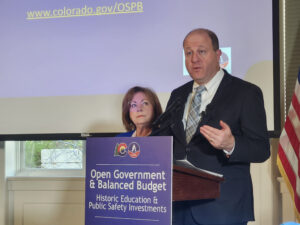
Gov. Jared Polis explains his budget proposal on Oct. 31 while standing beside Lt. Gov. Dianne Primavera.
Polis has hung his budget-balancing efforts on his proposal to disaffiliate state-chartered Pinnacol Assurance and allow Colorado’s largest workers’ compensation insurer to become fully privatized — and to expand across state borders to preserve market share. But numerous Democratic legislators fear this would eliminate the state-mandated insurer of last resort for high-risk employers who can’t find coverage elsewhere the market, and nothing less than the future of the state’s workers- comp system hangs in the balance.
Businesses will be proactive with efforts to bring down costs as well. A bill that would ban credit-card providers from charging restaurants and retailers per-transaction swipe fees on the taxes and tips on bills will return after being killed under pressure last year from banks and credit unions. Financial institutions will continue to oppose such a proposal, while Michael Smith, Colorado director for the National Federation of Independent Business, said his members will push hard for the “fantastic” idea.
And businesses likely will work to fend off several attempts to boost regulations on them again this year.
Regulatory bills impact affordability
Rep. Lisa Feret, D-Arvada, has said she will bring a bill that would require the largest employers with significant rosters of part-time workers — think, Amazon and Walmart — to help pay for Medicaid and SNAP benefits received by those workers.
Union leaders announced on Thursday that they will reintroduce a bill that upends the Colorado Labor Peace Act and would make it easier for private-sector Colorado workplaces to unionize. The same bill passed on a Democrat-led party-line vote last year but got vetoed by the Democratic governor, who said the lack of consensus surrounding it could hurt both businesses and workers.

Colorado state Rep. Javier Mabrey speaks Thursday to a coalition of labor groups seeking to upend the Colorado Labor Peace Act.
Two House Democrats also are expected to reintroduce a short-lived 2025 bill that would put new rules on workers performing jobs outside at temperatures below 30 degrees or above 80 degrees, including mandating the amount of cold water that employers must provide hourly. Businesses, particularly those in mountain areas and along the Western Slope, have called the effort a regulatory backbreaker; McCluskie has said it is a worthwhile pursuit but hopes that anything coming forward this year will have been negotiated with employers.
Workforce development an issue too
McCluskie will sponsor a bill to combine all the state’s workforce-development and higher-education programs into one new department that provides a one-stop front door for employers who want to find training grants or launch apprenticeships. The term-limited speaker, who spent much of her time in the Legislature passing legislation that tries to better match skills of Colorado graduates to those that employers need, said the legislation is designed to fix the “disconnected approaches” that have left too many employers saying they can’t find the workers they need in Colorado.
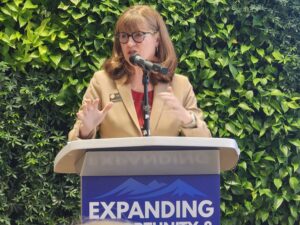
Colorado House Speaker Julie McCluskie discusses a report in December on streamlining Colorado’s workforce-development programs.
If that all sounds like a lot of issues that employers need to watch, that’s because it is. And that list of business-impacting bills doesn’t even include the numerous health-care-reform proposals or tech-focused regulatory proposals that are expected to come forward.
Can legislators find consensus that might slow the unaffordability crisis that has left Colorado as the state with the fourth-highest cost of living in America? That answer may depend on how much legislators are willing to work together to take a common goal and determine compromise on the path to get there.