
The 94 bills introduced on the first day of the 2026 legislative session include wide-ranging efforts to incentivize data centers, create an enterprise to boost mental-health treatment and declare high prices at airports and sporting events to be illegal price gouging.
Included in the first dump of bills Wednesday also are several previously announced or disclosed efforts that could have significant impact on businesses. Those include a proposal to eliminate the second election in unionization efforts, a bill to let local governments institute taxes on vacant homes and a plan to allow public utilities more time to meet the state’s emissions-reduction mandates.
While there are several high-profile proposals not yet introduced — including a regulatory-reform effort coming from Senate President James Coleman and a bill that would require some large employers to contribute to Medicaid and SNAP — the early bills give indication of what some of the key debates will involve this legislative session. There are several bills attempting to boost mental-health care, a pair of bills that could help grow the childcare sector and several proposals to address energy affordability.
“From reducing the cost of housing, health care and childcare to investing in our students, our first ten bills help address the most pressing issues our communities face,” House Speaker Julie McCluskie, D-Dillion said in a news release before introducing an additional 54 bills from both parties. “These legislative priorities highlight our commitment to making our great state more affordable, safer and healthier for all.”
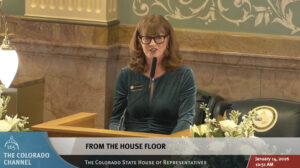
Colorado House Speaker Julie McCluskie offers opening-day remarks on Wednesday.
Here’s a quick look at some of the most impactful proposals.
Price Gouging
One year after Gov. Jared Polis signed a significantly scaled-back bill that expanded the definition of price gouging during declared disasters, proponents are back this year with a new target — pricing of goods and services for “captive consumers.” Those are people at places like airports, hospitals, outdoor festivals and event venues who don’t have the ability to shop around for better prices.
House Bill 1012 would define prices in such locations as excessive if a vendor charges more than an average cost of a good or service in that county — a low bar, as vendors usually pay significant fees to operate in these locations and raise prices to recoup costs. Violations would be considered an unfair or deceptive trade practice, punishable by civil legal actions.
The bill includes a provision that could raise costs significantly for businesses. A group of Democrats have tried unsuccessfully for the past three years to eliminate the requirement in state law that plaintiffs prove a deceptive trade practice had a significant public impact before being able to seek attorney’s fees and treble damages. But a clause in HB 1012 says any violation of this proposed law would be presumed to have a significant public impact.
Fees and Taxes
Despite the Legislature facing an $800 million budget shortfall, several bills seek to establish or extend tax breaks. HB 1030 would create a 100% state sales- and use-tax exemption for data centers for 20 years if they meet minimum investment and job-creation thresholds and secure power from a utility. HB 1014 would extend the state’s expiring job-growth incentive tax credit through 2034. And the Republican HB 1048 would create a sales-tax holiday for back-to-school items.
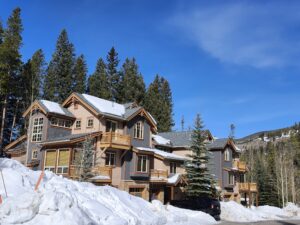
Houses in Keystone are surrounded by snow in the heart of ski season.
HB 1036 would allow local governments to seek voter approval to impose new taxes on homes that are vacant for significant portions of time and put the money toward attainable housing, with an exemption for short-term rental properties. Proponents, largely officials from mountain towns suffering shortages of workforce housing, told The Sum & Substance last year that they hope the taxes would spur second- and third-home owners to lease their properties to workers rather than have them sit open.
Senate Bill 8, meanwhile, seeks to create a new enterprise to fund greater access to mental-health and substance-abuse treatment by paying more providers to see patients and by awarding grants to entities that offer online mental-health services. The enterprise would charge a fee of as much as 25 cents per month to any Colorado resident with an internet service account, using the nexus between proposed online services and internet service as the nexus necessary to establish the enterprise.
Healthcare and Technology
Another bill, HB 1002, would seek to expand behavioral-health-care access by making it easier for providers to become part of both private and public health-insurance networks. It would require private insurers to expedite credentialing of these providers and to admit pre-licensed providers into their networks, and it would speed the enrollment process for mental-health and substance-abuse providers who apply to participate in Medicaid.
The Democratically sponsored HB 1019 would require insurers to provide total-cost coverage for preventive kidney-function screening services, stirring debate again about the health benefits of such a mandate versus the cost it could have on insurance premiums. Meanwhile, the Republican-sponsored SB 29 would offer an income tax credit for contributions to a health savings account in order to incentivize people to purchase the typically lower-cost insurance plans that offer those options.
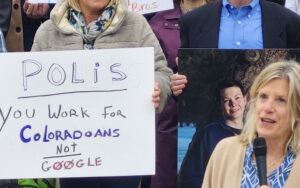
Chelsea Congdon, holding a microphone, speaks at an April 14 rally on the Capitol steps urging Gov. Jared Polis to sign a bill regulating social-media platforms.
In the area of technology, HB 1043 would boost penalties nearly tenfold against transportation network companies like Uber and Lyft in cases where drivers discriminate against potential passengers by refusing to pick them up. SB 11 would require operators of high-traffic websites and mobile applications to make it easier for law-enforcement agencies to contact them and to get subpoena responses withing 72 hours — a new effort to ensure the platforms are protecting for public safety.
Childcare and workforce development
Colorado’s dearth of childcare facilities, which has an estimated shortage of 75,000 slots, costs the state about $2.2 billion a year in economic development because it doesn’t allow caregivers, primarily women, to return to the workforce when they’re ready. Several bipartisan bills seek to address that this year.

A child plays at a preschool in Colorado.
HB 1004, which is sponsored by both caucus leaders in both chambers, would extend through 2038 a 50% income tax credit for contributions made to childcare facilities. And SB 20 would offer several childcare-facility regulatory reforms that industry leaders say are desperately needed, including streamlining the licensure system and allowing centers to open for as long as nine months even when they are facing disputes with local governments over zoning or licensing issues.
Meanwhile, HB 1010 would require the Colorado Workforce Development Council and other agencies to study how to boost employment for individuals that are 60 years of age or older and would mandate several commissions to have at least one member of that age.
Energy and Environment Bills
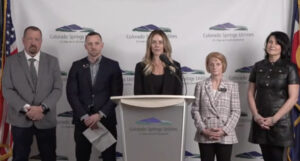
A Colorado Springs Utilities official is flanked at a news conference Monday by CSU CEO Travas Deal, Colorado House Minority Leader Jarvis Caldwell, state Rep. Amy Paschal and Johnna Reeder Kleymeyer, president/CEO of the Colorado Springs Chamber of Commerce and Economic Development Corp.
SB 22, which was announced at a news conference Monday, would allow municipal utilities and cooperative electric associations to submit plans to the state that would extend their deadline to reduce emissions 80% if they are unable to hit the goal by 2030. Bipartisan backers say the bill is needed to balance environmental goals with affordability and to allow such utilities to reach their deadlines at a slightly slower pace rather than shutting down affordable energy sources and hiking costs on their customers.
SB 2 would approach energy affordability from a different angle by requiring investor-owned utilities like Xcel Energy and Black Hills Corp. to set up programs in which income-qualified customers could receive a minimal level of electricity at marginal costs. The Colorado Public Utilities Commission would have to approve any such plans.
And SB 21, which came out of an interim legislative committee after significant discussion, seeks to approach emissions reduction with a carrot rather than a stick. It would allow the Clean Fleet Enterprise to offer grants to owners of old commercial trucks to upgrade them to much newer but still fuel-burning trucks rather than requiring purchase of electric vehicles — an effort to get some of the most polluting vehicles off the road.
Other Business Bills
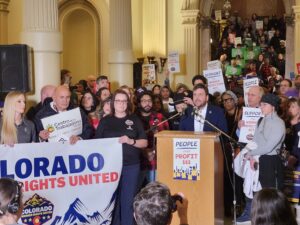
Colorado state Rep. Javier Mabrey speaks Thursday to a coalition of labor groups seeking to upend the Colorado Labor Peace Act.
HB 1005, unveiled Thursday in a news conference, will try again to remove the second election required for union security under Colorado’s Labor Peace Act, which business leaders see as a compromise between right-to-work and union-state laws. This year’s bill, which comes after Polis vetoed a similar measure last year, features a new provision that would declare it is not an unfair labor practice for an employer to refuse a lawful proposal made by employees and union representatives if they have bargained in good faith.
HB 1001 is the latest attempt to increase affordable housing — this time by letting nonprofits, educational institutions, housing authorities and transit districts build housing on their properties of less than five acres with only administrative approval required. It is likely to stir opposition from local governments, which would not be allowed to bar the construction based on certain height considerations or density reasons and couldn’t require rules more restrictive than on any other housing properties.
The session continues Thursday with the term-limited Polis giving the final State of the State Address. Legislators then have until May 13 to pass bills.