
Amid bipartisan talk of the need for regulatory reform, a bill introduced Wednesday by all four of the legislative caucus leaders would look to put teeth into the push, opening the way for more rules to be audited and even to be rolled back.
Senate Bill 137 comes after the Colorado Chamber of Commerce commissioned a study in late 2024 that found the state is the sixth-most regulated in the country — and a follow-up study that found rules governing employers continue to grow. Employers cite regulations as their biggest impediment to adding jobs in the state, and national business-friendliness rankings reflect that Colorado has become one of the most expensive states both for living and for doing business.
Currently, the Legislature requires each department to schedule a review of its rules, but there is no mandate on how often such reviews must happen or exactly what lawmakers have to do with those reviews. SB 137 would require such reviews occur at least once every five years, would prescribe more considerations that the reviews must include and would give legislators greater opportunity to act on those reviews to roll back outdated, duplicative or overly burdensome mandates.
Senate President James Coleman, who is sponsoring the bill in his chamber with Republican Senate Minority Leader Cleave Simpson of Alamosa, called the effort one that is aimed at ensuring “good governance.”
What the bill requires of regulatory reviews

Colorado Senate President James Coleman offers opening-day remarks at the start of the 2026 legislative session.
“SB 137 strengthens the transparency and accountability of our rulemaking processes by ensuring regular, meaningful review of existing regulations,” Coleman, D-Denver, said in a statement. “Bolstering regulatory review across the board will improve how state government functions, which will benefit Colorado businesses, workers and local communities across the state.”
In addition to requiring the reviews at regular intervals, the bill seeks to direct each department to make certain determinations when conducting their reviews. Those include:
- Whether the department has duplicative rules that can be eliminated;
- Whether a rule is outdated or obsolete;
- Whether funding levels to support a program or function that is subject to a rule are appropriate;
- Whether there are opportunities to improve the effectiveness of the rule in meeting its purpose, intent or goal; and,
- Whether a rule creates administrative burdens on the agency, consumers or businesses without a commensurate public benefit.
The StratAcumen study in 2024 found that businesses in Colorado faced more than 200,000 regulations — a number that increased 7.1% between 2020 and 2023 and that went up another 2.4% between 2024 and 2025, a follow-up study found. That’s caused employers to divert resources away from growth to compliance, and the study argued that each 10% increase in regulations stops some 9,000 businesses from moving forward and costs 36,000 jobs.
“Common-sense standards” get bipartisan support
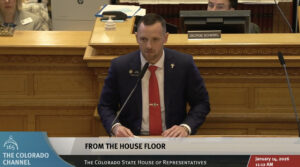
Colorado House Minority Leader Jarvis Caldwell offers opening-day remarks at the start of the 2026 legislative session.
House Minority Leader Jarvis Caldwell, who is sponsoring SB 137 in his chamber with Democratic House Speaker Julie McCluskie of Dillon, said that what the bill does is put “common-sense standards” in place to determine which rules are working and are needed. This will ensure the rules are not just necessary but are cost-effective and are working the way they were intended, the Monument Republican said.
“Too often, Colorado’s increasingly complex regulatory environment stands in the way of innovation and economic growth,” Caldwell said in a news release. “The Chamber’s data is clear — if we don’t take steps to address the issue long-term, our business climate will continue to feel the consequences.”
Each department already must discuss its rule reviews with legislative committees at the “SMART Act” hearings that take place at the beginning of each session. SB 137 would allow for those committees to go beyond just hearing about the reviews and to take action instead if they believe it’s needed.
Under the bill, the committees of reference can determine first whether a rule or rules should be subject to a sunset review that examines whether to continue that regulation. They also can request the Legislative Audit Committee seek a financial or performance audit on a particular program or function, which would allow lawmakers to determine whether bigger-picture changes are needed for any functions of state government.
“Balanced and effective regulatory system”

Loren Furman is president and CEO of the Colorado Chamber of Commerce.
The bill could face pushback from regulatory advocates and interest groups who have pushed some of the recent spate of rules into place and believe that the state should be playing an even bigger watchdog role in order to maintain public health and safety.
But the fact that the top legislators from each party in each chamber are the sponsors of SB 137 — a rare combination for any bill — shows the important support from legislative leadership for the proposal.
Last year, legislators passed another Chamber-backed bill, SB 25-306, which began the process of boosting regulatory and rule reviews by mandating a pair of upcoming audits for the Air Pollution Control Division and the Division of Unemployment Insurance. Both divisions have been responsible for a number of new rules governing business operations.
Loren Furman, president/CEO of the Colorado Chamber, said the more far-reaching effort that is laid out in SB 137 is a “pragmatic approach to regulatory reform” — one that doesn’t mow down rules so much as it ensures that new regulations are working as intended. Such careful analysis of what the state has done also could help legislators to think in a more holistic way about proposed new regulations in the future.
“A balanced and effective regulatory system is essential to a strong economy, but an increasingly complex regulatory environment continues to make it harder for employers to grow and create jobs,” Furman said. “Greater transparency and accountability in the rulemaking process will help protect jobs, strengthen our economy and improve Colorado’s long-term competitiveness.”