Colorado legislators across the ideological spectrum agreed Tuesday that the state needs to more thoroughly review the efficacy of its more than 200,000 regulations — and passed a bill unanimously out if its first committee that would require officials to do just that.
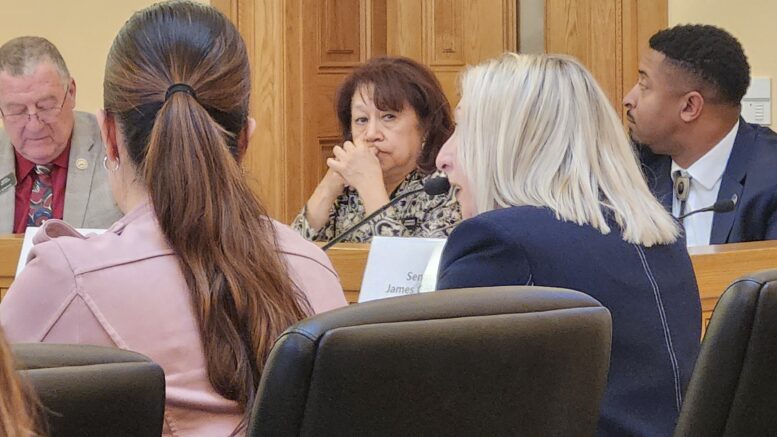
Senate Bill 137 — sponsored by Democratic Senate President James Coleman, Republican Senate Minority Leader Cleave Simpson and their House leadership counterparts — comes at a pivotal moment when job growth has slowed in Colorado and the cost of living is up. Its aim, as a litany of supporters told the Senate Finance Committee, is not to repeal vast swaths of rules but to make state leaders examine which are working as intended and which may be duplicative, outdated or so costly as to be detrimental to Colorado.
It would do so by requiring state agencies to dig into their regulations at least every five years and examine if they are redundant or obsolete, whether there are ways to improve their effectiveness and if funding levels to support the rules are appropriate. They must present their findings to legislative committees during the SMART Act hearings that begin every session, and legislators could request audits and sunset reviews of the regulations if they feel they are warranted.
More than just a chance to add a new administrative-review process, however, the bill presents an urgent opportunity for the state to ask if its regulations are so burdensome that they are costing it jobs — without shedding provisions critical to public health and safety. Colorado Bioscience Association Vice President Amy Goodman noted the state lost some $500 million in capital investment and more than 1,000 jobs in the past year as companies said they chose to expand elsewhere because of Colorado’s regulatory and cost burdens.
Proposal follows 2025 bill to audit state agencies
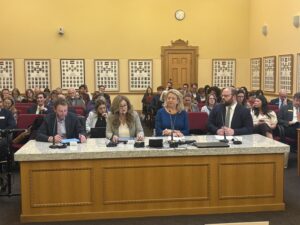
Grand Junction Area Chamber of Commerce President/CEO Candace Carnahan (second from left) testifies for Senate Bill 137 Tuesday as part of a panel of local business leaders.
“Senate Bill 137 creates an opportunity to pause, evaluate and understand real-world impact before adding another layer of rules,” said Candace Carnahan, president/CEO of the Grand Junction Area Chamber of Commerce. “When businesses are confident about the environment they are operating in, they invest, they hire and they grow.”
Committee members advanced SB 137 on a 9-0 vote to the Senate Appropriations Committee, with Sen. Marc Snyder, D-Manitou Springs, emphasizing that Colorado needs a process to re-examine the regulations it has in place. The bill currently has a $210,000 fiscal note, but wording in an amendment that Coleman’s added to the bill Tuesday is expected to remove that cost.
SB 137 follows the passage last year of what could be considered a predecessor effort to require the state to look more closely at its rules and determine their holistic impact, both good and bad. SB 25-306, also a bipartisan measure, will require multiple audits of two agencies involved in a significant number of regulations, the Colorado Air Pollution Division and the Division of Unemployment Insurance, over the next six years.
This latest bill, like that one, sprang from research commissioned by the Colorado Chamber of Commerce that found the Centennial State is the sixth-most regulated in the country and that the pace of new regulations has picked up in recent years. Bill backers cited that number repeatedly on Tuesday, sometimes in the same breath as they mentioned that Colorado ranked 44th in 2024 for new job creation, according to the University of Colorado Boulder Leeds School of Business.
Burdensome regulations or public protections?
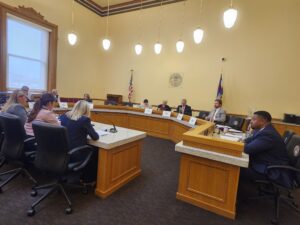
Senate President and SB 137 sponsor James Coleman watches a panel of business and state-government leaders testify for his proposal Tuesday in Senate Finance Committee.
A handful of labor and environmental advocates either opposed the bill or sought amendments Tuesday, expressing concern that some of the bill’s definitions were too undefined and could slant the reviews toward businesses over public safety. As an acknowledgement, Coleman removed a requirement from the bill for the agency reviews to consider whether existing rules create administrative burdens on businesses without a corresponding public benefit, although some groups still criticized SB 137.
“What may be labeled as burdensome to industry are often the very same regulations that protect consumers from harm,” said Jessica Herrera, legal counsel for GreenLatinos Colorado, which has led the push for many recent increased environmental regulations. “The bill ultimately proves a potential risk to our communities.”
But such arguments fell short with committee members as compared with the statements of business leaders who said the “balanced” proposal would give the state the ability to determine for itself whether the slew of new regulations is helping or hurting residents. So many came forth with stories for the committee that Sen. Kyle Mullica, a Thornton Democrat and supporter of SB 137, joked: “I’m still trying to figure out whether the business community likes this bill or not.”
Backers: Regulations boost cost of houses, childcare
Colorado Association of Home Builders CEO Ted Leighty said that regulations add $93, 870 to the cost of the average new residence in Colorado — 25% of construction costs for single-family home and 40% of those costs for multifamily structures. Reexamining those regulations could aid discussions on how to make housing more affordable, he said.
The large number of regulations around childcare have contributed significantly to the 40% rise in the consumer cost of such care since 2017, said Nicole Riehl, president/CEO of Executives Partnering to Invest in Children. And they drive up the costs of operating mom-and-pop businesses, said Nick Hoover, director of government affairs for the Colorado Restaurant Association.
Adams County Regional Economic Partnership President/CEO Lisa Hough cited a local advanced manufacturing facility that is looking to expand but is finding that duplicative reporting is costing it significant time and resources and is delaying its plans. Tim Griesmer, associate director for American Petroleum Institute Colorado, said his industry has participated in more than 50 rulemakings since 2020 because of the increasing number of regulations coming from the Legislature.
“Not here to eliminate any rules”
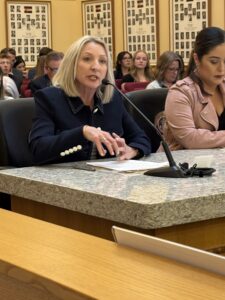
Colorado Chamber of Commerce President/CEO Loren Furman testifies for Senate Bill 137 Tuesday before the Senate Finance Committee.
One theme of the supporters was that the bill is not looking to dismantle regulations; in fact, it only allows audits or sunset reviews at the request of legislators. Instead, they said the legislation can help state officials review and determine what may not be boosting public health and safety protections as bill sponsors intended.
“We are not here to eliminate any rules, any departments, any agencies,” Colorado Chamber of Commerce President/CEO Loren Furman said. “We simply want to make sure these rules are working the way they were intended … This is a good-governance bill.”
Added Coleman: “This bill strengthens the transparency and accountability of rulemaking processes.”