

The agricultural and accounting sectors are expected to get boosts from a pair of bills — one controversial and one passed without a single opposing vote — that Gov. Jared Polis signed into law on Monday.
Senate Bill 121 increases to 56 hours that amount of time that farm laborers must work in a week before they earn time-and-a-half overtime pay. Current law had set that threshold at 48 hours for the majority of the year, and agricultural-industry leaders said that they were having to reduce workers’ hours to avoid paying overtime and, because of that, were seeing Colorado field and farm workers leaving for surrounding states without similar thresholds.
Senate Bill 76, meanwhile, increases the pathways by which financial professionals can become certified professional accountants, offering more credit toward that goal for people who have worked in the field rather than just gone to grad school. Such a move is needed, financial-industry leaders said because retirements are winnowing the current field of CPAs without an adequate pipeline of replacements, despite the need for the certification growing.
Polis has focused on workforce development throughout his two terms in office, and several bills — including an advancing measure that seeks to combine all of the state’s talent-development and higher-education initiatives in one department — aim broadly at that goal this session. But the two newest laws are likely to have just as big an impact, only on small slices of the state’s workforce.
Ag overtime law could stabilize industry worker base
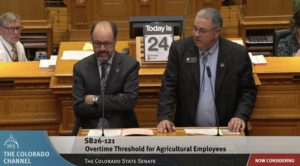
Colorado Senate Majority Leader Robert Rodriguez and Minority Leader Cleave Simpson explain Senate Bill 121 to the chamber on March 24.
SB 121 was a response to the 2021 Agricultural Workers’ Bill of Rights that made Colorado one of just a handful of states to establish overtime laws for farm workers, who are exempted from such requirements in the federal Fair Labor Standards Act. It set overtime thresholds at 48 hours per week — or 56 hours during a 22-week peak period for highly seasonal operations — and that standard had been causing problems, ag leaders said.
Because many farms, already suffering from high tariff rates and depressed commodity prices, had to reduce worker hours to avoid paying overtime, workers saw pay levels decrease and had to take second jobs or leave Colorado, workers and farmers testified. That in turn spurred some farm owners to reduce planting and reconsider their operations, adding more uncertainty to a sector that has seen 1.6 million acres of land taken out of production since 2022.
Against the heavy opposition of labor unions and immigrant-rights organizations who had backed a competing bill that sought to reduce the overtime threshold for the sector down to 40 hours, SB 121 sponsors pushed the bill through the Senate on a 19-16 vote and the House on a 33-32 vote, arguing that it will serve as a lifeline for struggling farmers. The Democratic Polis signed it without comment, and the bill goes into law right away.
CPA certification law expected to attract new professionals
SB 76, meanwhile, was a feel-good fest as it passed through the Legislature, earning kudos from business groups, accounting organizations and education-reform advocates who praised its credential-based approach to producing needed workers. It is set to become law on Jan. 1.
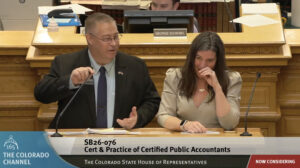
Colorado state Rep. Rebekah Stewart laughs on March 30 as her cosponsor on Senate Bill 76, Rep. Chris Richardson, makes a joke to the House about how eagerly the members had been waiting to hear the bill.
Currently, Colorado requires CPA candidates to have a bachelor’s degree in accounting as part of 150 total semester hours of college education — a requirement that usually mandates a master’s degree — and one year’s experience in a field involving accounting, financial advising, tax or consulting. The added expense of completing that second degree has scared off a good number of potential candidates, particularly those who may have taken non-traditional educational paths and may be balancing working and raising a family, industry leaders said.
SB 76, passed unanimously through both chambers, doesn’t change the requirement to receive a bachelor’s degree with some sort of accounting concentration or the overall 150-hour educational mandate, but it offers flexibility in how individuals get there. Candidates with one year of work experience can have completed the 30 post-baccalaureate hours without earning a master’s degree, or they can bypass the post-baccalaureate degree altogether by completing two years of experience in the field.
A balance between safeguards and career accessibility
Rep. Chris Richardson, the Elbert County Republican who cosponsored the measure in the House with Democratic Rep. Rebekah Stewart of Lakewood, said that the more the state and federal governments pass financial regulations, the more CPAs are needed. Yet, the field faces a critical shortage of workers right now, and this bill seeks to allow more people into the profession without loosening the requirements to enter it, sponsors said.
“It’s pro-workforce, it’s pro-business,” Richardson told the House on March 30 as the bill received preliminary approval. “It reduces unnecessary burdens without compromising trust or the safeguards that are in place.”
The two new laws were part of the 25 bills that Polis signed on Monday in what is likely his last major signing push before the 2026 regular legislative session adjourns on May 13. After that, he will have 30 days to sign or veto all of the proposals that made it through both the House and the Senate this year.