Colorado insurers — and the businesses that purchase health-care policies from them — will not have to pay $40 million in new fees next year to boost a state enterprise on the brink of an insolvency, following a major change to a bill that was made on Wednesday morning.
However, arguments around the benefits that the Health Insurance Affordability Enterprise should offer have left Senate Bill 178 in limbo, just eight days before the mandatory adjournment of the 2026 legislative session. And it’s unclear how the dispute over a potential cost-cutting amendment for the bill will be resolved.
The HIAE funds three programs — the reinsurance program subsidizing individual plans in high-cost counties, the OmniSalud program offering policies to undocumented immigrants and a program of subsidies for those buying individual plans on the Connect for Health Colorado exchange. After legislators approved a one-year fix last year that involved the sale of tax credits to insurers, Colorado Division of Insurance leaders expect the HIAE once again to be $139 million short of the funds needed to maintain the status of its existing subsidies next year.
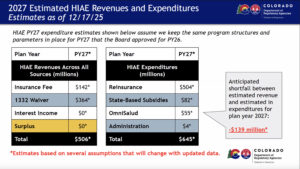
A slide from the January meeting of the Health Insurance Affordability Enterprise board meeting explains the expected funding shortfall for the HIAE next year.
Sen. Kyle Mullica, the Thornton Democrat who authored the tax-credit sale to bridge this year’s funding gap — caused in part by the federal government’s decision to end payments for enhanced premium tax credits for individual-policy buyers — proposed a two-part stopgap measure for 2027 in SB 178. The bill would permit the exchange to sell bonds to raise $100 million and allow it to impose $40 million in fees on the state’s five largest health insurers to cover what was left.
Pushback against fee by insurers
However, the Colorado Association of Health Plans and Aetna owner CVS Health protested the plan at a Senate Finance Committee hearing last week, with CVS officials saying the fees would raise premiums for their members by about $480 each year. That likely would push some customers to drop their plans and could lead to the same increase in uninsured Coloradans that a decrease in funding to the HIAE would cause, they said.
So, Mullica and cosponsoring Sen. Iman Jodeh, D-Aurora, amended SB 178 during a hearing in the Senate Appropriations Committee Wednesday morning to remove the fee and instead take $40 million from the $100 million that the Marijuana Tax Cash Fund must contribute to the state’s emergency reserve funds. Those funds will be replaced by putting a state building into the reserve fund instead, and the $40 million will serve as a one-time transfer, allowing the HIAE to sell and repay $140 million in bonds instead of $100 million.

Colorado state Sen. Kyle Mullica describes his conundrum regarding insurance-policy fees while speaking in February to the Colorado Chamber of Commerce Health Care Council.
“We heard a lot in testimony in the finance committee as well, and we are just trying to address some of the concerns we heard,” Mullica said of the decision to drop the proposed one-time fee. He and other supporters say the key is getting funding to the HIAE to avoid an estimated 45,000 people dropping insurance if they lose subsidies — and likely flooding emergency rooms of already struggling hospitals with patients that can’t pay their bills.
Other amendment seeks to cut enterprise spending
Had that been the only change suggested to SB 178 Wednesday, the bill might be starting its path to Gov. Jared Polis’ desk. However, Sen. Barbara Kirkmeyer, R-Brighton, then proposed an amendment that would seek to pare down benefits offered by the HIAE to bring the enterprise closer to long-term stability, and that set off a firestorm of debate among committee members.
Kirkmeyer’s proposal would do two things. It would limit the subsidies that the HIAE offers to individual exchange customers to those people making 300% of the federal poverty level or less — $99,000 for a family of four — instead of the 400% threshold ($132,000 for a family of four) that now exists. And it would require the enterprise board to put forward a proposal sometime next year of how the roughly 6,7000 OmniSalud registrants can begin paying for a portion of their policy premiums — a change that several health-care advocacy groups said last week would be acceptable.
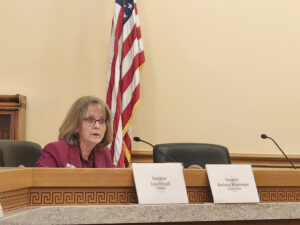
Colorado state Sen. Barbara Kirkmeyer airs her concerns about Senate Bill 178 during an April 30 Senate Finance Committee hearing.
Kirkmeyer said the moves are necessary to bring down the HIAE’s spending and avoid legislators having to search for the third straight year next year for another solution to keep the enterprise solvent. She also does not want legislators to have to consider a long-term fee hike to fund the enterprise, as was originally proposed in 2025 before Mullica stepped in with the bill to fund it through tax-credit sales, because that would hurt residents already struggling with cost-of-living increases.
Cuts will hurt lower-income residents, sponsors argue
Mullica and Jodeh objected to the amendment, saying that they are particularly concerned about the reduction of exchange subsidies that could affect tens of thousands of people and could push some of them to drop their insurance policies. Because the subsidies are funded in part by federal draw-down money based on the health-care savings achieved by offering subsidies to people at 400% FPL or lower, the change also would cost the state federal funding, Mullica emphasized.
The discussions got particularly heated when Sen. Jeff Bridges, D-Greenwood Village, announced he would support the amendment not because he felt the cuts were wise but because HIAE supporters have refused to offer other suggestions of how to cut spending, despite his repeated entreaties to do so. The roughly $150 million a year the enterprise formerly got for enhanced premium tax credits is not coming back as long as President Donald Trump is in office, and state legislators must figure out how to wind down that spending rather than throwing new pots of money at the enterprise every year, he insisted.

Colorado state Sen. Jeff Bridges, standing beside Lt. Gov. Dianne Primavera, speaks in 2025 about his bill to cap some hospital reimbursements. That bill did not pass.
“I don’t think these are the right cuts. But I’ve been asking advocates, for weeks, how we cut this program … No one seems to get that with the state we’re in that we have to make cuts,” an exasperated Bridges declared. “We can’t afford 140 million dollars more in this program. We have to make cuts. This amendment at least is a starting point.”
Sen. Julie Gonzales, D-Denver, responded to Bridges by saying she feels it is “atrocious” to be trying to start a conversation by forcing cuts onto the poorest and most marginalized Colorado residents.
Even without fee, SB 178 faces tough path forward
To that, Bridges responded that he not only can’t get their advocates to suggest any cuts to what’s become an unsustainable program but that he can’t even get answers from DOI leaders on how much changes to the potentially impacted programs will cost.
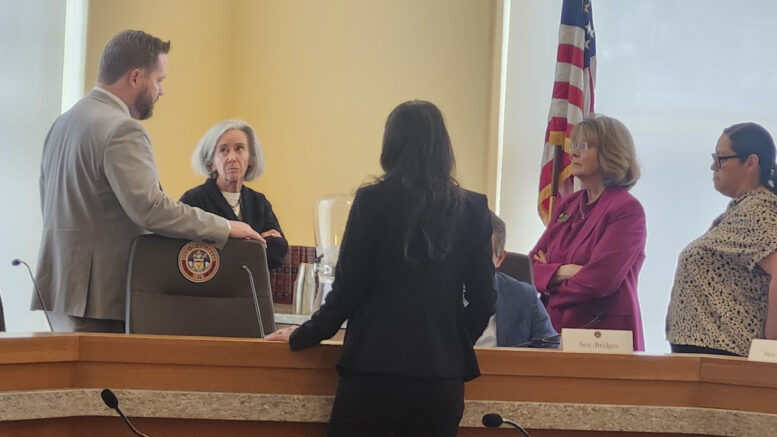
Committee chairwoman Sen. Judy Amabile, D-Boulder, called a break to try to turn the temperatures down, but conversation remained heated as the bill sponsors gathered behind the committee dais with several committee members.
Kirkmeyer said that was not trying to ambush anyone with the amendment, which Mullica and Jodeh had said they had not seen before the committee meeting. Meanwhile, Bridges said that if her amendment or another proposal to cut HIAE spending were not added onto the bill, he would be voting against the bill, meaning any effort to boost enterprise funding this year would die in committee.
Finally, the committee went back into session and Amabile laid the bill over to a future committee meeting, which could come as early as Thursday morning. But it remains clear that with the Legislature having to end its session no later than May 13 that that sponsors have a lot of work to do on the HIAE funding effort.