
Colorado manufacturers that exceed emissions-reduction requirements can sell the value of those emissions cuts outside the state, and those who achieve cuts this year via carbon capture can count those reductions immediately, state regulators ruled Friday.
Those were just two of the issues settled by the Colorado Air Quality Control Commission after a two-day hearing billed as a small update to rules on credit trading stemming from emissions-reduction mandates on the state’s largest manufacturing facilities. However, the discussions took in much wider concerns, and “bamboozled” environmental groups said they are likely to come back and request further regulations in the wake of a hearing that left them frustrated.
Colorado established its GEMM 2 (Greenhouse Gas Emissions and Energy Management for Manufacturing) program in 2023, becoming the first state to demand cuts in emissions or emissions intensity from manufacturers, setting plans for its 21 largest facilities. Those range from the Suncor Energy USA refinery in Commerce City to the Molson Coors plant in Golden to remote facilities like the Natural Soda baking-soda plant in rural Rio Blanco County.
Required as a sector to reduce emissions 20% by 2030 as compared to their 2015 totals, the facilities exceeded their goal by the end of last year, cutting collective emissions 23.4%, noted Megan McCarthy, staff authority for the climate change program in the Colorado Air Pollution Control Division. That was due to a combination of on-site emissions reductions and a trading program in which companies exceeding their goals could earn emissions-reduction credits and sell them to companies needing such credit to reach their mandates.
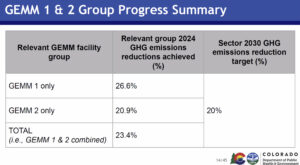
A Colorado Department of Public Health and Environment chart shows the progress manufacturers have made in reducing greenhouse gas emissions.
Clarifications to regulations for manufacturers
The AQCC in 2023 had envisioned creation of a third path to achieve compliance — a fund that facilities short of their goals could pay into to cover air-pollution-reduction projects in other locations — and the commission was set this week to discuss that. But because the fund is unneeded for the sector as a whole to reach compliance and because business and state leaders could not agree on how it would work, commissioners scrapped that idea.
Instead, they sought to make clarifications through the hearing to how the trading program works, as it is expected to gain participation as midstream oil-and-gas facilities can enter it — most likely as buyers of credits to meet their emissions-cut goals — beginning in 2028. But what may have begun as simple clarifications erupted during a two-day hearing into discussions of specific facilities and whether the program is really meeting the parameter of the 2021 Environmental Justice Act that ordered the AQCC to create it.
Both the Health & Justice Coalition — composed of GreenLatinos and Physicians for Social Responsibility — and the Local Government Coalition made up of 49 governments asked the AQCC not to count carbon-capture emissions reductions toward manufacturers’ cuts until state protocols for the practice are in place. Carbon capture refers to the practice of trapping carbon in the manufacturing process — or the less common practice of removing it from the air — and injecting it into underground rock formations for permanent storage.
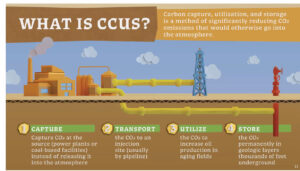
A graphic created by the University of Wyoming Center for Geology Research explains carbon capture and underground storage.
Why target carbon-capture reductions?
The two coalitions argued that because state protocols are not yet in place — Colorado is waiting to receive approval for already written protocols and then the ability to regulate the practice from the U.S. Environmental Protection Agency — that current work shouldn’t count toward emissions-reduction counts. Several environmental groups also question the efficacy of the practice in general, although the Colorado Energy Office has said it is vital to the state being able to achieve its emissions-reduction goals.
But several GEMM 2 facilities, including Windsor ethanol producer Front Range Energy and Greeley-based JBS Foods, argued carbon capture is key to their compliance plans and said nixing this year’s reductions would change the rules that have been set for them. APCD also noted that EPA approval of the protocols is expected in the coming months, and AQCC members agreed unanimously that eliminating carbon capture as a source of reductions would hurt the state’s overall goals.
“I think we, in terms of policy, should be encouraging emissions-reduction projects,” AQCC commissioner Curtis Reuter said.
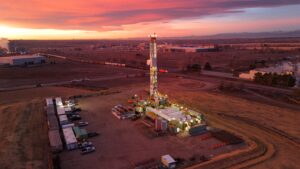
Crews drill a monitoring well for a Class VI carbon-sequestration well on the property of ethanol producer Front Range Energy near Windsor. When the well is complete, the tall tower will be replaced by an inobtrusive wellhead.
The same groups, plus several organizations that spoke during public comments, blasted Suncor’s approved GEMM 2 plan, noting the refinery is expected to achieve only 25% of its goal from on-site emissions reductions while getting the rest from credit purchases. Green House Connections Center Director Harmony Cummings said plants in disproportionately impacted communities should have to do 75% of their reductions via onsite improvements — an issue that wasn’t up for consideration in the hearing — and Sierra Club attorney Jim Dennison said he wants a future rulemaking to address the issue.
Can manufacturers sell emissions cuts in out-of-state markets?
“The Environmental Justice Act demands better,” said Devon Reynolds, a policy analyst for Colorado Communities for Climate Action.
Suncor attorney Jennifer Biever, meanwhile, pushed back that the refinery had larger emissions-reduction requirements than any other GEMM 2 facility, meaning that it already is investing substantially in on-site improvements. And she also argued — in opposition to several other GEMM 2 facilities — that companies that earn emissions-reduction credits should not be able to sell their emissions reductions outside the state of Colorado.
If manufacturers are allowed to sell emissions reductions in out-of-state markets, there could be a shortage of credits for companies like hers to buy — a sentiment that was backed by West Slope Colorado Oil & Gas Association Executive Director Chelsie Miera. If the AQCC were to permit that despite the original GEMM 2 rules not specifying such an allowance, Biever argued, then companies like hers should be allowed to purchase an equal amount of credits in out-of-state markets and pull them back into Colorado.
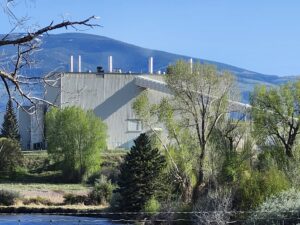
The American Gypsum plant in Eagle County is one of the 17 facilities regulated by the GEMM 2 rules.
APCD Emissions Credit Trading Supervisor Cecelia White, however, called the idea “absurd,” saying this essentially would allow double-counting of emissions-reduction credits and undermine the reductions that the state seeks to achieve. AQCC members agreed and rejected the idea unanimously.
Publication of long-term contract details
Business groups were able to work with APCD leaders to amend out proposed changes to the rules that had worried them during the drafting process, but they had to fight during the hearing to keep environmental groups from adding them back into the rules.
APCD staffers, for example, nixed a provision that would have required companies entering into long-term contracts to sell and buy emissions-reduction credits from each other to disclose details of those contracts publicly. Local Government Coalition leaders asked the AQCC to reinsert that requirement, but commissioners agreed by a large margin that such disclosures would be more hurtful to private companies than it would be beneficial to public transparency.
Dave Kulmann, regulatory affairs advisor for the Colorado Chamber of Commerce, added that it companies were forced to expose such information, they would be less likely to sell their credits. That would give them less incentive to go above and beyond state emissions-cut mandates and make it harder for the state to achieve its climate goals, he said.

Dave Kulmann is the regulatory affairs advisor for the Colorado Chamber of Commerce
Kulmann also asked the AQCC to remove a proposed provision requiring GEMM 2 facilities that underreport emissions and must later purchase more credits than originally planned to generate 150% of the value of the new credits through onsite emissions reductions. Forcing such cuts will likely mean reductions in production, particularly because companies purchasing credits are require to make commercially reasonable reductions onsite before going to the trading market, and could therefore result in job losses, he said.
However, environmental groups pushed back on this suggestion, saying that facilities located in poorer and already polluted disproportionately impacted communities should have to clean up more on their site if they make errors in reporting. And commissioners agreed, leaving the requirement in the rule before passing it unanimously.
“Not exactly worse off”
Kulmann said after the hearing that businesses scored several wins to keep the regulations feasible, particularly in regard to carbon capture and to long-term contracts, but could be hurt by the 150% onsite requirement. He lauded the APCD for listening to the concerns of facility owners and for not making major changes to a program that has produced significant emissions reductions so far without harming the economy.
“Through the rulemaking process — with the division and now with the commission — we’re not exactly worse off,” he said, speaking to business leaders’ fears of significant regulatory upgrades entering the rulemaking process. “We’ve proven that the program is working, that the facilities are doing what they need to do to make cuts.”
Other groups, however, lamented that the AQCC didn’t use the rulemaking process to close what they call loopholes in the current regulations that allow for too many emissions cuts to be made on paper while pollution still spews into poorer communities. Patricia Garcia Nelson, the Colorado fossil fuels just transition advocate for GreenLatinos, said she felt that state officials gave too much leeway to regulated entities and not enough to residents asking for greater protections.
“I feel like I’ve been bamboozled through this rulemaking process,” she told the AQCC. “The rules that have been brought forth by the division have been stripped down to their bare bones, the bare minimum, by industry.”